Physics and Chemistry of Materials with A - Böcker
Visar alla böcker i serien . Handla med fri frakt och snabb leverans.
13 produkter
13 produkter
1 589 kr
Skickas inom 10-15 vardagar
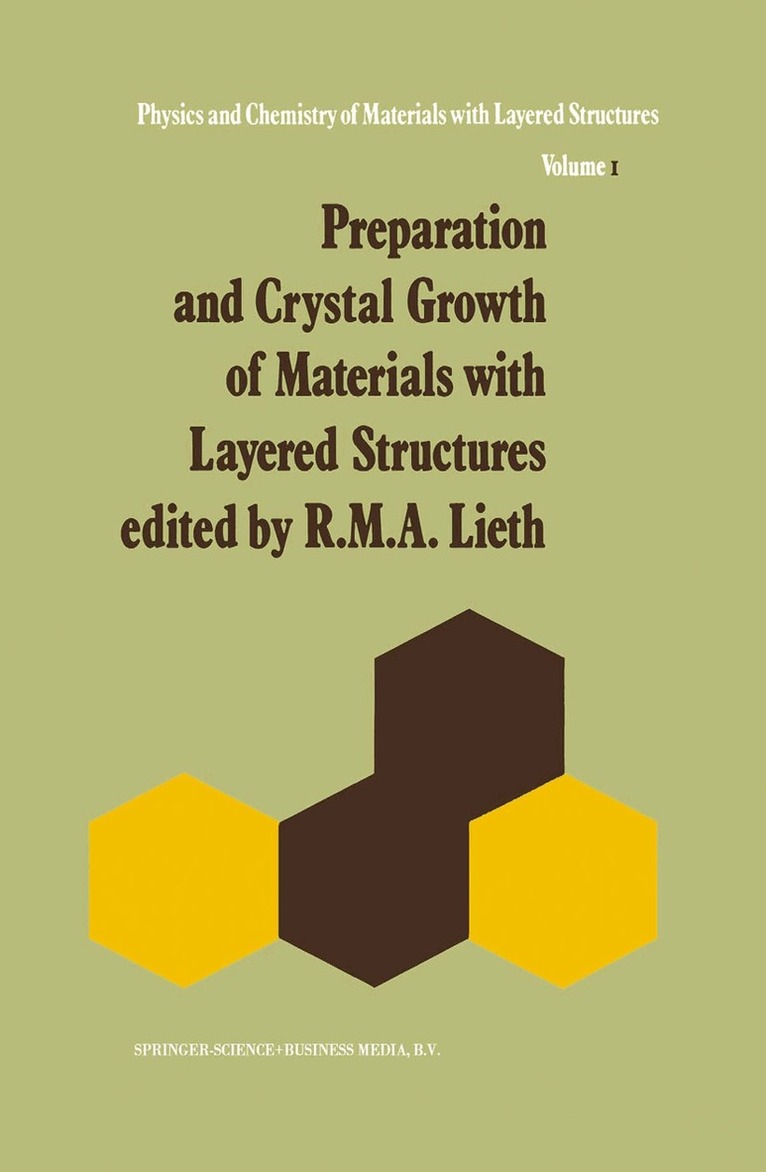
The goal of the series Physics and Chemistry of Materials with Layered Structures is to give a critical survey of our present knowledge on a large family of materials which can be described as solids containing molecules which in two dimensions extend to infinity and which are loosely stacked on top of each other to form three dimensional crystals. Of course, the physics and chemistry of these crystals are specific chapters in ordinary solid state science, and many a scientist hunting for new phenomena has in the past been disappointed to find that materials with layered structures are not entirely exotic. Their electron and phonon states are not two dimensional, and the high hopes held by some for spectacular dimensionality effects in superconductivity were shattered. Nevertheless, the structural features and their physical and chemical consequences singularize layered structures sufficiently to make them a fascinating subject of research. This is all the more true since they are met in insulators and semiconductors as well as in normal and superconducting metals. Although for the time being the series is intentionally limited to cover inorganic materials only, the many known organic layered structures may well be the subject of future volumes. Among the noteworthy peculiarities of layered structures, we mention specific growth mechanisms and crystal habits. Polytypism is very common and it is fasci nating indeed to find up to 240 different polytypes in the same chemical substance.
2 117 kr
Skickas inom 10-15 vardagar
This fourth volume in the series 'Physics and Chemistry of Materials with Layered Structures' is concerned with providing a critical review of the significant optical and electrical properties by established authors who have themselves made many significant contributions to these fields. Research into these materials has recently gained a new impetus and their fascinating properties have attracted many new research workers. These people should find much of value in the reviews contained in this volume and the editor is very much indebted for the painstaking and hard work put into the preparation of the various chapters by the authors. The optical properties provide useful information for deriving the band struc tures, a knowledge of which is required for an interpretation of measurements on the electronic properties. The chapters by Dr Evans, Dr Williams and Dr Bordas describe different techniques which have provided much detailed data on this subject. An interesting property of these materials is the comparative ease with which thin specimens may be prepared for these measurements and this is highlighted in the super conducting experiments outlined by Professor Frindt and Dr Huntley. These authors together with Dr Vandenberg's chapter on the magnetic properties also describe the interesting and significant intercalation mechanisms whereby a wide range of organic compounds and alkali metals may be incorporated in the lattice. This provides an additional parameter for varying the properties of these materials and may yet be seen to provide eventual possible applications of layer compounds.
2 117 kr
Skickas inom 10-15 vardagar
This monograph is intended to give the reader an appreciation of the wealth of phases, elements and inorganic compounds, which crystallize in layer-type or two dimensional structures. Originally this work was planned as a short review article but the large number of phases made it grow out to the size of a book. As is evident from the arrangement of the chapters our point of view was gradually transmuting from geometric to chemical. Moreover, the decision about the compounds that should be discussed was taken only during the course of the work, as is partly evident from the sequence of the references. For chemical or geometrical reason we have included also certain layered chain and molecular structures as well as some layered structures whose layers are linked by hydrogen bonds, thus are in fact three-dimensional. Instead of writing only a review with pseudo-scientific interpretations that later turn out to be wrong anyway we thought it more profitable to include the crystallographic data which are scattered in various original articles and hand books but never in one single volume. We have transcribed many of the data in order to make them correspond with the standard settings of the International Tables for X-Ray Crystallography. The figures are consistent with the data given in the tables. We apologize for errors and hope that their number is at a reasonably low level in spite of the time pressure.
2 117 kr
Skickas inom 10-15 vardagar
Materials with layered structures remain an extensively investigated subject in current physics and chemistry. Most of the promising technological applications however deal with intercalation compounds of layered materials. Graphite intercalation compounds have now been known for a long time. Intercalation in transition metal dichalcogenides, on the other hand, has been investigated only recently. The amount of information on intercalated layered materials has increased far beyond the original concept for this volume in the series Physics and Chemistry of Materials with Layered Structures. The large size of this volume also indicates how important this field of research will be, not only in basic science, but also in industrial and energy applications. In this volume, two classes of materials are included, generally investigated by different scientists. Graphite intercalates and intercalates of other inorganic com pounds actually constitute separate classes of materials. However, the similarity between the intercalation techniques and some intercalation processes does not justify this separation, and accounts for the inclusion of both classes in this volume. The first part of the volume deals with intercalation processes and intercalates of transition metal dichalcogenides. Several chapters include connected topics necessary to give a good introduction or comprehensive review of these types of materials. Organic as well as inorganic intercalation compounds are treated. The second part includes contributions concerning graphite intercalates. It should be noted that graphite intercalation compounds have already been mentioned in Volumes I and V.
Del 7 - Physics and Chemistry of Materials with A
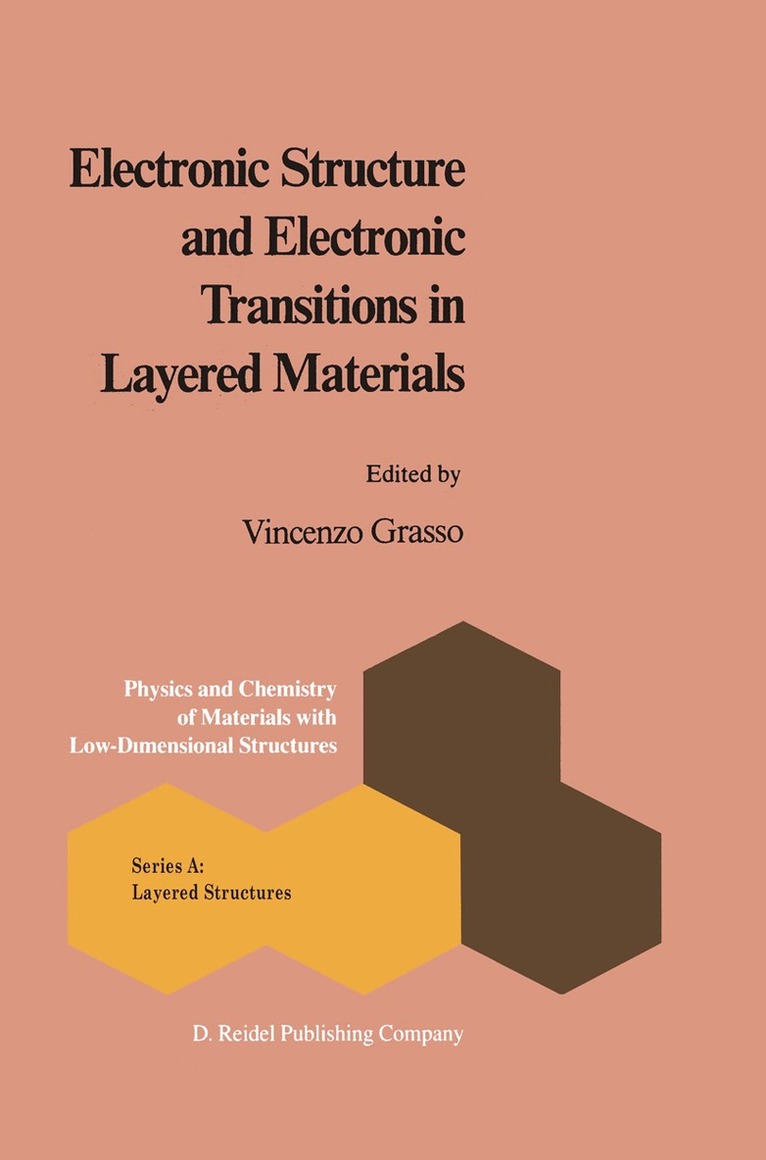
Electronic Structure and Electronic Transitions in Layered Materials
Inbunden, Engelska, 1986
2 117 kr
Skickas inom 10-15 vardagar
This new volume in the series Physics and Chemistry of Materials with Layered Structures satisfies the need for a comprehensive review of the progress made in the decade 1972-1982 in the field of the electronic properties of layer compounds. Some recent theoretical and experimental developments are highlighted by authori tative physicists active in current research. The previous books of this series covering similar topics are volumes 3 and 4. The present review is mainly intended to fulfill the gap up to 1982 and part of 1983. I am indebted to all the authors for their friendly co-operation and continuous effort in preparing the contributions in their own fields of competence. I am sure that both the expertise scientists and the beginners in the field of the electronic properties of layered materials will find this book a valuable tool for their research work. Warm thanks are due to Prof. E. Mooser, General Editor of the series, for his constant and authoritative advice. * * * This book has been conceived as a tribute to Prof. Franco Bassani to whom the Italian tradition in the field of layer compounds, as well as in other fields of solid state physics, owes much. The authors of this review have all benefited at some time of their professional life from close cooperation with him. Istituto di Struttura della Materia, VINCENZO GRASSO Universitd di Messina IX V Grasso (ed.). Electronic Structure and Electronic Transitions in Layered Materials. ix.
2 117 kr
Skickas inom 10-15 vardagar
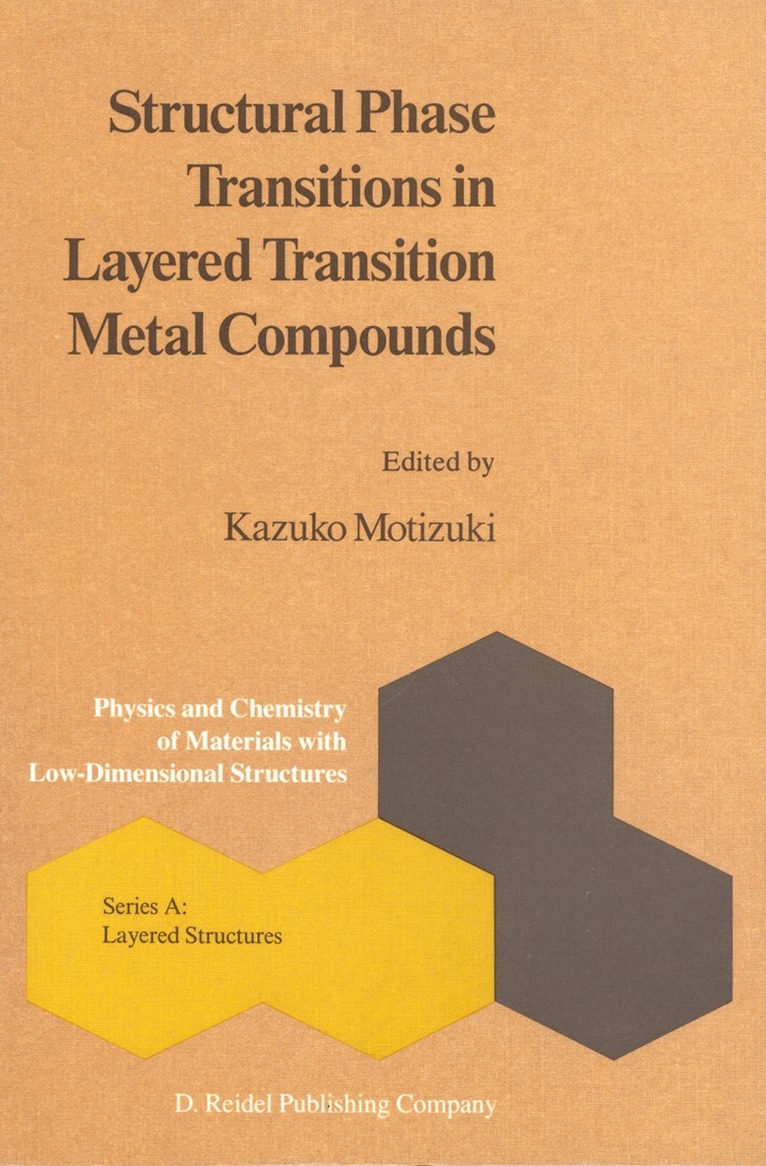
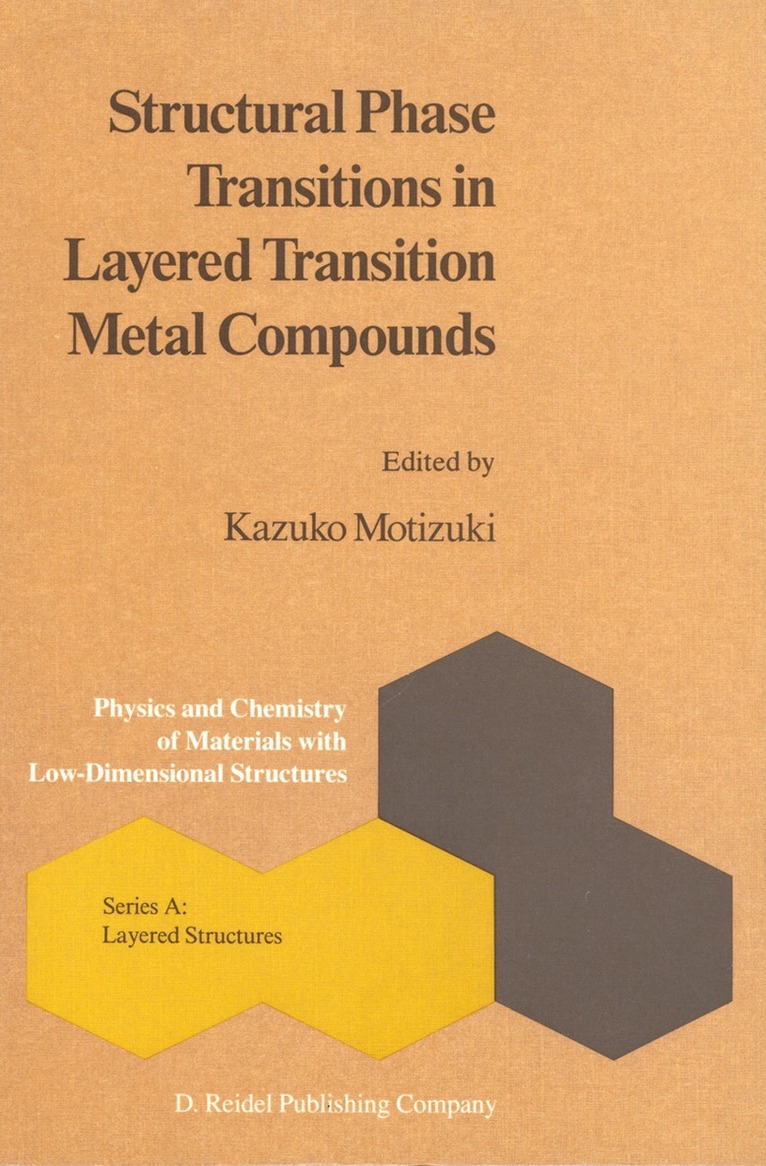
The structural phase transition is one of the most fundamental problems in solid state physics. Layered transition-metal dichalcogenides provide us with a most exciting area for the study of structural phase transitions that are associated with the charge density wave (CDW). A large variety of structural phase transitions, such as commensurate and incommensurate transitions, and the physical proper ties related to the formation of a CDW, have been an object of intense study made for many years by methods employing modem microscopic techniques. Rather recently, efforts have been devoted to the theoretical understanding of these experimental results. Thus, McMillan, for example, has developed an elegant phenomenological theory on the basis of the Landau free energy expansion. An extension of McMillan's theory has provided a successful understanding of the successive phase transitions observed in the IT- and 2H-compounds. In addition, a microscopic theory of lattice instability, lattice dynamics, and lattice distortion in the CDW state of the transition-metal dichalcogenides has been developed based on their electronic structures. As a result, the driving force of the CDW formation in the IT- and 2H-compounds has become clear. Furthermore, the effect of lattice fluctuations on the CDW transition and on the anomalous behavior of various physical properties has been made clear microscopically.
1 589 kr
Skickas inom 10-15 vardagar
The goal of the series Physics and Chemistry of Materials with Layered Structures is to give a critical survey of our present knowledge on a large family of materials which can be described as solids containing molecules which in two dimensions extend to infinity and which are loosely stacked on top of each other to form three dimensional crystals. Of course, the physics and chemistry of these crystals are specific chapters in ordinary solid state science, and many a scientist hunting for new phenomena has in the past been disappointed to find that materials with layered structures are not entirely exotic. Their electron and phonon states are not two dimensional, and the high hopes held by some for spectacular dimensionality effects in superconductivity were shattered. Nevertheless, the structural features and their physical and chemical consequences singularize layered structures sufficiently to make them a fascinating subject of research. This is all the more true since they are met in insulators and semiconductors as well as in normal and superconducting metals. Although for the time being the series is intentionally limited to cover inorganic materials only, the many known organic layered structures may well be the subject of future volumes. Among the noteworthy peculiarities of layered structures, we mention specific growth mechanisms and crystal habits. Polytypism is very common and it is fasci nating indeed to find up to 240 different polytypes in the same chemical substance.
534 kr
Skickas inom 10-15 vardagar
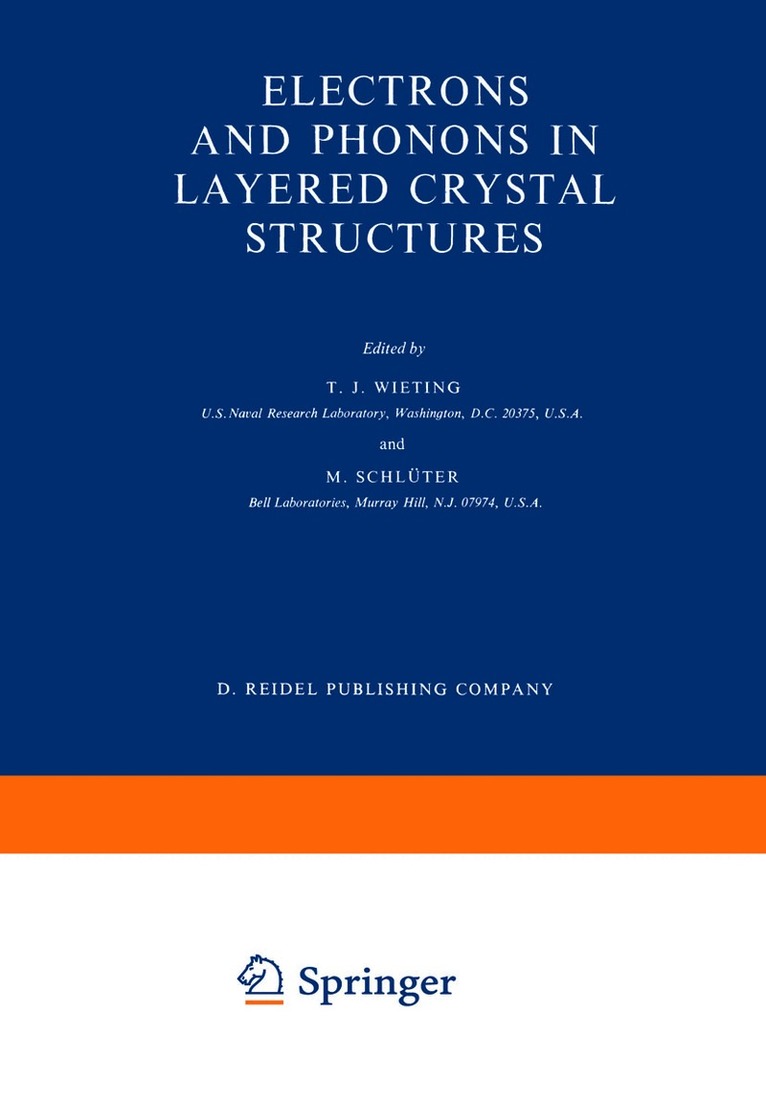
This volume is devoted to the electron and phonon energy states of inorganic layered crystals. The distinctive feature of these low-dimensional materials is their easy mechanical cleavage along planes parallel to the layers. This feature implies that the chemical binding within each layer is much stronger than the binding between layers and that some, but not necessarily all, physical properties of layered crystals have two-dimensional character. In Wyckoff's Crystal Structures, SiC and related com pounds are regarded as layered structures, because their atomic layers are alternately stacked according to the requirements of cubic and hexagonal close-packing. How ever, the uniform (tetrahedral) coordination of the atoms in these compounds excludes the kind of structural anisotropy that is fundamental to the materials dis cussed in this volume. An individual layer of a layered crystal may be composed of either a single sheet of atoms, as in graphite, or a set of up to five atomic sheets, as in Bi2 Te3' A layer may also have more complicated arrangements of the atoms, as we find for example in Sb S . But the unique feature common to all these materials is 2 3 the structural anisotropy, which directly affects their electronic and vibrational properties. The nature of the weak interlayer coupling is not very well understood, despite the frequent attribution of the coupling in the literature to van der Waals forces. Two main facts, however, have emerged from all studies.
2 117 kr
Skickas inom 10-15 vardagar
This monograph is intended to give the reader an appreciation of the wealth of phases, elements and inorganic compounds, which crystallize in layer-type or two dimensional structures. Originally this work was planned as a short review article but the large number of phases made it grow out to the size of a book. As is evident from the arrangement of the chapters our point of view was gradually transmuting from geometric to chemical. Moreover, the decision about the compounds that should be discussed was taken only during the course of the work, as is partly evident from the sequence of the references. For chemical or geometrical reason we have included also certain layered chain and molecular structures as well as some layered structures whose layers are linked by hydrogen bonds, thus are in fact three-dimensional. Instead of writing only a review with pseudo-scientific interpretations that later turn out to be wrong anyway we thought it more profitable to include the crystallographic data which are scattered in various original articles and hand books but never in one single volume. We have transcribed many of the data in order to make them correspond with the standard settings of the International Tables for X-Ray Crystallography. The figures are consistent with the data given in the tables. We apologize for errors and hope that their number is at a reasonably low level in spite of the time pressure.
534 kr
Skickas inom 10-15 vardagar
In the last ten years, the chemistry and physics of materials with layered structures became an intensively investigated field in the study of the solid state. Research into physical properties of these crystals and especially investigations of their physical anisotropy related to the structural anisotropy has led to remarkable and perplexing results. Most of the layered materials exist in several polytypic modifications and can include stacking faults. The crystal structures are therefore complex and it became apparent that there was a great need for a review of the crystallographic data of materials approximating two-dimensional solids. This second volume in the series 'Physics and Chemistry of Materials with Layered Structures' has been written by specialists of different classes of layered materials. Structural data are reviewed and the most important relations between the structure and the chemical and physical properties are emphasized. The first three contributions are devoted to the transition metal dichalcogenides whose physical properties have been investigated in detail. The crystallographic data and crystal growth conditions are presented in the first paper. The second paper constitutes an incisive review of the phase transformations and charge density waves which have been observed in the metallic dichalcogenides. In two contributions the layered structures of newer ternary compounds are de scribed and the connection between structure and non-stoichiometry is discussed.
2 117 kr
Skickas inom 10-15 vardagar
This fourth volume in the series 'Physics and Chemistry of Materials with Layered Structures' is concerned with providing a critical review of the significant optical and electrical properties by established authors who have themselves made many significant contributions to these fields. Research into these materials has recently gained a new impetus and their fascinating properties have attracted many new research workers. These people should find much of value in the reviews contained in this volume and the editor is very much indebted for the painstaking and hard work put into the preparation of the various chapters by the authors. The optical properties provide useful information for deriving the band struc tures, a knowledge of which is required for an interpretation of measurements on the electronic properties. The chapters by Dr Evans, Dr Williams and Dr Bordas describe different techniques which have provided much detailed data on this subject. An interesting property of these materials is the comparative ease with which thin specimens may be prepared for these measurements and this is highlighted in the super conducting experiments outlined by Professor Frindt and Dr Huntley. These authors together with Dr Vandenberg's chapter on the magnetic properties also describe the interesting and significant intercalation mechanisms whereby a wide range of organic compounds and alkali metals may be incorporated in the lattice. This provides an additional parameter for varying the properties of these materials and may yet be seen to provide eventual possible applications of layer compounds.
2 117 kr
Skickas inom 10-15 vardagar
This new volume in the series Physics and Chemistry of Materials with Layered Structures satisfies the need for a comprehensive review of the progress made in the decade 1972-1982 in the field of the electronic properties of layer compounds. Some recent theoretical and experimental developments are highlighted by authori tative physicists active in current research. The previous books of this series covering similar topics are volumes 3 and 4. The present review is mainly intended to fulfill the gap up to 1982 and part of 1983. I am indebted to all the authors for their friendly co-operation and continuous effort in preparing the contributions in their own fields of competence. I am sure that both the expertise scientists and the beginners in the field of the electronic properties of layered materials will find this book a valuable tool for their research work. Warm thanks are due to Prof. E. Mooser, General Editor of the series, for his constant and authoritative advice. * * * This book has been conceived as a tribute to Prof. Franco Bassani to whom the Italian tradition in the field of layer compounds, as well as in other fields of solid state physics, owes much. The authors of this review have all benefited at some time of their professional life from close cooperation with him. Istituto di Struttura della Materia, VINCENZO GRASSO Universitd di Messina IX V Grasso (ed.). Electronic Structure and Electronic Transitions in Layered Materials. ix.
2 117 kr
Skickas inom 10-15 vardagar
The structural phase transition is one of the most fundamental problems in solid state physics. Layered transition-metal dichalcogenides provide us with a most exciting area for the study of structural phase transitions that are associated with the charge density wave (CDW). A large variety of structural phase transitions, such as commensurate and incommensurate transitions, and the physical proper ties related to the formation of a CDW, have been an object of intense study made for many years by methods employing modem microscopic techniques. Rather recently, efforts have been devoted to the theoretical understanding of these experimental results. Thus, McMillan, for example, has developed an elegant phenomenological theory on the basis of the Landau free energy expansion. An extension of McMillan's theory has provided a successful understanding of the successive phase transitions observed in the IT- and 2H-compounds. In addition, a microscopic theory of lattice instability, lattice dynamics, and lattice distortion in the CDW state of the transition-metal dichalcogenides has been developed based on their electronic structures. As a result, the driving force of the CDW formation in the IT- and 2H-compounds has become clear. Furthermore, the effect of lattice fluctuations on the CDW transition and on the anomalous behavior of various physical properties has been made clear microscopically.