Pocket Guide to Social Work Research Methods - Böcker
Visar alla böcker i serien Pocket Guide to Social Work Research Methods. Handla med fri frakt och snabb leverans.
11 produkter
11 produkter
455 kr
Skickas inom 5-8 vardagar
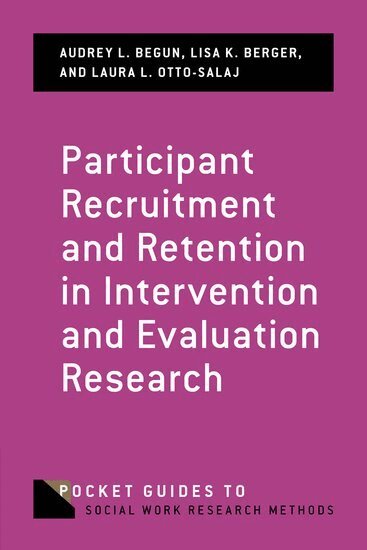
This practical "how to" guide integrates a comprehensive, interdisciplinary review of literature, alongside a wealth of the authors' combined research experience, into a framework for behavioral health and other investigators concerned with successful participant recruitment and retention in intervention and evaluation research studies. The content applies across disciplines, provides numerous real-world and hypothetical examples, analyzes complex issues and ethical concerns, and provides investigators with concrete, practical tools for planning, budgeting, assessing, engaging in, analyzing, and reporting their studies' participant recruitment and retention efforts. The book's focus is on application to intervention and evaluation research, and the authors present a great deal of information of contemporary relevance, including demonstrating an awareness of the opportunities and limitations of engaging research participants in an electronic age. In these ways, Participant Recruitment and Retention in Intervention and Evaluation Research stands out from the fragmented published literature concerning participant recruitment and retention and from research methodology textbooks, many of which dedicate very little attention to the practical issues involved in successfully recruiting and retaining study participants in studies of these types.
536 kr
Skickas inom 5-8 vardagar
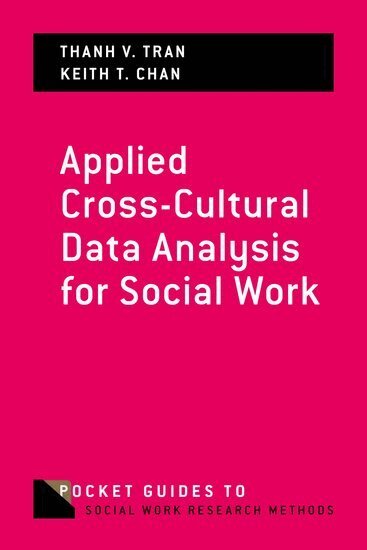
Applied Cross-Cultural Data Analysis for Social Work is a research guide for examining and interpreting data for the purpose of cultural group comparisons. This book aims to provide practical applications in statistical approaches of data analyses that are commonly used in cross-cultural research and evaluation. Readers are presented with step-by-step illustrations in the use of descriptive, bivariate, and multivariate statistics to compare cross-cultural population using large-scale, population-based survey data. These techniques have important applications in health, mental health, and social science research relevant to social work and other helping professions, especially in providing a framework of evidence to examine health disparities using population-health data. For each statistical approach discussed in this book, Thanh V. Tran and Keith T. Chan explain the underlying purpose, basic assumptions, types of variables, application of the Stata statistical package, the presentation of statistical findings, and the interpretation of results. Unlike previous guides on statistical approaches and data analysis in social work, this book explains and demonstrates the strategies of cross-cultural data analysis using descriptive and bivariate analysis, multiple regression, additive and multiplicative interaction, mediation, SEM and HLM for subgroup analysis and cross-cultural comparisons. This book also includes sample syntax from Stata for social work researchers to conduct cross-cultural analysis with their own research.
546 kr
Skickas inom 5-8 vardagar
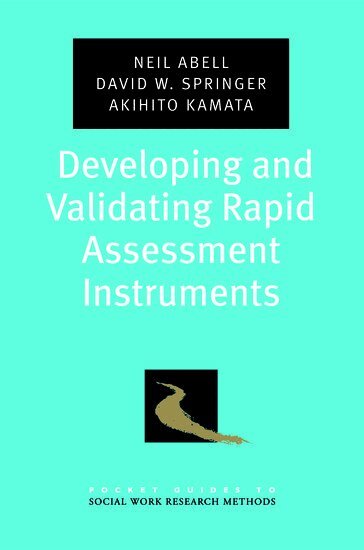
Despite increases in their application and improvements in their structure, there is a paucity of reliable and valid scales compared to the complex range of problems that social workers and other health professionals confront daily. They need to be able to design rapid assessment instruments (RAIs) to fit their specific situations, and with this step-by-step guide by RAI experts, that prospect will be much less intimidating. For each stage of RAI development, from conceptualization through design, data collection, and analysis, the authors identify critical concerns, ground them in the growing conceptual and empirical psychometric literature, and offer practical advice. A presentation of the basics of construct conceptualization and the search for evidence of validity is complemented by introductions to concept mapping and cross-cultural translation, as well as an in-depth discussion of cutting-edge topics like bias and invariance in item responses. In addition, they critique and illustrate factor analysis in exploratory and confirmatory strategies, offering guidance for anticipating elements of a complete data collection instrument, determining sampling frame and size, and interpreting resulting coefficients. This pocket guide provides a comprehensive start-to-finish overview of the basics of scale development, giving practical guidance that practitioners at all levels will be able to put to use.
549 kr
Skickas inom 5-8 vardagar
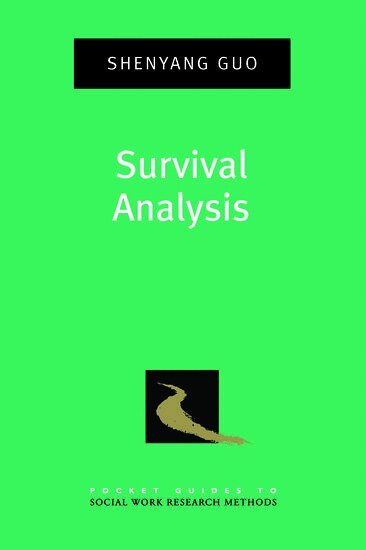
Survival analysis is a class of statistical methods for studying the occurrence and timing of events. Statistical analysis of longitudinal data, particularly censored data, lies at the heart of social work research, and many of social work research's empirical problems, such as child welfare, welfare policy, evaluation of welfare-to-work programs, and mental health, can be formulated as investigations of timing of event occurrence. Social work researchers also often need to analyze multilevel or grouped data (for example, event times formed by sibling groups or mother-child dyads or recurrences of events such as reentries into foster care), but these and other more robust methods can be challenging to social work researchers without a background in higher math.With clearly written summaries and plentiful examples, all written with social work issues and social work researchers in mind, this pocket guide will put this important statistical tool in the hands of many more social work researchers than have been able to use it before, to the field's benefit.
586 kr
Skickas inom 7-10 vardagar
Measures that are reliable, valid and can be used across diverse populations are vital to social work research, but the development of new measures is an expensive and time-consuming process. An array of existing measures can provide a cost-effective alternative, but in order to take this expedient step with confidence, researchers must ensure that the existing measure is appropriate for the new study. Confirmatory factory analysis (CFA) is one way to do so, and in this clearly written pocket guide Donna Harrington provides social work researchers with an essential roadmap to the highlights of CFA's powers and how to harness them. CFA has four primary functions-- psychometric evaluation of measures, construct validation, testing method effects, and testing measurement invariance-- all of which Harrington makes exceedingly accessible. She includes an easy-to-follow overview of the method, step-by-step guides to creating a CFA model and assessing its fit, and clear explanations of the requirements for using CFA, as well as underscoring the issues that are necessary to consider in alternative situations, such as when multiple groups are involved. Real-world examples, screenshots from the Amos software program that can be used to conduct CFA, and reading suggestions for each chapter make the material accessible for even the greenest novice. This pocket guide is ideally suited for readers who plan to conduct CFA analyses and need a brief, non-technical introduction to the topic to get them started before getting into the more detailed and technical literature, as well as readers who do not plan to conduct CFA analyses, but want to be knowledgeable consumers of research literature that uses CFA.
556 kr
Skickas inom 7-10 vardagar
Single system, or single case, design studies are a convenient method for evaluating practice, allowing professionals to track clients' response to treatment and change over time. They also allow researchers to gather data where it might be difficult to conduct a study involving treatment and control groups; in a school setting, or a community mental health agency, for example, random assignment may be impossible, whereas individual student or client progress across time can be more easily monitored. This pocket guide reviews a wide range of techniques for analyzing single system design data, including visual analysis methods, graphical methods, and statistical methods. From basic visual observation to complex ARIMA statistical models for use with interrupted time series designs, numerous data analysis methods are described and illustrated in this unique and handy book. The author frankly describes limitations and strengths of the data analysis methods so that readers can select an appropriate method and use the results responsibly in order to improve practice and client well-being. This accessible yet in-depth introduction will serve as a highly practical resource for doctoral students and researchers alike.
607 kr
Skickas inom 5-8 vardagar
Many otherwise strong doctoral students get stuck at the dissertation stage, but this trusty guide takes students from the early planning phase to finishing the final draft. It contains straightforward advice for each stage of the dissertation process: selecting a chair, completing the literature review, developing a hypothesis, selecting a study sample and appropriate measures, managing and analyzing both quantitative and qualitative data, establishing good writing habits, and overcoming obstacles to completing the dissertation on schedule. Practical guidelines, tips and strategies, and action steps checklists in each chapter make this a handy pocket guide for students as well as advisors seeking a comprehensive, unintimidating road map to the social work dissertation.
712 kr
Skickas inom 5-8 vardagar
Group Work Research is an essential resource for anyone seeking to conduct research on groups or develop empirically based group work practices. It illustrates how to plan and conduct group work research, including studies of the impact of groups on individual members, group conditions (e.g. cohesiveness, roles, processes, structures), and other systems external to the group. Furthermore, it will walk the reader through the process of conducting group work research, from formulating the research problem to selecting a design, measuring variables, and disseminating the findings. The authors also discuss considerations when the purpose of the research is an evaluation of a group work program. The amount of research that has been published about group work is not reflective of the technique's extensive use. Laying out all the fundamental details of group work research in a straightforward, reader-friendly manner, Group Work Research will be invaluable to doctoral students and faculty in group work, as well as professionals without formal training in using research to inform their practice.
549 kr
Skickas inom 5-8 vardagar
This pocket guide offers researchers a framework for conducting research in a culturally sensitive manner with individuals, families, and communities in diverse settings. This unique framework focuses on a process, rather than a typology of behaviors, attitudes, values, and beliefs. All too frequently, cross-cultural research improperly attributes behaviors, beliefs, and values entirely to culture, when a closer examination would reveal the shared influences of gender, socioeconomic status, immigration status, and racial and ethnic backgrounds that interact in complex ways. By encouraging practitioners to incorporate an intersectionality lens into their work, this pocket guide helps researchers reveal stories that are more than the sum of particular identities.Sharing their extensive research experience with diverse populations around the world, the authors present a range of fluid and dynamic cross-cultural research practices that readers can easily adapt to their unique circumstances. At the intersection of culture and research methods, chapters illustrate the application of the model to three broad areas of inquiry: describing the nature of a problem; understanding the etiology of the problem; and evaluating the interventions designed to ameliorate the problem. Each area is illustrated with examples of research projects that incorporate multiple epistemologies and methodologies in order to better understand and respond to a population's needs.This guide offers a complete roadmap for developing cross-cultural projects that truly engage communities, and will be a trusted resource for students and seasoned researchers alike.
596 kr
Skickas inom 5-8 vardagar
The complexity of social problems necessitates that social work researchers understand and apply multivariate statistical methods in their investigations. In this pocket guide, the authors introduce readers to three of the more frequently used multivariate methods in social work research with an emphasis on basic statistics. The primary aim is to prepare entry-level doctoral students and early career social work researchers in the use of multivariate methods by providing an easy-to-understand presentation, building on the basic statistics that inform them. The pocket guide begins with a review of basic statistics, hypothesis testing with inferential statistics, and bivariate analytic methods. Subsequent sections describe bivariate and multiple linear regression analyses, one-way and two-way analysis of variance (ANOVA) and covariance (ANCOVA), and path analysis. In each chapter, the authors introduce the various basic statistical procedures by providing definitions, formulas, descriptions of the underlying logic and assumptions of each procedure, and examples of how they have been used in social work research literature, particularly with diverse populations. They also explain estimation procedures and how to interpret results. The multivariate chapters conclude with brief step-by-step instructions for conducting multiple regression analysis and one-way ANOVA in Statistical Package for the Social Sciences (SPSS), and path analysis in Amos, using data from the National Educational Longitudinal Study of 1988 (NELS: 88). As an additional supplement, the book offers a companion website that provides more detailed instructions, as well as data sets and worked examples.
607 kr
Skickas inom 5-8 vardagar
With the changing demographic landscape of American society, there has been a steady increase in studies and research on diverse populations and groups. However, it is not uncommon for these studies to be affected by methodological problems, including but not limited to the problems of overgeneralization, misuse of measurements, misinterpretation of findings, and the interpretation of differences not as diversity but as deficiencies. Simply put, the application of conventional research strategies with a different population does not qualify a study as culturally competent research.This pocket guide adopts ethnography as a meta-framework for conducting culturally competent research. This suggests the following components of culturally competent research: (1) a collaborative social relationship with the study group and community, (2) use of firsthand, long-term participant observation, (3) use of self as research instrument, (4) researcher as learner, (5) a contextual view of phenomena, (6) a holistic perspective, (7) an interactive-reactive research process, (8) a cross-cultural frame of reference, and (9) a spirit of discovery.Each phase of research is described and incorporated throughout the process, from framing and designing the study; to data collection, management, and analysis; to final analysis and report writing; and to dissemination to a variety of audiences. With a practical, step-by-step approach, this book provides social work researchers, doctoral students, and professionals with a model for conducting culturally competent research with and close to the lived experience of diverse populations and groups.