Princeton Analytical Sociology Series - Böcker
Visar alla böcker i serien Princeton Analytical Sociology Series. Handla med fri frakt och snabb leverans.
6 produkter
6 produkter
439 kr
Skickas inom 7-10 vardagar
The English East India Company was one of the most powerful and enduring organizations in history. Between Monopoly and Free Trade locates the source of that success in the innovative policy by which the Company's Court of Directors granted employees the right to pursue their own commercial interests while in the firm's employ. Exploring trade network dynamics, decision-making processes, and ports and organizational context, Emily Erikson demonstrates why the English East India Company was a dominant force in the expansion of trade between Europe and Asia, and she sheds light on the related problems of why England experienced rapid economic development and how the relationship between Europe and Asia shifted in the eighteenth and nineteenth centuries. Though the Company held a monopoly on English overseas trade to Asia, the Court of Directors extended the right to trade in Asia to their employees, creating an unusual situation in which employees worked both for themselves and for the Company as overseas merchants.Building on the organizational infrastructure of the Company and the sophisticated commercial institutions of the markets of the East, employees constructed a cohesive internal network of peer communications that directed English trading ships during their voyages. This network integrated Company operations, encouraged innovation, and increased the Company's flexibility, adaptability, and responsiveness to local circumstance. Between Monopoly and Free Trade highlights the dynamic potential of social networks in the early modern era.
402 kr
Skickas inom 7-10 vardagar
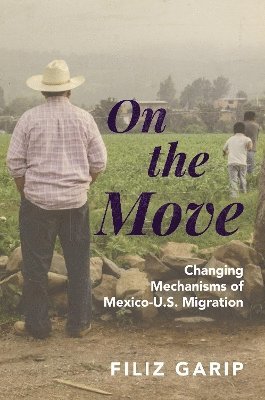
Why do Mexicans migrate to the United States? Is there a typical Mexican migrant? Beginning in the 1970s, survey data indicated that the average migrant was a young, unmarried man who was poor, undereducated, and in search of better employment opportunities. This is the general view that most Americans still hold of immigrants from Mexico. On the Move argues that not only does this view of Mexican migrants reinforce the stereotype of their undesirability, but it also fails to capture the true diversity of migrants from Mexico and their evolving migration patterns over time. Using survey data from over 145,000 Mexicans and in-depth interviews with nearly 140 Mexicans, Filiz Garip reveals a more accurate picture of Mexico-U.S migration. In the last fifty years there have been four primary waves: a male-dominated migration from rural areas in the 1960s and '70s, a second migration of young men from socioeconomically more well-off families during the 1980s, a migration of women joining spouses already in the United States in the late 1980s and '90s, and a generation of more educated, urban migrants in the late 1990s and early 2000s.For each of these four stages, Garip examines the changing variety of reasons for why people migrate and migrants' perceptions of their opportunities in Mexico and the United States. Looking at Mexico-U.S. migration during the last half century, On the Move uncovers the vast mechanisms underlying the flow of people moving between nations.
292 kr
Skickas inom 7-10 vardagar
The English East India Company was one of the most powerful and enduring organizations in history. Between Monopoly and Free Trade locates the source of that success in the innovative policy by which the Company's Court of Directors granted employees the right to pursue their own commercial interests while in the firm's employ. Exploring trade network dynamics, decision-making processes, and ports and organizational context, Emily Erikson demonstrates why the English East India Company was a dominant force in the expansion of trade between Europe and Asia, and she sheds light on the related problems of why England experienced rapid economic development and how the relationship between Europe and Asia shifted in the eighteenth and nineteenth centuries. Though the Company held a monopoly on English overseas trade to Asia, the Court of Directors extended the right to trade in Asia to their employees, creating an unusual situation in which employees worked both for themselves and for the Company as overseas merchants.Building on the organizational infrastructure of the Company and the sophisticated commercial institutions of the markets of the East, employees constructed a cohesive internal network of peer communications that directed English trading ships during their voyages. This network integrated Company operations, encouraged innovation, and increased the Company's flexibility, adaptability, and responsiveness to local circumstance. Between Monopoly and Free Trade highlights the dynamic potential of social networks in the early modern era.
330 kr
Skickas inom 7-10 vardagar
A new, counterintuitive theory for how social networks influence the spread of behaviorNew social movements, technologies, and public-health initiatives often struggle to take off, yet many diseases disperse rapidly without issue. Can the lessons learned from the viral diffusion of diseases be used to improve the spread of beneficial behaviors and innovations? In How Behavior Spreads, Damon Centola presents over a decade of original research examining how changes in societal behavior--in voting, health, technology, and finance—occur and the ways social networks can be used to influence how they propagate. Centola's startling findings show that the same conditions accelerating the viral expansion of an epidemic unexpectedly inhibit the spread of behaviors.While it is commonly believed that "weak ties"—long-distance connections linking acquaintances—lead to the quicker spread of behaviors, in fact the exact opposite holds true. Centola demonstrates how the most well-known, intuitive ideas about social networks have caused past diffusion efforts to fail, and how such efforts might succeed in the future. Pioneering the use of Web-based methods to understand how changes in people's social networks alter their behaviors, Centola illustrates the ways in which these insights can be applied to solve countless problems of organizational change, cultural evolution, and social innovation. His findings offer important lessons for public health workers, entrepreneurs, and activists looking to harness networks for social change.Practical and informative, How Behavior Spreads is a must-read for anyone interested in how the theory of social networks can transform our world.
284 kr
Skickas inom 7-10 vardagar
Why do Mexicans migrate to the United States? Is there a typical Mexican migrant? Beginning in the 1970s, survey data indicated that the average migrant was a young, unmarried man who was poor, undereducated, and in search of better employment opportunities. This is the general view that most Americans still hold of immigrants from Mexico. On the Move argues that not only does this view of Mexican migrants reinforce the stereotype of their undesirability, but it also fails to capture the true diversity of migrants from Mexico and their evolving migration patterns over time.Using survey data from over 145,000 Mexicans and in-depth interviews with nearly 140 Mexicans, Filiz Garip reveals a more accurate picture of Mexico-U.S migration. In the last fifty years there have been four primary waves: a male-dominated migration from rural areas in the 1960s and '70s, a second migration of young men from socioeconomically more well-off families during the 1980s, a migration of women joining spouses already in the United States in the late 1980s and ’90s, and a generation of more educated, urban migrants in the late 1990s and early 2000s. For each of these four stages, Garip examines the changing variety of reasons for why people migrate and migrants’ perceptions of their opportunities in Mexico and the United States.Looking at Mexico-U.S. migration during the last half century, On the Move uncovers the vast mechanisms underlying the flow of people moving between nations.
237 kr
Skickas inom 7-10 vardagar
A new, counterintuitive theory for how social networks influence the spread of behaviorNew social movements, technologies, and public-health initiatives often struggle to take off, yet many diseases disperse rapidly without issue. Can the lessons learned from the viral diffusion of diseases improve the spread of beneficial behaviors and innovations? How Behavior Spreads presents over a decade of original research examining how changes in societal behavior—in voting, health, technology, and finance—occur and the ways social networks can be used to influence how they propagate. Damon Centola's startling findings show that the same conditions that accelerate the viral expansion of an epidemic unexpectedly inhibit the spread of behaviors. How Behavior Spreads is a must-read for anyone interested in how the theory of social networks can transform our world.