Princeton Series in Evolutionary Biology – serie
Visar alla böcker i serien Princeton Series in Evolutionary Biology. Handla med fri frakt och snabb leverans.
2 produkter
2 produkter
674 kr
Skickas inom 5-8 vardagar
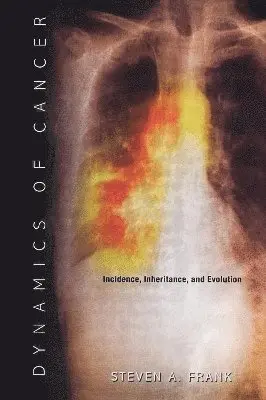
The onset of cancer presents one of the most fundamental problems in modern biology. In Dynamics of Cancer, Steven Frank produces the first comprehensive analysis of how particular genetic and environmental causes influence the age of onset. The book provides a unique conceptual and historical framework for understanding the causes of cancer and other diseases that increase with age. Using a novel quantitative framework of reliability and multistage breakdown, Frank unifies molecular, demographic, and evolutionary levels of analysis. He interprets a wide variety of observations on the age of cancer onset, the genetic and environmental causes of disease, and the organization of tissues with regard to stem cell biology and somatic mutation. Frank uses new quantitative methods to tackle some of the classic problems in cancer biology and aging: how the rate of increase in the incidence of lung cancer declines after individuals quit smoking, the distinction between the dosage of a chemical carcinogen and the time of exposure, and the role of inherited genetic variation in familial patterns of cancer. This is the only book that presents a full analysis of the age of cancer onset.It is a superb teaching tool and a rich source of ideas for new and experienced researchers. For cancer biologists, population geneticists, evolutionary biologists, and demographers interested in aging, this book provides new insight into disease progression, the inheritance of predisposition to disease, and the evolutionary processes that have shaped organismal design.
432 kr
Skickas inom 11-20 vardagar
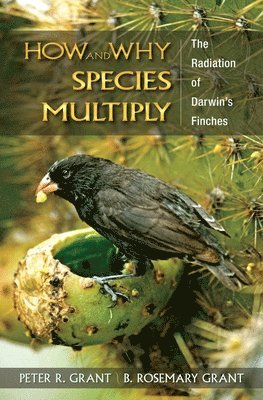
Charles Darwin's experiences in the Galapagos Islands in 1835 helped to guide his thoughts toward a revolutionary theory: that species were not fixed but diversified from their ancestors over many generations, and that the driving mechanism of evolutionary change was natural selection. In this concise, accessible book, Peter and Rosemary Grant explain what we have learned about the origin and evolution of new species through the study of the finches made famous by that great scientist: Darwin's finches. Drawing upon their unique observations of finch evolution over a thirty-four-year period, the Grants trace the evolutionary history of fourteen different species from a shared ancestor three million years ago. They show how repeated cycles of speciation involved adaptive change through natural selection on beak size and shape, and divergence in songs.They explain other factors that drive finch evolution, including geographical isolation, which has kept the Galapagos relatively free of competitors and predators; climate change and an increase in the number of islands over the last three million years, which enhanced opportunities for speciation; and flexibility in the early learning of feeding skills, which helped species to exploit new food resources. Throughout, the Grants show how the laboratory tools of developmental biology and molecular genetics can be combined with observations and experiments on birds in the field to gain deeper insights into why the world is so biologically rich and diverse. Written by two preeminent evolutionary biologists, How and Why Species Multiply helps to answer fundamental questions about evolution--in the Galapagos and throughout the world.