Reforming Higher Education: Innovation and the Public Good – Serie
Visar alla böcker i serien Reforming Higher Education: Innovation and the Public Good. Handla med fri frakt och snabb leverans.
5 produkter
5 produkter
231 kr
Skickas
In MOOCs, High Technology, and Higher Learning, Robert A Rhoads places the OpenCourseWare (OCW) movement into the larger context of a revolution in educational technology. In doing so, he seeks to bring greater balance to increasingly polarized discussions of massively open online courses (MOOCs) and show their ongoing relevance to reforming higher education and higher learning. Rhoads offers a provocative analysis of a particular moment in history when cultural, political, and economic forces came together with evolving teaching and learning technologies to bring about the MOOC. He argues persuasively that the OCW and MOOC movements have had a significant impact on the digitalization of knowledge and that they have helped expand the ways students and teachers interact and develop ideas collaboratively. He also critically analyzes the extensive media coverage of MOOCs while examining empirical studies of MOOC content delivery, the organizational system supporting the OCW/MOOC movement, and faculty labor concerns. Too often, technology advocates champion the MOOC movement as a solution to higher education's challenges without recognizing the pedagogical, social, and economic costs.MOOCs, High Technology, and Higher Learning challenges many of the democratic claims made by MOOC advocates, pointing to vast inequities in the ways MOOCs are presented as an alternative to brick-and-mortar access for low-income populations. This book offers a clear-eyed perspective on the potential and peril of this new form of education.
345 kr
Skickas inom 7-10 vardagar
It is no surprise that college tuition and student debt are on the rise. Universities no longer charge tuition to simply cover costs. They are market enterprises that charge whatever the market will bear. Institutional ambition, along with increasing competition for students, now shapes the economics of higher education. In The Market Imperative, Robert Zemsky and Susan Shaman argue that too many institutional leaders and policymakers do not understand how deeply the consumer markets they promoted have changed American higher education. Instead of functioning as a single integrated industry, higher education is in fact a collection of segmented and more or less separate markets. These markets have their own distinctive operating constraints and logics, especially regarding price. But those most responsible for federal higher education policy have made a muck of the enterprise, while state policymaking has all but disappeared, the victim of weak imaginations, insufficient funding, and an aversion to targeted investment.Chapter by chapter, The Market Imperative draws on new data developed by the authors in a Gates Foundation-funded project to describe the landscape: how the market for higher education distributes students among competing institutions; what the job market is looking for; how markets differ across the fifty states; and how the higher education market determines the kinds of faculty at different kinds of institutions. The volume concludes with a three-pronged set of policies for making American higher education mission centered as well as market smart. Although there is no "one-size-fits-all" approach for reforming higher education, this clearly written book will productively advance understanding of the challenges colleges and universities face by providing a mapping of the configuration of the market for an undergraduate education.
Becoming Hispanic-Serving Institutions
Opportunities for Colleges and Universities
Häftad, Engelska, 2019
345 kr
Skickas inom 7-10 vardagar
How can striving Hispanic-Serving Institutions serve their students while countering the dominant preconceptions of colleges and universities?Winner of the AAHHE Book of the Year Award by the American Association of Hispanics in Higher EducationHispanic-Serving Institutions (HSIs)—not-for-profit, degree-granting colleges and universities that enroll at least 25% or more Latinx students—are among the fastest-growing higher education segments in the United States. As of fall 2016, they represented 15% of all postsecondary institutions in the United States and enrolled 65% of all Latinx college students. As they increase in number, these questions bear consideration: What does it mean to serve Latinx students? What special needs does this student demographic have? And what opportunities and challenges develop when a college or university becomes an HSI? In Becoming Hispanic-Serving Institutions, Gina Ann Garcia explores how institutions are serving Latinx students, both through traditional and innovative approaches. Drawing on empirical data collected over two years at three HSIs, Garcia adopts a counternarrative approach to highlight the ways that HSIs are reframing what it means to serve Latinx college students. She questions the extent to which they have been successful in doing this while exploring how those institutions grapple with the tensions that emerge from confronting traditional standards and measures of success for postsecondary institutions. Laying out what it means for these three extremely different HSIs, Garcia also highlights the differences in the way each approaches its role in serving Latinxs. Incorporating the voices of faculty, staff, and students, Becoming Hispanic-Serving Institutions asserts that HSIs are undervalued, yet reveals that they serve an important role in the larger landscape of postsecondary institutions.
375 kr
Skickas inom 7-10 vardagar
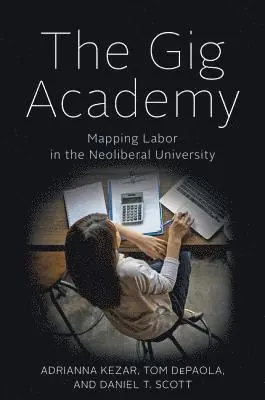
Why the Gig Academy is the dominant organizational form within the higher education economy—and its troubling implications for faculty, students, and the future of college education.Over the past two decades, higher education employment has undergone a radical transformation with faculty becoming contingent, staff being outsourced, and postdocs and graduate students becoming a larger share of the workforce. For example, the faculty has shifted from one composed mostly of tenure-track, full-time employees to one made up of contingent, part-time teachers. Non-tenure-track instructors now make up 70 percent of college faculty. Their pay for teaching eight courses averages $22,400 a year—less than the annual salary of most fast-food workers. In The Gig Academy, Adrianna Kezar, Tom DePaola, and Daniel T. Scott assess the impact of this disturbing workforce development. Providing an overarching framework that takes the concept of the gig economy and applies it to the university workforce, this book scrutinizes labor restructuring across both academic and nonacademic spheres. By synthesizing these employment trends, the book reveals the magnitude of the problem for individual workers across all institutional types and job categories while illustrating the damaging effects of these changes on student outcomes, campus community, and institutional effectiveness. A pointed critique of contemporary neoliberalism, the book also includes an analysis of the growing divide between employees and administrators.The authors conclude by examining the strengthening state of unionization among university workers. Advocating a collectivist, action-oriented vision for reversing the tide of exploitation, Kezar, DePaola, and Scott urge readers to use the book as a tool to interrogate the state of working relations on their own campuses and fight for a system that is run democratically for the benefit of all. Ultimately, The Gig Academy is a call to arms, one that encourages non-tenure-track faculty, staff, postdocs, graduate students, and administrative and tenure-track allies to unite in a common struggle against the neoliberal Gig Academy.
365 kr
Skickas inom 7-10 vardagar
How what we know about K–12 education can revolutionize learning in college.Honorable Mention in the Foreword INDIES Award for Education by FOREWORD Reviews, Winner of the 2021 Bronze IPPY Award for Education IIAmid the wide-ranging public debate about the future of higher education is a tension about the role of the faculty as instructors versus researchers and the role of teaching in the mission of a university. What is absent from that discourse is any clear understanding of what constitutes good teaching in college. In Convergent Teaching, masterful professors of education Aaron M. Pallas and Anna Neumann make the case that American higher education must hold fast to its core mission of fostering learning and growth for all people.Arguing that colleges and universities do this best through their teaching function, the book portrays teaching as a professional practice that teachers should actively hone. Drawing on rich research on K–12 classroom teaching, the authors develop the novel idea of convergent teaching, an approach that attends simultaneously to what students are learning and the personal, social, and cultural contexts shaping this process. Convergent teaching, they write, spurs teachers to join students' cognitions with the students' emotions and identities as they learn. Offering new ways to think about how college teachers can support and advance their students' learning of core disciplinary ideas, Pallas and Neumann outline targeted actions that campus administrators, public policy makers, and foundation leaders can take to propel such efforts. Vivid examples of instructors enacting three key principles—targeting, surfacing, and navigating—help bring the idea of convergent teaching to life.Full of research-based, practical ideas for better teaching and learning, Convergent Teaching presents numerous instances of successful campus-based initiatives. It also sets a bold agenda for disciplinary organizations, philanthropies, and the federal government to support teaching improvement. This book will challenge higher education students while motivating college administrators and faculty to enact change on their campuses.