Revolutions in Science - Böcker
Visar alla böcker i serien Revolutions in Science. Handla med fri frakt och snabb leverans.
3 produkter
3 produkter
402 kr
Skickas inom 3-6 vardagar
Launched in 1942, the Manhattan Project was a well-funded, secret effort by the United States, the United Kingdom, and Canada to develop an atomic bomb before the Nazis. The results—the bombs named "Little Boy" and "Fat Man"—were dropped on Hiroshima and Nagasaki in August of 1945.A vast state within a state, the Manhattan Project employed 130,000 people and cost the United States and its allies 2 billion dollars, but its contribution to science as a prestigious investment was invaluable. After the bombs were dropped, states began allocating unprecedented funds for scientific research, leading to the establishment of many of twentieth century's major research institutions. Yet the union of science, industry, and the military did not start with the development of the atomic bomb; World War II only deepened the relationship. This absorbing history revisits the interactions among science, the national interest, and public and private funding that was initiated in World War I and flourished in WWII. It then follows the Manhattan Project from inception to dissolution, describing the primary influences that helped execute the world's first successful plan for nuclear research and tracing the lineages of modern national nuclear agencies back to their source.
548 kr
Skickas inom 3-6 vardagar
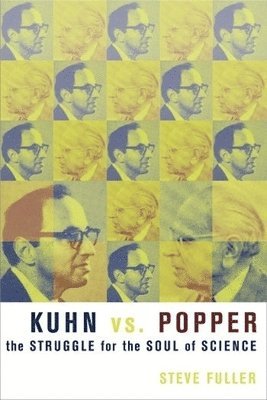
Thomas Kuhn's Structure of Scientific Revolutions has sold over a million copies in more than twenty languages and has remained one of the ten most cited academic works for the past half century. In contrast, Karl Popper's seminal book The Logic of Scientific Discovery has lapsed into relative obscurity. Although the two men debated the nature of science only once, the legacy of this encounter has dominated intellectual and public discussions on the topic ever since. Almost universally recognized as the modern watershed in the philosophy of science, Kuhn's relativistic vision of shifting paradigms-which asserted that science was just another human activity, like art or philosophy, only more specialized-triumphed over Popper's more positivistic belief in science's revolutionary potential to falsify society's dogmas. But has this victory been beneficial for science? Steve Fuller argues that not only has Kuhn's dominance had an adverse impact on the field but both thinkers have been radically misinterpreted in the process.This debate raises a vital question: Can science remain an independent, progressive force in society, or is it destined to continue as the technical wing of the military-industrial complex? Drawing on original research-including the Kuhn archives at MIT-Fuller offers a clear account of "Kuhn vs. Popper" and what it will mean for the future of scientific inquiry.
504 kr
Skickas inom 3-6 vardagar
How is it possible that Earth's atmospheric temperature has remained perfectly suited to supporting life for billions of years? Why do oxygen levels in the atmosphere remain relatively stable when only a minuscule increase would cause everything on Earth to spontaneously combust? Why are the oceans salty, but not salty enough to make them uninhabitable? In the 1960s, an English scientist names James Lovelock formulated a groundbreaking and highly controversial explanation: Earth is alive. Naming his theory after the ancient Greek earth goddess, Lovelock's "Gaia hypothesis" argued that everything on the planet-air, water, soil, and living organisms-somehow act together in a global, self-organizing system to maintain conditions suitable to sustaining and perpetuating life. Lovelock speculated that the geosphere and biosphere were interdependent and that every part of the Earth system worked in symbiotic harmony with every other part. Once considered more science fiction than legitimate science, the Gaia hypothesis was met with indifference, and even hostility, when it was first revealed.The theory only started to gain widespread attention when emerging issues such as environmental degradation and global warming proved that a single species-humans-could radically upset the ecological and atmospheric balance of the planet. While Gaia attracted a quasi-religious following among environmentalists and New Age spiritualists, it was still largely viewed with skepticism by the scientific community. But over the past few decades, many of Lovelock's ideas have led to significant breakthroughs. In fact, the Gaia hypothesis has developed into a guiding principle for a vast range of discrete inquiries into how the Earth works, often referred to as "Earth system science" or "geophysiology." Telling the story of this maverick pioneer and his long struggle to gain respectability, Lovelock and Gaia explains how Lovelock's remarkable hypothesis is gradually ushering in a scientific revolution.