Rochester Studies in Managerial Economics and Policy – serie
Visar alla böcker i serien Rochester Studies in Managerial Economics and Policy. Handla med fri frakt och snabb leverans.
11 produkter
11 produkter
Inbunden, Engelska, 1989
1 651 kr
Skickas inom 10-15 vardagar
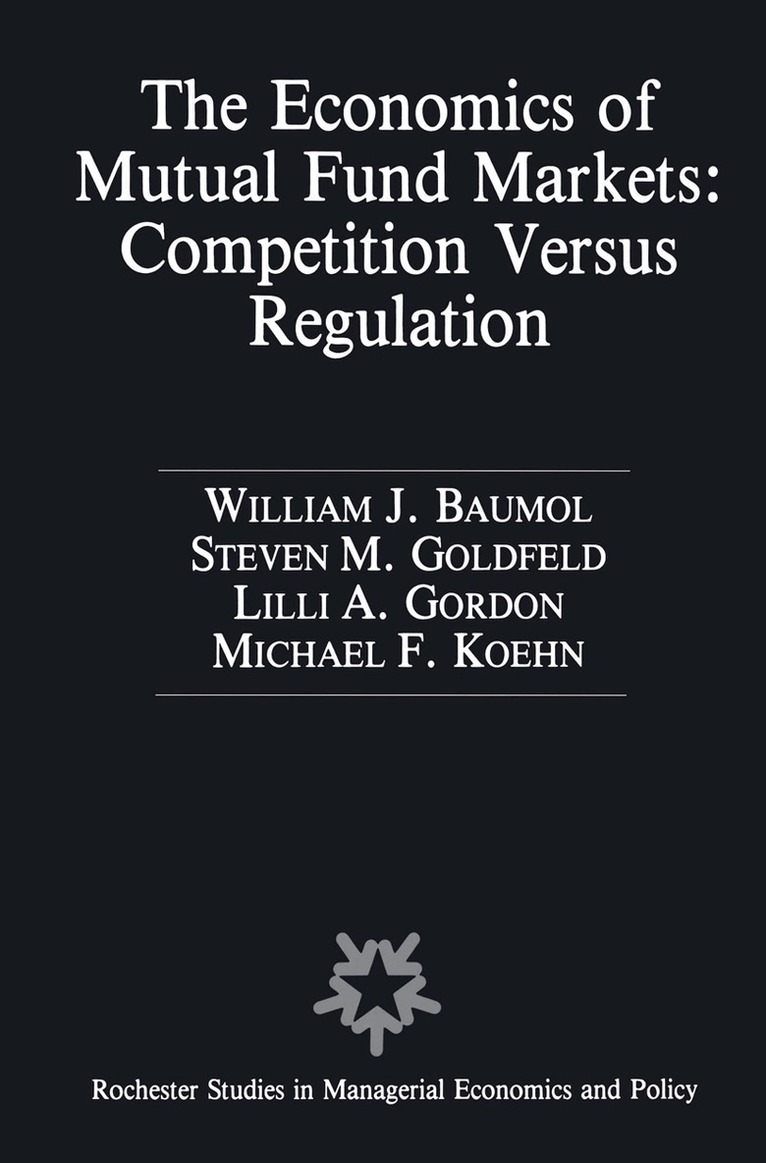
The original impetus for this research was provided several years ago by a request to assist Counsel for Fidelity Management and Research Corporation in analyzing the mutual fund industry, with particular emphasis on money market mutual funds. We were asked to focus our efforts on the mechanism by which the advisory fees of mutual funds are determined. This request arose out of litigation that challenged the level of advisory fees charged to the shareholders of the Fidelity Cash Reserve Fund. Subsequently, we were asked to provide similar assistance to Counsel for T. Rowe Price Associates regarding the fees charged to shareholders of their Prime Reserve Fund. 1940, advisers of Under the Investment Company Act of mutual funds have a fiduciary duty with respect to the level of fees they may charge a fund's shareholders. Since the passage of the Investment Company Act, there have been numerous lawsuits brought by shareholders alleging that advisory fees were excessive. In these lawsuits, the courts have failed to provide a set of standards for determining when such fees are excessive. Instead, they have relied on arbitrary and frequently ill-defined criteria for jUdging the reasonableness of fees. This failure to apply economic-based tests for evaluating the fee structure of mutual funds provided the motivation for the present book, which undertakes a comprehensive analysis of the economics of the mutual fund industry.
Inbunden, Engelska, 1981
1 071 kr
Skickas inom 10-15 vardagar
Inbunden, Engelska, 1987
1 103 kr
Skickas inom 10-15 vardagar
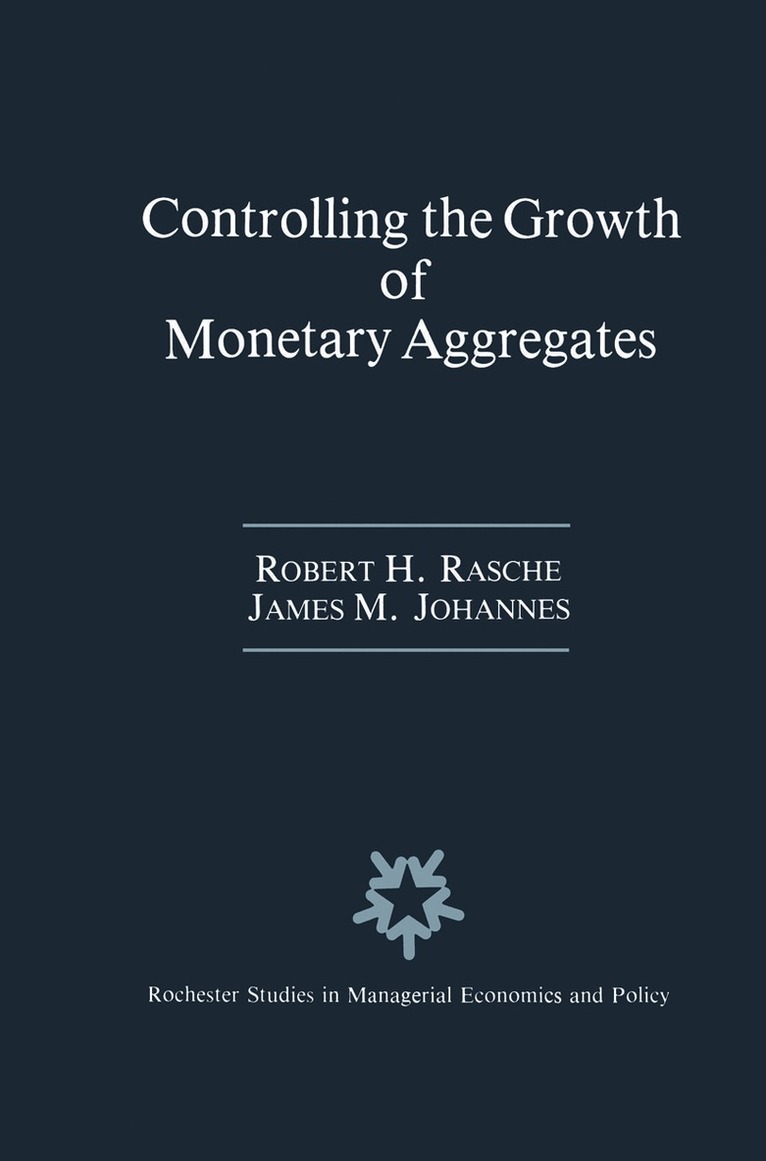
Karl Brunner Monetary affairs have preoccupied observers over the ages. In the middle of the 14th century, the chaos in the French currency system after many rounds of currency debasement attracted comments expressing helpless confusion. Goethe's Mephistopheles convinced the imperial court to inflate with paper money "for the benefit of the public" and to satisfy all the demands on the government's largesse. Our century is no exception. The massive technological improvement in creating money has contributed to hyperinflationary experiences never before recorded in history. These events occurred, however, in the political disarray following major wars. More important are the persistent pe ace time failures of our monetary institutions. A massive worldwide deflation, centered in the United States and Germany, imposed a tragic social and political fate on Western societies. Similarly, the sequence of a worldwide inflation followed by deflation observed over the past 15 years has fostered disruptive economic and political conditions. The monetary disarray experienced throughout history was crucially influenced by the prevailing monetary arrangements. These arrangements determine the level and movement of the nation's money stock over time. Under the circumstances, the political issue confronting us bears on the useful choice of monetary arrangements. This choice should involve institutions that prohibit both massive deflation and persistent inflation.
Inbunden, Engelska, 1988
1 103 kr
Skickas inom 10-15 vardagar
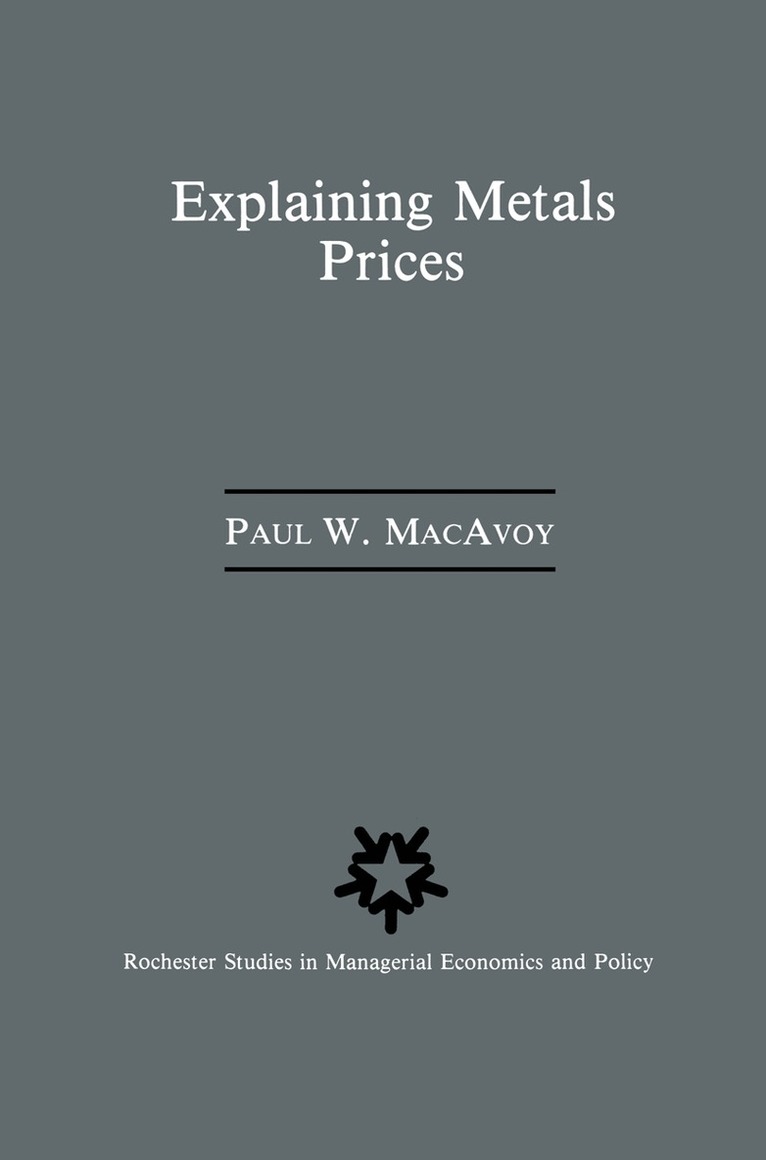
Work on this book began in the Spring of 1983, not long after an Amax Corporation annual budget meeting. As a member of the Amax board of directors since 1979, I had been present at such meetings in which the molybdenum price had been forecast to move higher than $7.00 per pound. The actual annual average prices were $9.70 in 1980, $8.50 in 1981, and $4.00 in 1982. The forecast for 1983 called for prices to return to higher levels, but as both dealer and producer prices declined further, my research began in earnest. Initially, the research was to address the question of why the molybdenum price had declined by more than half in a short period. More fundamental, as other metals prices also declined, was an impelling need to know the causes of the abrupt and sustained reduction in metals price levels that year. As prices stayed at low levels, while those of other materials recovered over the 1983-1986 period, the question became that of why metals prices had remained at startlingly low levels for over five years.
Del 2 - Rochester Studies in Managerial Economics and Policy
Great Depression Revisited
Häftad, Engelska, 2011
555 kr
Skickas inom 10-15 vardagar
The fateful days of the great stock market crash entered modem history almost 50 years ago to this day. The cyclic turning point of the U. S. economy oc curred, however, around June 1929, and economic activity receded substantial ly over the subsequent months. The onset of an economic downswing thus became clearly visible before the famous crash. But the October event stays in the public's mind as the symbol of the Great Depression. For nearly four years, until the spring of 1933, the U. S. economy plunged into a deep reces sion. Activity declined, prices fell, and there emerged a massive unemploy ment problem. The economy ultimately overcame this shock in 1933. Prices rose rapidly in spite of substantial margins of unusual resources. Activity ex panded, but occasionally at a somewhat hesitant rate. The expansion, however, was interrupted by another recession of major proportions during 1937-38. The tragic sequence of events shaped public consciousness and influenced new approaches and views in economic policymaking. The activist approach to "stabilization policy" and a wide range of regulatory policies were essentially justified in terms of this experience. These policies were crucially influenced by our understanding and interpretation of the Great Depression. The view of a radically unstable economic process perennially on the edge of serious collapse gained wide popularity and became a central element of the Keynesian tradi- 2 INTRODUCTION tion. It encouraged, with supplementary interpretations, an interventionist and expanding role of the government in our economic affairs.
Häftad, Engelska, 2014
1 071 kr
Skickas inom 10-15 vardagar
Häftad, Engelska, 2011
1 103 kr
Skickas inom 10-15 vardagar
The productive work of widely distributed academic research has contributed substantially, over the postwar period, to important advances in our understanding. It has also offered a clearer recognition of many unresolved problems. Never theless, the progress achieved over the last decades, ex hibited by the systematic application of "theory" to actual issues and observable problems, could not overcome a per vasive sense of dissatisfaction. Some academic endeavors pursued within a traditional range of economic analysis have appeared increasingly remote from broad social issues, motivating the social and intellectual unrest experienced in recent years. Conditioned by the traditional use of economic analysis, many have naturally concluded that the "most relevant" social issues agitating our times are beyond the reach of economics. Purist advocates of a traditional view thus condemn any extension of economic analysis to social issues as an escape into "ideology". Others argue the need for an "interdisciplinary approach" involving sociology, social psychology, or anthropology as necessary strands in a useful understanding of social, institutional, and human problems of contemporary societies. We note here, in par ticular, the subtle attraction inherent in Marxian thought. It appears to offer a unified approach, with a coherent inter pretation, to all matters and aspects of human society, in cluding even nature.
Häftad, Engelska, 2011
1 651 kr
Skickas inom 10-15 vardagar
The original impetus for this research was provided several years ago by a request to assist Counsel for Fidelity Management and Research Corporation in analyzing the mutual fund industry, with particular emphasis on money market mutual funds. We were asked to focus our efforts on the mechanism by which the advisory fees of mutual funds are determined. This request arose out of litigation that challenged the level of advisory fees charged to the shareholders of the Fidelity Cash Reserve Fund. Subsequently, we were asked to provide similar assistance to Counsel for T. Rowe Price Associates regarding the fees charged to shareholders of their Prime Reserve Fund. 1940, advisers of Under the Investment Company Act of mutual funds have a fiduciary duty with respect to the level of fees they may charge a fund's shareholders. Since the passage of the Investment Company Act, there have been numerous lawsuits brought by shareholders alleging that advisory fees were excessive. In these lawsuits, the courts have failed to provide a set of standards for determining when such fees are excessive. Instead, they have relied on arbitrary and frequently ill-defined criteria for jUdging the reasonableness of fees. This failure to apply economic-based tests for evaluating the fee structure of mutual funds provided the motivation for the present book, which undertakes a comprehensive analysis of the economics of the mutual fund industry.
Häftad, Engelska, 2011
1 103 kr
Skickas inom 10-15 vardagar
Work on this book began in the Spring of 1983, not long after an Amax Corporation annual budget meeting. As a member of the Amax board of directors since 1979, I had been present at such meetings in which the molybdenum price had been forecast to move higher than $7.00 per pound. The actual annual average prices were $9.70 in 1980, $8.50 in 1981, and $4.00 in 1982. The forecast for 1983 called for prices to return to higher levels, but as both dealer and producer prices declined further, my research began in earnest. Initially, the research was to address the question of why the molybdenum price had declined by more than half in a short period. More fundamental, as other metals prices also declined, was an impelling need to know the causes of the abrupt and sustained reduction in metals price levels that year. As prices stayed at low levels, while those of other materials recovered over the 1983-1986 period, the question became that of why metals prices had remained at startlingly low levels for over five years.
Häftad, Engelska, 2011
1 103 kr
Skickas inom 10-15 vardagar
Karl Brunner Monetary affairs have preoccupied observers over the ages. In the middle of the 14th century, the chaos in the French currency system after many rounds of currency debasement attracted comments expressing helpless confusion. Goethe's Mephistopheles convinced the imperial court to inflate with paper money "for the benefit of the public" and to satisfy all the demands on the government's largesse. Our century is no exception. The massive technological improvement in creating money has contributed to hyperinflationary experiences never before recorded in history. These events occurred, however, in the political disarray following major wars. More important are the persistent pe ace time failures of our monetary institutions. A massive worldwide deflation, centered in the United States and Germany, imposed a tragic social and political fate on Western societies. Similarly, the sequence of a worldwide inflation followed by deflation observed over the past 15 years has fostered disruptive economic and political conditions. The monetary disarray experienced throughout history was crucially influenced by the prevailing monetary arrangements. These arrangements determine the level and movement of the nation's money stock over time. Under the circumstances, the political issue confronting us bears on the useful choice of monetary arrangements. This choice should involve institutions that prohibit both massive deflation and persistent inflation.
Del 6 - Rochester Studies in Managerial Economics and Policy
Privatization and State-Owned Enterprises
Lessons from the United States, Great Britain and Canada
Häftad, Engelska, 2012
555 kr
Skickas inom 10-15 vardagar
The book is divided into three major sections. The first presents a theoretical discussion that underlies the other essays. The second section deals with privatization issues from the perspective of the United States. The third describes research addressed to the U. K. and Canada. In the first chapter, Richard Zeckbauser and Murray Horn develop a wide-ranging theoretical framework for assessing the capabilities and role of state-owned enterprises; it provides a foundation for the analyses that follow. In The Control and Perfonnance o[ State-Owned Enterprises , they describe state-owned enterprises as an extreme case of the separation of ownership and control. The focus is on management --the incentives it faces and the conflicts to which it is subjected. The distinguishing characteristics of public enterprise, the authors suggest, give it a comparative advantage over both public bureaucracy and private enterprise in certain situations. They argue that legislators are more likely to prefer SOEs over private enterprise when the efficiency of private enterprise is undermined by regulation or the tbreat of opportunistic state action, when the informational demands of subsidizing private production to meet distributional objectives are high, when it is difficult to assign property rights, or when state ownership is ideologically appealing. These considerations suggest why SOEs are usually assigned special rights and responsibilities, and they help explain observed regularities in the distribution of SOEs across countries and sectors. Zeckhauser and Horn apply principal-agent theory to identify the key factors underlying the performance of state-owned enterprises.