Routledge Library Editions: Milton - Böcker
Visar alla böcker i serien Routledge Library Editions: Milton. Handla med fri frakt och snabb leverans.
19 produkter
19 produkter
21 284 kr
Skickas inom 10-15 vardagar
This set of 9 volumes, originally published between 1965 and 1991, amalgamates a wide breadth of research on John Milton, with a particular focus on his epic poem Paradise Lost. This collection of books from some of the leading scholars in the field provides a comprehensive overview of how Milton criticism has evolved over time, and will be of particular interest to students of English Literature.
2 419 kr
Skickas inom 10-15 vardagar
First published in 1894. This Concordance to the Poetical Works of John Milton includes all of Milton’s poems, excluding the Psalms and the Translations in the prose works; and all of the words are given with the exception of some of the pronouns, conjunctions, adverbs and prepositions; but any of these used peculiarly are given. It is hoped that the work will be found useful not only by the student of Milton but by the grammarian and the philologist.
583 kr
Skickas inom 10-15 vardagar
First published in 1894. This Concordance to the Poetical Works of John Milton includes all of Milton’s poems, excluding the Psalms and the Translations in the prose works; and all of the words are given with the exception of some of the pronouns, conjunctions, adverbs and prepositions; but any of these used peculiarly are given. It is hoped that the work will be found useful not only by the student of Milton but by the grammarian and the philologist.
1 952 kr
Skickas inom 10-15 vardagar
First published in 1987. Milton and Free Will is an incisive, ambitious and comprehensive analysis and defence of the concept of free will, using Milton as an example and exemplar. Written with passion, and out of a lifelong engagement with the poetry of Milton and the philosophical and theological problems it encompasses, the book will illuminate both Milton studies and philosophical debate. The author engages with all the major currents of the free will debate, starting with Aristotle and Aquinas and considering arguments advanced by Hume and Kant as well as those of a number of modern philosophers including Polanyi, Kenny, Parfit, Plantinga, Swinburne, Dennett and Davidson. He pays particular attention to the Marxist formalism of Bakhtin, the Catholic phenomenology of Pope John Paul II and the evolutionism of Monod and Sober. He concludes with a rebuttal of the deconstructionism of Barthes, Derrida and Foucault. He claims that all the major difficulties faced by defenders of free will can be overcome if a notion of willing implicit in the work of Milton is properly understood. Freedom as Milton represented and understood it, he suggests, is a condition of mind arising out of inter-personal awareness and not a property or consequence of practical reasoning. He finds supporting evidence for this view in the writings of Newman and in Henry James’s The Portrait of a Lady, which he reads as a narrative structurally reversing Milton’s representation of the fall of Eve in Paradise Lost. The author systematically analyses and reanalyses key passages in his texts in the light of the many arguments for and against free will, seeking thereby to affirm the validity in principle, and the personal and political importance in practice, of the Christian humanist tradition of which he sees Milton, Newman and the Pope as important (if sometimes misleading) spokesmen.
552 kr
Skickas inom 10-15 vardagar
First published in 1987. Milton and Free Will is an incisive, ambitious and comprehensive analysis and defence of the concept of free will, using Milton as an example and exemplar. Written with passion, and out of a lifelong engagement with the poetry of Milton and the philosophical and theological problems it encompasses, the book will illuminate both Milton studies and philosophical debate. The author engages with all the major currents of the free will debate, starting with Aristotle and Aquinas and considering arguments advanced by Hume and Kant as well as those of a number of modern philosophers including Polanyi, Kenny, Parfit, Plantinga, Swinburne, Dennett and Davidson. He pays particular attention to the Marxist formalism of Bakhtin, the Catholic phenomenology of Pope John Paul II and the evolutionism of Monod and Sober. He concludes with a rebuttal of the deconstructionism of Barthes, Derrida and Foucault. He claims that all the major difficulties faced by defenders of free will can be overcome if a notion of willing implicit in the work of Milton is properly understood. Freedom as Milton represented and understood it, he suggests, is a condition of mind arising out of inter-personal awareness and not a property or consequence of practical reasoning. He finds supporting evidence for this view in the writings of Newman and in Henry James’s The Portrait of a Lady, which he reads as a narrative structurally reversing Milton’s representation of the fall of Eve in Paradise Lost. The author systematically analyses and reanalyses key passages in his texts in the light of the many arguments for and against free will, seeking thereby to affirm the validity in principle, and the personal and political importance in practice, of the Christian humanist tradition of which he sees Milton, Newman and the Pope as important (if sometimes misleading) spokesmen.
2 185 kr
Skickas inom 10-15 vardagar
First published in 1987. Passionately praised and equally passionately criticised by contemporary and later writers, the figure of Milton inherited by the twentieth century is by no means unified, despite the appearance of monumental unity his work sometimes acquires in the classroom and in academic criticism. This collection of essays gathers together disparate and often conflicting representations of Milton as author and cultural figure. Critics familiar with the traditions of Milton scholarship and with debates in literary theory reconstruct Milton from evidence provided by his own prose and poetry, by his contemporaries (including some little-known women writers), by Romantics such as Blake and Wordsworth, and, finally, by a tradition of Afro-American writing that reflects Milton's influence in ways previously unexamined by critics. The process of reconstruction can also be seen as a process of "re-membering." The volume draws inspiration from, but also interrogates, the figure used in Areopagita to describe the quest for truth. Likening Truth to the dismembered body of Osiris, Milton urges Truth's friends to seek up and down, gathering "limb by limb" the body scattered through time and space. Re-membering Milton includes work by established critics from both sides of the Atlantic. Together these contributors place Milton and different Milton traditions firmly within the arenas of modem critical debate. As a result, the collection will be of interest to a wide range of readers: scholars concerned with Milton and Renaissance literature and history; advanced undergraduates and graduate students; researchers in women’s studies; and all readers generally concerned with trends in literary and cultural theory.
583 kr
Skickas inom 10-15 vardagar
First published in 1987. Passionately praised and equally passionately criticised by contemporary and later writers, the figure of Milton inherited by the twentieth century is by no means unified, despite the appearance of monumental unity his work sometimes acquires in the classroom and in academic criticism. This collection of essays gathers together disparate and often conflicting representations of Milton as author and cultural figure. Critics familiar with the traditions of Milton scholarship and with debates in literary theory reconstruct Milton from evidence provided by his own prose and poetry, by his contemporaries (including some little-known women writers), by Romantics such as Blake and Wordsworth, and, finally, by a tradition of Afro-American writing that reflects Milton's influence in ways previously unexamined by critics. The process of reconstruction can also be seen as a process of "re-membering." The volume draws inspiration from, but also interrogates, the figure used in Areopagita to describe the quest for truth. Likening Truth to the dismembered body of Osiris, Milton urges Truth's friends to seek up and down, gathering "limb by limb" the body scattered through time and space. Re-membering Milton includes work by established critics from both sides of the Atlantic. Together these contributors place Milton and different Milton traditions firmly within the arenas of modem critical debate. As a result, the collection will be of interest to a wide range of readers: scholars concerned with Milton and Renaissance literature and history; advanced undergraduates and graduate students; researchers in women’s studies; and all readers generally concerned with trends in literary and cultural theory.
1 952 kr
Skickas inom 10-15 vardagar
First published in 1970. Few books on Milton have dealt with his poetry as a whole. The present study, a discussion of Milton’s major poetry, seeks to examine each of the poems on its own distinctive grounds and also to delineate the pattern of continuity which the poems enter into and sustain. The author shows how each poem creates its own strategy of insight and demonstrates that together they explore and define a centre of recognition more fully than is possible with any single work. The book makes full use of the results of Milton scholarship and will provide a basis for a fresh appreciation of the complexity and unity of Milton’s achievement.
552 kr
Skickas inom 10-15 vardagar
First published in 1970. Few books on Milton have dealt with his poetry as a whole. The present study, a discussion of Milton’s major poetry, seeks to examine each of the poems on its own distinctive grounds and also to delineate the pattern of continuity which the poems enter into and sustain. The author shows how each poem creates its own strategy of insight and demonstrates that together they explore and define a centre of recognition more fully than is possible with any single work. The book makes full use of the results of Milton scholarship and will provide a basis for a fresh appreciation of the complexity and unity of Milton’s achievement.
1 952 kr
Skickas inom 10-15 vardagar
First published in 1980. Paradise Lost was once a favourite text for family reading; today it is confined to the educational system, which treats it as an object to be investigated rather than a subject that demands response. Professor Hunter writes inevitably for an audience of literary students, but he invites them to consider Paradise Lost as a text that must be enjoyed before it can be explained. He understands the need to explain complexities, but is mainly concerned with the onward flow of our engagement with an ancient poem. Milton’s narrative technique is explored as a system which both encourages and frustrates our native sense of story. His poetic power is shown to grow from our assent to its brilliant evocation of "as if" fictions. Milton is a master of audience manipulation, of dramatic tension and intellectual paradox. These characteristics are described in the context of the task the poem sets itself to tell the untellable and describe what no man has ever seen. The power of Milton’s art is traced through his rehandling of Homer and Virgil and in his daringly individual fidelity to scripture. Professor Hunter does not try to smooth away the contradictions inherent in Milton’s ambition to write an English classical Christian epic. He rather stresses the contradictions as cues to a properly alert reading. And this is what the book aims at above all a response to Paradise Lost which is alert to poetry and unintimidated by scholarship.
552 kr
Skickas inom 10-15 vardagar
First published in 1980. Paradise Lost was once a favourite text for family reading; today it is confined to the educational system, which treats it as an object to be investigated rather than a subject that demands response. Professor Hunter writes inevitably for an audience of literary students, but he invites them to consider Paradise Lost as a text that must be enjoyed before it can be explained. He understands the need to explain complexities, but is mainly concerned with the onward flow of our engagement with an ancient poem. Milton’s narrative technique is explored as a system which both encourages and frustrates our native sense of story. His poetic power is shown to grow from our assent to its brilliant evocation of "as if" fictions. Milton is a master of audience manipulation, of dramatic tension and intellectual paradox. These characteristics are described in the context of the task the poem sets itself to tell the untellable and describe what no man has ever seen. The power of Milton’s art is traced through his rehandling of Homer and Virgil and in his daringly individual fidelity to scripture. Professor Hunter does not try to smooth away the contradictions inherent in Milton’s ambition to write an English classical Christian epic. He rather stresses the contradictions as cues to a properly alert reading. And this is what the book aims at above all a response to Paradise Lost which is alert to poetry and unintimidated by scholarship.
2 185 kr
Skickas inom 10-15 vardagar
First published in 1971. The intention of Milton’s Creation is to provide the student with a simple and direct entry into Paradise Lost. The author is not concerned with taking sides in critical controversy. His aim is to elucidate Milton’s primary meanings; this is a work of exegesis, not of interpretation. In this new book, on arguably the greatest epic in the English language, the central substance of Milton’s ‘great Argument’ is articulated with great clarity. By keeping in mind the epic status and universality common to Paradise Lost and Ulysses, the author introduces a post-Joycean perspective into his vision of Milton’s Creation.
583 kr
Skickas inom 10-15 vardagar
First published in 1971. The intention of Milton’s Creation is to provide the student with a simple and direct entry into Paradise Lost. The author is not concerned with taking sides in critical controversy. His aim is to elucidate Milton’s primary meanings; this is a work of exegesis, not of interpretation. In this new book, on arguably the greatest epic in the English language, the central substance of Milton’s ‘great Argument’ is articulated with great clarity. By keeping in mind the epic status and universality common to Paradise Lost and Ulysses, the author introduces a post-Joycean perspective into his vision of Milton’s Creation.
1 641 kr
Skickas inom 10-15 vardagar
This study, first published in 1979, explores the idea that all spheres of action - hell, heaven, and earth - of the classical epic is relevant to all parts of Paradise Lost. The author also examines the structure, style, and the narrator of the text. This title will be of great interest to students of Milton and English Literature.
552 kr
Skickas inom 10-15 vardagar
This study, first published in 1979, explores the idea that all spheres of action - hell, heaven, and earth - of the classical epic is relevant to all parts of Paradise Lost. The author also examines the structure, style, and the narrator of the text. This title will be of great interest to students of Milton and English Literature.
1 641 kr
Skickas inom 10-15 vardagar
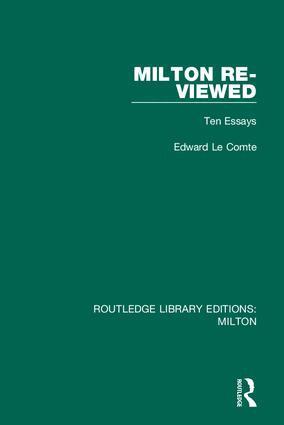
First published in 1991. These ten essays by the distinguished Milton scholar Edward Le Comte examines the various themes, context and structure of Milton’s poetry and prose, including particular focus on both Paradise Lost and Paradise Regained. This title will be of great interest to students of John Milton and English Literature.
552 kr
Skickas inom 10-15 vardagar
First published in 1991. These ten essays by the distinguished Milton scholar Edward Le Comte examines the various themes, context and structure of Milton’s poetry and prose, including particular focus on both Paradise Lost and Paradise Regained. This title will be of great interest to students of John Milton and English Literature.
2 185 kr
Skickas inom 10-15 vardagar
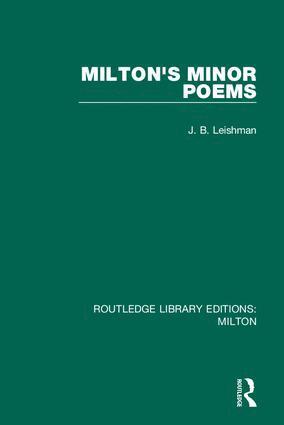
First published in 1969. These nine lectures written by the distinguished scholar J. B. Leishman examines the various themes, context and structure of Milton’s poetry, with particular focus on L’Allegro, Il Penseroso and Lycidas. This title will be of great interest to students of John Milton and English Literature.
583 kr
Skickas inom 10-15 vardagar
First published in 1969. These nine lectures written by the distinguished scholar J. B. Leishman examines the various themes, context and structure of Milton’s poetry, with particular focus on L’Allegro, Il Penseroso and Lycidas. This title will be of great interest to students of John Milton and English Literature.