Software Environments and Tools - Böcker
Visar alla böcker i serien Software Environments and Tools. Handla med fri frakt och snabb leverans.
6 produkter
6 produkter
963 kr
Tillfälligt slut
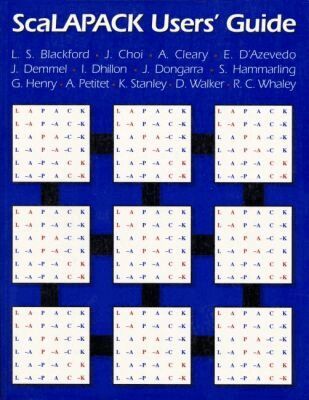
ScaLAPACK is an acronym for Scalable Linear Algebra Package or Scalable LAPACK. It is a library of high-performance linear algebra routines for distributed memory message-passing MIMD computers and networks of workstations supporting parallel virtual machine (PVM) and/or message passing interface (MPI). It is a continuation of the LAPACK project, which designed and produced analogous software for workstations, vector supercomputers, and shared memory parallel computers. Both libraries contain routines for solving systems of linear equations, least squares problems, and eigenvalue problems. The goals of both projects are efficiency, scalability, reliability, portability, flexibility, and ease of use.ScaLAPACK includes routines for the solution of dense, band, and tridiagonal linear systems of equations, condition estimation and iterative refinement, for LU and Cholesky factorization, matrix inversion, full-rank linear least squares problems, orthogonal and generalized orthogonal factorizations, orthogonal transformation routines, reductions to upper Hessenberg, bidiagonal and tridiagonal form, reduction of a symmetric-definite/ Hermitian-definite generalized eigenproblem to standard form, the symmetric/Hermitian, generalized symmetric/Hermitian, and nonsymmetric eigenproblem, and the singular value decomposition. Prototype codes are provided for out-of-core linear solvers for LU, Cholesky, and QR, the matrix sign function for eigenproblems, an HPF interface to a subset of ScaLAPACK routines, and SuperLU.Software is available in single-precision real, double-precision real, single-precision complex, and double-precision complex. The software has been written to be portable across a wide range of distributed-memory environments such as the Cray T3, IBM SP, Intel series, TM CM-5, networks of workstations, and any system for which PVM or MPI is available.Each Users' Guide includes a CD-ROM containing the HTML version of the ScaLAPACK Users' Guide, the source code for ScaLAPACK and LAPACK, testing and timing programs, prebuilt versions of the library for a number of computers, example programs, and the full set of LAPACK Working Notes.
757 kr
Skickas inom 7-10 vardagar
This is the only book on spectral methods built around MATLAB programs. Along with finite differences and finite elements, spectral methods are one of the three main technologies for solving partial differential equations on computers. Since spectral methods involve significant linear algebra and graphics they are very suitable for the high level programming of MATLAB. This hands-on introduction is built around forty short and powerful MATLAB programs, which the reader can download from the World Wide Web. This book presents the key ideas along with many figures, examples, and short, elegant MATLAB programs for readers to adapt to their own needs. It covers ODE and PDE boundary value problems, eigenvalues and pseudospectra, linear and nonlinear waves, and numerical quadrature.
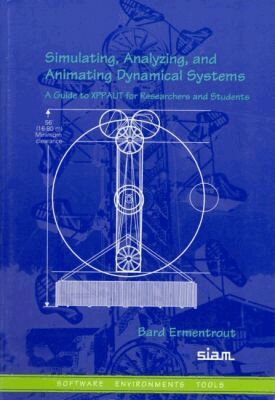
Simulating, Analyzing, and Animating Dynamical Systems
A Guide to XPPAUT for Researchers and Students
Häftad, Engelska, 2002
901 kr
Tillfälligt slut
Provides sophisticated numerical methods for the fast and accurate solution of a variety of equations, including ordinary differential equations, delay equations, integral equations, functional equations, and some partial differential equations, as well as boundary value problems. It introduces many modeling techniques and methods for analyzing the resulting equations.Instructors, students, and researchers will all benefit from this book, which demonstrates how to use software tools to simulate and study sets of equations that arise in a variety of applications. Instructors will learn how to use computer software in their differential equations and modeling classes, while students will learn how to create animations of their equations that can be displayed on the World Wide Web. Researchers will be introduced to useful tricks that will allow them to take full advantage of XPPAUT’s capabilities. In addition, readers will learn several concepts from the field of dynamical systems, including chaos theory, how systems depend on parameters, and how simple physical systems can lead to complicated behavior.XPPAUT is a tool for simulating, animating, and analyzing dynamical systems that evolved from tools developed by the author for studying nonlinear oscillations. XPPAUT offers several advantages over MATLAB, Maple, and Mathematica, including the following: 1) A faster way to numerically solve differential equations and do numerical integration.2) More flexibility with integration, including interactive integration that allows the user to see the progress of the solution as it is computed. 3) An interface with AUTO, a continuation packae.4) Simpler syntax for setting up differentiation equations. 5) Free downloading of the source code.
460 kr
Tillfälligt slut
The second edition of Understanding Search Engines follows the basic premise of the first edition by discussing many of the key design issues for building search engines and emphasizing the important role that applied mathematics can play in improving information retrieval. The authors discuss important data structures, algorithms, and software as well as user-centered issues such as interfaces, manual indexing, and document preparation. Readers will find that the second edition includes significant changes that bring the text up to date on current information retrieval methods. For example, the authors have added a completely new chapter on link-structure algorithms used in search engines such as Google, and the chapter on user interface has been rewritten to specifically focus on search engine usability. To reflect updates in the literature on information retrieval, the authors have added new recommendations for further reading and expanded the bibliography. In addition, the index has been updated and streamlined to make it more reader friendly.
759 kr
Tillfälligt slut
This is the first book on parallel MATLAB and the first parallel computing book focused on the design, code, debug, and test techniques required to quickly produce well-performing parallel programs.MATLAB is currently the dominant language of technical computing with one million users worldwide, many of whom can benefit from the increased power offered by inexpensive multicore and multinode parallel computers. MATLAB is an ideal environment for learning about parallel computing, allowing the user to focus on parallel algorithms instead of the details of implementation.Parallel MATLAB for Multicore and Multinode Computers covers more parallel algorithms and parallel programming models than any other parallel programming book due to the succinctness of MATLAB. It presents a hands-on approach with numerous example programs; wherever possible, the examples are drawn from widely known and well-documented parallel benchmark codes that are representative of many real applications across the field of technical computing.
1 230 kr
Skickas inom 7-10 vardagar
This book is a guide to concepts and practice in numerical algebraic geometry - the solution of systems of polynomial equations by numerical methods. Through numerous examples, the authors show how to apply the well-received and widely used open-source Bertini software package to compute solutions, including a detailed manual on syntax and usage options. The authors also maintain a complementary web page where readers can find supplementary materials and Bertini input files.Numerically Solving Polynomial Systems with Bertini approaches numerical algebraic geometry from a user's point of view with numerous examples of how Bertini is applicable to polynomial systems. It treats the fundamental task of solving a given polynomial system and describes the latest advances in the field, including algorithms for intersecting and projecting algebraic sets, methods for treating singular sets, the nascent field of real numerical algebraic geometry, and applications to large polynomial systems arising from differential equations.Those who wish to solve polynomial systems can start gently by finding isolated solutions to small systems, advance rapidly to using algorithms for finding positive-dimensional solution sets (curves, surfaces, etc.), and learn how to use parallel computers on large problems. These techniques are of interest to engineers and scientists in fields where polynomial equations arise, including robotics, control theory, economics, physics, numerical PDEs, and computational chemistry.