• Fri frakt över 249 kr
  • •
  • Snabba leveranser
  • •
  • Billiga böcker
Kundservice

Du är på sajten för privatpersoner.

Företag, bibliotek eller offentlig verksamhet?

Du handlar på classic.bokus.com, där alla dina funktioner finns intakta.
Till classic.bokus.com
Bokus logotyp. Gå till startsidan.
  • Erbjudanden
  • Student
  • Topplistor
  • Barn & ungdom
  • Bokus Play
  • E-böcker
  • Ljudböcker
  • Pocketböcker
  • Spel & pussel

10% rabatt på allt med kod NYSTART10 →

Sidfot

Mina sidor

    Hjälp

    • Kundservice
    • Vanliga frågor och svar
    • Frakt och leverans
    • Retur vid ångerrätt
    • Reklamera vara
    • Betalning
    • Köpvillkor
    • Allmänna villkor
    • Information om webbplatsens tillgänglighet

    Om Bokus

    • Om oss
    • Pressrum
    • För studenter
    • För företag
    • För bibliotek och offentlig verksamhet
    • För leverantörer
    • Hållbarhet

    Populärt

    • Aktuella erbjudanden
    • Presentkort
    • Studentlitteratur
    • Nya böcker
    • Topplistor
    • Signerade böcker
    • Engelska böcker

    Inspiration

    • Boktips
    • BookTok
    • Populära bokserier
    • Barnbokskaraktärer
    • Populära författare
    Logotyp för Bokus
    Följ oss på Facebook (extern länk)Följ oss på Instagram (extern länk)Följ oss på YouTube (extern länk)Följ oss på TikTok (extern länk)
    bokus @ CookiesAnpassa cookiesIntegritetspolicyKöpvillkor
    Till Citymail hemsida (extern länk)Till Budbee hemsida (extern länk)Till Postnord hemsida (extern länk)Till Schenker hemsida (extern länk)Till Early Bird hemsida (extern länk)Till Walleys hemsida (extern länk)
    1. Data och IT
    2. Systemvetenskap och AI

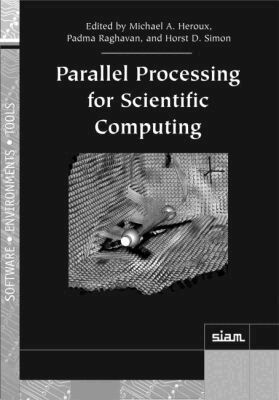
    Parallel Processing for Scientific Computing

    AvMichael A. Heroux,Padma Raghavan

    Häftad, Engelska, 2006

    Del i serien Software Environments and Tools

    1 429 kr

    Beställningsvara. Skickas inom 5-8 vardagar. Fri frakt över 249 kr.

    Beskrivning

    Scientific computing has often been called the third approach to scientific discovery, emerging as a peer to experimentation and theory. Historically, the synergy between experimentation and theory has been well understood: experiments give insight into possible theories, theories inspire experiments, experiments reinforce or invalidate theories, and so on. As scientific computing has evolved to produce results that meet or exceed the quality of experimental and theoretical results, it has become indispensable.Parallel processing has been an enabling technology in scientific computing for more than 20 years. This book is the first in-depth discussion of parallel computing in 10 years; it reflects the mix of topics that mathematicians, computer scientists, and computational scientists focus on to make parallel processing effective for scientific problems. Presently, the impact of parallel processing on scientific computing varies greatly across disciplines, but it plays a vital role in most problem domains and is absolutely essential in many of them. Parallel Processing for Scientific Computing is divided into four parts: The first concerns performance modeling, analysis, and optimization; the second focuses on parallel algorithms and software for an array of problems common to many modeling and simulation applications; the third emphasizes tools and environments that can ease and enhance the process of application development; and the fourth provides a sampling of applications that require parallel computing for scaling to solve larger and realistic models that can advance science and engineering.

    Produktinformation

    • Utgivningsdatum:2006-11-30
    • Mått:152 x 229 x 19 mm
    • Vikt:848 g
    • Format:Häftad
    • Språk:Engelska
    • Serie:Software Environments and Tools
    • Antal sidor:421
    • Förlag:Society for Industrial & Applied Mathematics,U.S.
    • ISBN:9780898716191

    Utforska kategorier

    • Systemvetenskap och AI inom Data och IT

    Mer om författaren

    Michael A. Heroux is the Solvers Project Leader at Sandia National Laboratory; his work focuses on new algorithm development and robust parallel implementation of solver components. He leads development of the Trilinos Project, an effort to provide solution methods in a state-of-the-art software framework. He also maintains an active interest in the interaction between scientific/engineering applications and high-performance computer architectures. Padma Raghavan is a Professor in the Department of Computer Science and Engineering at Pennsylvania State University. Her research interests include parallel and distributed computing, sparse matrix graph techniques and their applications, and software environments and component architectures for large-scale computational materials science. Horst D. Simon is Associate Laboratory Director for Computing Sciences at Lawrence Berkeley National Laboratory. His recursive spectral bisection algorithm is regarded as a breakthrough in parallel algorithms for unstructured computations, and he was honored for his algorithm research efforts with the 1988 Gordon Bell Prize for parallel processing research.

    Innehållsförteckning

    • List of FiguresList of TablesPrefaceChapter 1: Frontiers of Scientific Computing: An OverviewPart I: Performance Modeling, Analysis and Optimization. Chapter 2: Performance Analysis: From Art to ScienceChapter 3: Approaches to Architecture-Aware Parallel Scientific ComputationChapter 4: Achieving High Performance on the BlueGene/L SupercomputerChapter 5: Performance Evaluation and Modeling of Ultra-Scale SystemsPart II: Parallel Algorithms and Enabling Technologies. Chapter 6: Partitioning and Load BalancingChapter 7: Combinatorial Parallel and Scientific ComputingChapter 8: Parallel Adaptive Mesh RefinementChapter 9: Parallel Sparse Solvers, Preconditioners, and Their ApplicationsChapter 10: A Survey of Parallelization Techniques for Multigrid SolversChapter 11: Fault Tolerance in Large-Scale Scientific ComputingPart III: Tools and Frameworks for Parallel Applications. Chapter 12: Parallel Tools and Environments: A SurveyChapter 13: Parallel Linear Algebra SoftwareChapter 14: High-Performance Component Software SystemsChapter 15: Integrating Component-Based Scientific Computing SoftwarePart IV: Applications of Parallel Computing. Chapter 16: Parallel Algorithms for PDE-Constrained OptimizationChapter 17: Massively Parallel Mixed-Integer ProgrammingChapter 18: Parallel Methods and Software for Multicomponent SimulationsChapter 19: Parallel Computational BiologyChapter 20: Opportunities and Challenges for Parallel Computing in Science and EngineeringIndex.