Springer Advanced Texts in Life Sciences - Böcker
Visar alla böcker i serien Springer Advanced Texts in Life Sciences. Handla med fri frakt och snabb leverans.
6 produkter
6 produkter
906 kr
Skickas inom 10-15 vardagar
Succession-nothing in plant, community, or ecosystem ecology has been so elaborated by terminology, so much reviewed, and yet so much the center of controversy. In a general sense, every ecologist uses the concept in teaching and research, but no two ecologists seem to have a unified concept of the details of succession. The word was used by Thoreau to describe, from a naturalist's point of view, the general changes observed during the transition of an old field to a forest. As data accumulated, a lengthy taxonomy of succession developed around early twentieth century ecologists such as Cooper, Clements, and Gleason. Now, nearer the end of the century, and after much discussion concerning the nature of vegetation communities, where do ecologists stand with respect to knowledge of ecological succession? The intent of this book is not to rehash classic philosophies of succession that have emerged through the past several decades of study, but to provide a forum for ecologists to present their current research and present-day interpretation of data. To this end, we brought together a group of scientists currently studying terrestrial plant succession, who represent research experience in a broad spectrum of different ecosystem types. The results of that meeting led to this book, which presents to the reader a unique summary of contemporary research on forest succession.
536 kr
Skickas inom 10-15 vardagar
The objective of this book is to make analytical methods available to students of ecology. The text deals with concepts of energy exchange, gas exchange, and chemical kinetics involving the interactions of plants and animals with their environments. The first four chapters are designed to show the applications of biophysical ecology in a preliminary, sim plified manner. Chapters 5-10, treating the topics of radiation, convec tion, conduction, and evaporation, are concerned with the physical environment. The spectral properties of radiation and matter are thoroughly described, as well as the geometrical, instantaneous, daily, and annual amounts of both shortwave and longwave radiation. Later chapters give the more elaborate analytical methods necessary for the study of photosynthesis in plants and energy budgets in animals. The final chapter describes the temperature responses of plants and animals. The discipline of biophysical ecology is rapidly growing, and some important topics and references are not included due to limitations of space, cost, and time. The methodology of some aspects of ecology is illustrated by the subject matter of this book. It is hoped that future students of the subject will carry it far beyond its present status. Ideas for advancing the subject matter of biophysical ecology exceed individual capacities for effort, and even today, many investigators in ecology are studying subjects for which they are inadequately prepared. The potential of modern science, in the minds and hands of skilled investigators, to of the interactions of organisms with their advance our understanding environment is enormous.
536 kr
Skickas inom 10-15 vardagar
The rapid increase in environmental measurements during the past few decades is associated with (1) increasing awareness of the complex relations linking biological responses to atmospheric variables, (2) development of improved data acquisition and handling equipment, (3) the application of modeling to environmental problems, and (4) the implementation of large, cooperative studies of international scope. The consequences of man's possible alteration of the environment have increased our interest in the complex nature of biological responses to meteorological variables. This has generated activity in both measurements and in the application of modeling techniques. The virtual explosion of modeling activity is also associated with the development oflarge computers. The testing of these models has demonstrated the need for more, different, and better environmental data. In addition, technological developments, such as integrated circuits, have reduced the cost, power consumption, and complexity of data acquisition systems, thus promoting more environmental measurements. The emergence of scientific cooperation on a global scale has increased measurement activities markedly. The International Geophysical Year (1958) has been followed by the International Hydrologic Decade, the Inter national Biological Program, the Global Atmospheric Research Program, and a host of environmental studies of a regional nature that have all emphasized field data collection.
536 kr
Skickas inom 10-15 vardagar
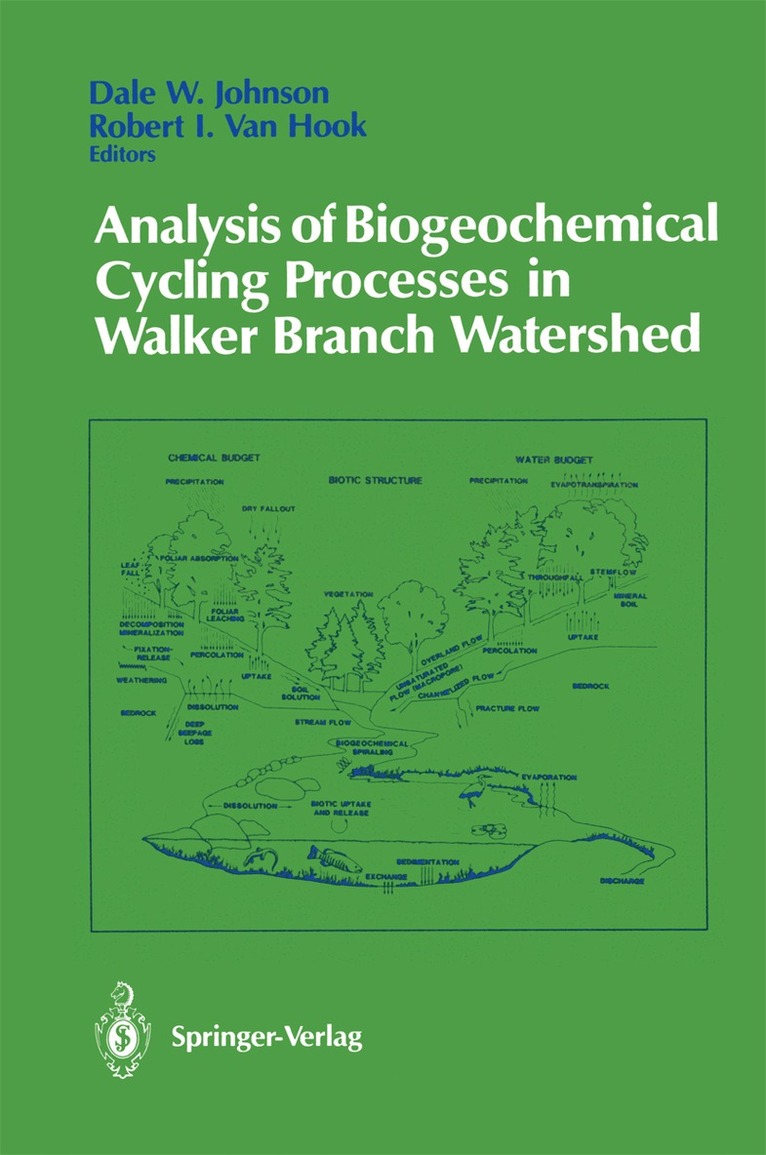
The Oak Ridge National Laboratory's Environmental Sciences Division initiated the Walker Branch Watershed Project on the Oak Ridge Reservation in east Tennessee in 1967, with the support of the U. S. Department of Energy's Office of Health and Environmental Research (DOE/OHER), to quantify land-water interactions in a forested landscape. It was designed to focus on three principal objectives: (1) to develop baseline data on unpolluted ecosystems, (2) to contribute to our knowledge of cycling and loss of chemical elements in natural ecosystems, and (3) to provide the understanding necessary for the construction of mathe matical simulation models for predicting the effects of man's activities on forested landscapes. In 1969, the International Biological Program's Eastern Deciduous Forest Biome Project was initiated, and Walker Branch Watershed was chosen as one of several sites for intensive research on nutrient cycling and biological productivity. This work was supported by the National Science Foundation (NSF). Over the next 4 years, intensive process-level research on primary productivity, decomposition, and belowground biological processes was coupled with ongoing DOE-supported work on the characterization of basic geology and hydrological cycles on the watershed. In 1974, the NSF's RANN Program (Research Applied to National Needs) began work on trace element cycling on Walker Branch Wa tershed because of the extensive data base being developed under both DOE and NSF support.
536 kr
Skickas inom 10-15 vardagar
Ecotoxicology is the science that seeks to predict the impacts of chemi cals upon ecosystems. This involves describing and predicting ecological changes ensuing from a variety of human activities that involve release of xenobiotic and other chemicals to the environment. A fundamental principle of ecotoxicology is embodied in the notion of change. Ecosystems themselves are constantly changing due to natural processes, and it is a challenge to distinguish the effects of anthropogenic activities against this background of fluctuations in the natural world. With the frustratingly large, diverse, and ever-emerging sphere of envi ronmental problems that ecotoxicology must address, the approaches to individual problems also must vary. In part, as a consequence, there is no established protocol for application of the science to environmental prob lem-solving. The conceptual and methodological bases for ecotoxicology are, how ever, in their infancy, and thus still growing with new experiences. In deed, the only robust generalization for research on different ecosystems and different chemical stresses seems to be a recognition of the necessity of an ecosystem perspective as focus for assessment. This ecosystem basis for ecotoxicology was the major theme of a previous pUblication by the Ecosystems Research Center at Cornell University, a special issue of Environmental Management (Levin et al. 1984). With that effort, we also recognized an additional necessity: there should be a continued develop ment of methods and expanded recognition of issues for ecotoxicology and for the associated endeavor of environmental management.
536 kr
Skickas inom 10-15 vardagar
Ecological Microcosms is a seminal work which reviews the expanding field of enclosed ecosystem research, and relates the results and models of microcosm studies to general concepts in ecology. Microcosms are miniaturized pieces of our biosphere, ranging from streams and lakes to terraria, agroecosystems, and waste systems. The study of these simplified ecosystems is providing provocative insights into ecological principles as well as issues of environmental management and global stability. The authors have used the well-known thermodynamic approach of H.T. Odum and numerous computer simulations. The book also includes an evaluation of alternative mesocosm approaches for the support of humans in space, as well as appendices to aid in the teaching of environmental concepts using student-created microcosms. Ecological Microcosms will be of interest to ecologists, environmental engineers, policy makers and environmental managers, space scientists, and educators. Robert J. Beyers is a Professor of Biology at the University of South Alabama. Howard T. Odum is Graduate Research Professor of Environmental Engineering Sciences at the University of Florida, and was awarded, with Eugene Odum, the 1987 Crafoord Prize in the Biosciences.