• Fri frakt över 249 kr
  • •
  • Snabba leveranser
  • •
  • Billiga böcker
Kundservice

Du är på sajten för privatpersoner.

Företag, bibliotek eller offentlig verksamhet?

Du handlar på classic.bokus.com, där alla dina funktioner finns intakta.
Till classic.bokus.com
Bokus logotyp. Gå till startsidan.
  • Erbjudanden
  • Nyheter
  • Student
  • Topplistor
  • Barn & ungdom
  • Bokus Play
  • E-böcker
  • Pocketböcker
  • Spel & pussel

10% rabatt på allt med kod: NYSTART10 →

Sidfot

Mina sidor

    Hjälp

    • Kundservice
    • Vanliga frågor och svar
    • Frakt och leverans
    • Retur vid ångerrätt
    • Reklamera vara
    • Betalning
    • Köpvillkor
    • Allmänna villkor
    • Information om webbplatsens tillgänglighet

    Om Bokus

    • Om oss
    • Pressrum
    • För studenter
    • För företag
    • För bibliotek och offentlig verksamhet
    • För leverantörer
    • Hållbarhet

    Populärt

    • Aktuella erbjudanden
    • Presentkort
    • Studentlitteratur
    • Nya böcker
    • Topplistor
    • Signerade böcker
    • Engelska böcker

    Inspiration

    • Boktips
    • BookTok
    • Populära bokserier
    • Barnbokskaraktärer
    • Populära författare
    Logotyp för Bokus
    Följ oss på Facebook (extern länk)Följ oss på Instagram (extern länk)Följ oss på YouTube (extern länk)Följ oss på TikTok (extern länk)
    bokus @ CookiesAnpassa cookiesIntegritetspolicyKöpvillkor
    Till Citymail hemsida (extern länk)Till Budbee hemsida (extern länk)Till Postnord hemsida (extern länk)Till Schenker hemsida (extern länk)Till Early Bird hemsida (extern länk)Till Walleys hemsida (extern länk)
    1. Naturvetenskap och teknik
    2. Geovetenskap
    3. Geovetenskap

    Analysis of Biogeochemical Cycling Processes in Walker Branch Watershed

    AvDale W. Johnson,Robert I. Van Hook

    Häftad, Engelska, 2011

    Del i serien Springer Advanced Texts in Life Sciences

    547 kr

    Beställningsvara. Skickas inom 10-15 vardagar. Fri frakt över 249 kr.

    Beskrivning

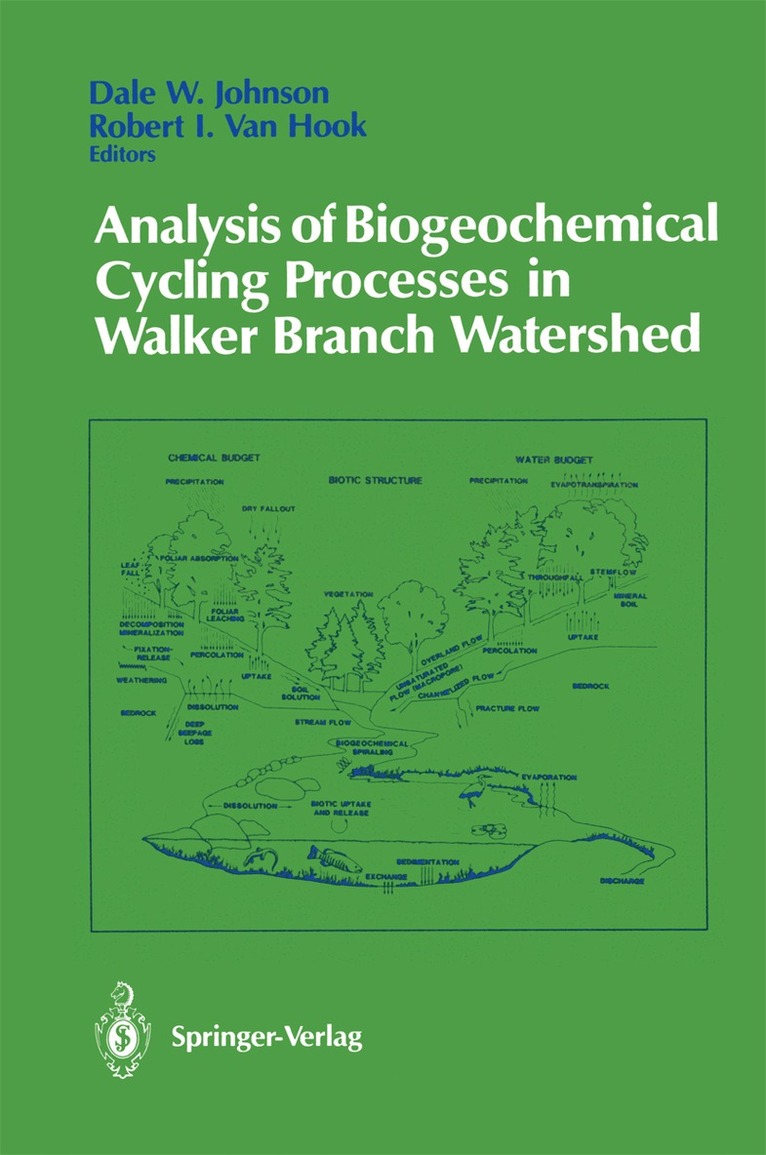
    The Oak Ridge National Laboratory's Environmental Sciences Division initiated the Walker Branch Watershed Project on the Oak Ridge Reservation in east Tennessee in 1967, with the support of the U. S. Department of Energy's Office of Health and Environmental Research (DOE/OHER), to quantify land-water interactions in a forested landscape. It was designed to focus on three principal objectives: (1) to develop baseline data on unpolluted ecosystems, (2) to contribute to our knowledge of cycling and loss of chemical elements in natural ecosystems, and (3) to provide the understanding necessary for the construction of mathe­ matical simulation models for predicting the effects of man's activities on forested landscapes. In 1969, the International Biological Program's Eastern Deciduous Forest Biome Project was initiated, and Walker Branch Watershed was chosen as one of several sites for intensive research on nutrient cycling and biological productivity. This work was supported by the National Science Foundation (NSF). Over the next 4 years, intensive process-level research on primary productivity, decomposition, and belowground biological processes was coupled with ongoing DOE-supported work on the characterization of basic geology and hydrological cycles on the watershed. In 1974, the NSF's RANN Program (Research Applied to National Needs) began work on trace element cycling on Walker Branch Wa­ tershed because of the extensive data base being developed under both DOE and NSF support.

    Produktinformation

    • Utgivningsdatum:2011-09-26
    • Mått:155 x 235 x 23 mm
    • Vikt:639 g
    • Format:Häftad
    • Språk:Engelska
    • Serie:Springer Advanced Texts in Life Sciences
    • Antal sidor:401
    • Förlag:Springer-Verlag New York Inc.
    • ISBN:9781461281344

    Utforska kategorier

    • Geovetenskap inom Naturvetenskap och teknik
    • Biovetenskap inom Naturvetenskap och teknik
    • Skogsbruk inom Naturvetenskap och teknik

    Innehållsförteckning

    • 1 Introduction.- 2 Site Description.- 2.1 Location.- 2.2 Climate.- 2.3 Air Quality.- 2.4 Geology.- 2.5 Soils.- 2.6 Vegetation.- 2.7 Land-Use History.- References.- 3 Forest Meteorology.- 3.1 Introduction.- 3.2 Site Description.- 3.3 Characterization of Boundary Conditions.- 3.4 Canopy Radiation Transfers and Regimes.- 3.5 Canopy-Atmosphere Turbulent Exchange.- References.- 4 Atmospheric Chemistry, Deposition, and Canopy Interactions.- 4.1 Introduction.- 4.2 Methodology.- 4.3 Major Ions.- 4.4 Trace Metals.- References.- 5 Water.- 5.1 Introduction.- 5.2 Hydrologie Features.- 5.3 Hydrologie Monitoring.- 5.4 Annual Water Budget.- 5.5 Precipitation.- 5.6 Soil-Plant-Atmosphere Processes.- 5.7 Streamflow.- 5.8 Watershed Comparisons.- 5.9 Summary.- References.- 6 Carbon Dynamic and Productivity.- 6.1 Introduction.- 6.2 Forest Biomass and Productivity.- 6.3 Carbon Fluxes.- 6.4 Comparisons with Other Forests.- 6.5 Summary and Conclusions.- References.- 7 Terrestrial Nutrient Cycling.- 7.1 Introduction.- 7.2 Nutrient Cycles: Basic Characteristics.- 7.3 Perturbations.- 7.4 Comparison of Walker Branch Watershed with Other Forest Ecosystems.- 7.5 Summary and Conclusions.- References.- 8 Streams: Water Chemistry and Ecology.- 8.1 Introduction.- 8.2 Site Description.- 8.3 Stream Water Chemistry.- 8.4 Nutrient Limitation and Phosphorus Spiraling.- 8.5 Summary.- References.- 9 Modeling Chemical Transport, Uptake, and Effects in the Soil-Plant-Litter System.- 9.1 Introduction.- 9.2 Landscape Context.- 9.3 Modeling the Soil-Plant-Litter System.- 9.4 Model Applications.- 9.5 Pollutants and the Diurnal Cycle.- 9.6 Walker Branch Watershed Perspective.- 9.7 Summary.- References.- 10 Implications of Walker Branch Watershed Research.- References.