SpringerBriefs in Information Security and Cryptography - Böcker
Visar alla böcker i serien SpringerBriefs in Information Security and Cryptography. Handla med fri frakt och snabb leverans.
5 produkter
5 produkter
Introduction to Secret Sharing
A Systematic Overview and Guide for Protocol Selection
Häftad, Engelska, 2023
497 kr
Skickas inom 10-15 vardagar
This book provides an introduction to secret sharing, a key technology for practical applications and higher-level cryptographic protocols.
552 kr
Skickas inom 10-15 vardagar
The main research in this field is to define new algorithms for coding that detects and corrects errors, random codes, stream ciphers, block ciphers, pseudo-random generators, hash functions, etc. These codes are a combination of cryptographic algorithms and error-correcting codes and depend on several parameters.
588 kr
Skickas inom 10-15 vardagar
The current digital signature methods like RSA, DSA, and ECDSA are relatively simple to understand, and their signing and verification processes operate in comparable time frames. However, in the quantum computing era, cryptographic methods must be designed to withstand both classical and quantum attacks. This requires an in-depth understanding of advanced mathematical concepts like algebraic geometry, lattice theory, Gaussian sampling, and efficient polynomial computation techniques such as FFT and NTT, which are essential for lattice-based cryptosystems.The FALCON algorithm, chosen as a finalist in the NIST Post-Quantum Cryptography (PQC) standardization project, is a lattice-based, hash-and-sign digital signature scheme known for its efficiency and compactness compared to other quantum-resistant signatures like Dilithium and SPHINCS+. Following FALCON’s development, the SOLMAE algorithm was introduced in 2021, offering a simplified signing process within the same GPV framework and also implemented in Python for easier accessibility.This monograph provides a practical and educational introduction to post-quantum digital signatures, focusing on the FALCON and SOLMAE algorithms. The material aims to bridge the gap between theory and practice, offering hands-on knowledge of post-quantum cryptographic techniques. With a focus on clear, practical examples using Python, this book is a valuable resource for anyone looking to understand or implement quantum-secure digital signatures.
608 kr
Kommande
Secure computation allows any number of mutually distrustful parties to jointly run anarbitrary computation on their combined inputs without compromising their privacy. Securecomputation offers a theoretical solution to a vast array of problems where one wishes tosimultaneously maintain a fine-grained control over the users’ privacy and have flexibilityin how their data is used in a protocol. Over the past decade, secure computation haslargely emerged from the depth of theoretical research to enter the realm of practically-usabletechnologies, and secure protocols are now routinely implemented and deployed. This isthe result of a widespread and ongoing research effort from the cryptography community,which has produced a diverse ecosystem of protocols and paradigms optimized for a varietyof concrete applications. This book covers one such recent paradigm, the area of silentsecure computation, which strikes a careful balance between communication and computationoverheads. This paradigm has recently emerged as a promising path towards fast securecomputation in bandwidth-restricted settings, and has had a significant influence on thelandscape of practical secure computation. The goal of the book is to provide an accessibleintroduction to silent secure computation. It is aimed at Ph.D. students and researchersin cryptography and has a strong focus on explaining the intuitions and giving the readera sense of scale, in the hope of conveying insights about the practicality of silent securecomputation in various contexts and to give a clear overview of some of the core challengesin the field.
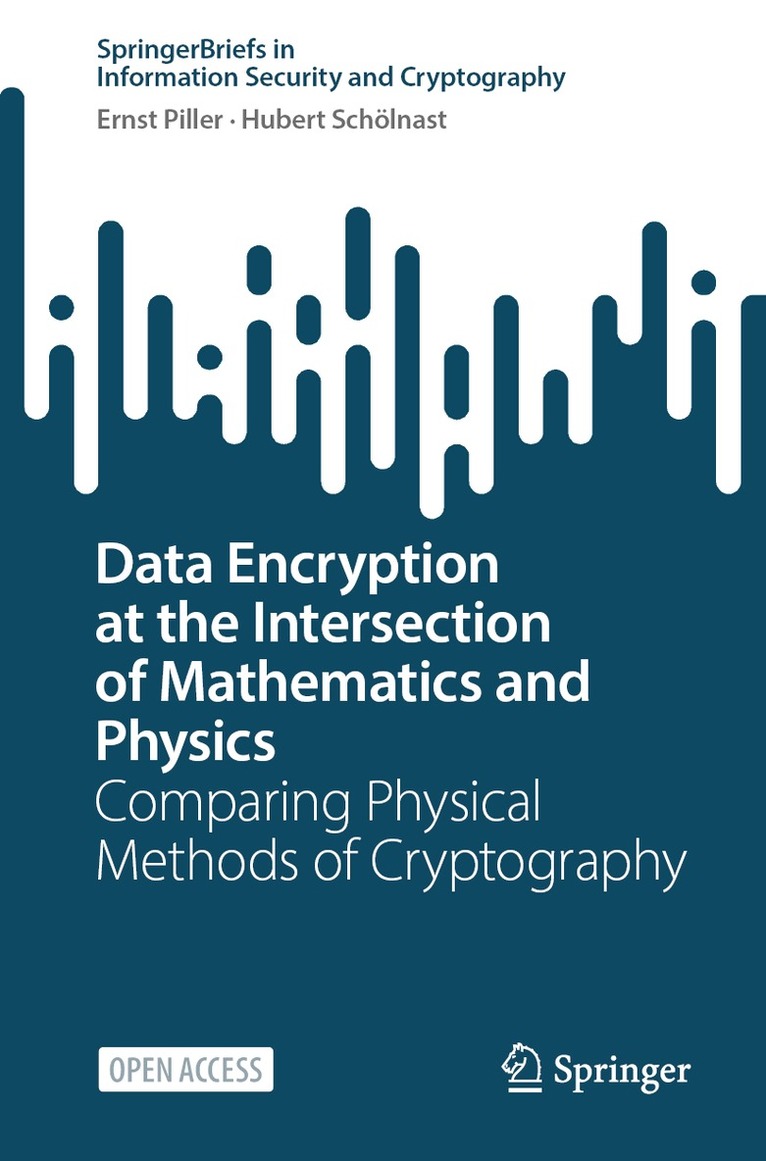
Data Encryption at the Intersection of Mathematics and Physics
Comparing Physical Methods of Cryptography
Häftad, Engelska, 2026
572 kr
Kommande
Data is becoming increasingly important, and so is data security. This book is aimed at anyone interested in high data security in telecommunications and data storage, especially IT security experts, procurers, decision-makers, consultants, and computer scientists. Anyone involved in procurement in this field makes decisions about algorithms, technologies, and providers, and thus also about infrastructure and security. The generation and distribution of keys for data encryption play a central role in this. Because security assessments for mathematical methods are based on assumptions, physical methods are becoming interesting in the high-security sector. They promise to link security more closely to the laws of nature. This raises the key question: Which technology is suitable for which application scenario, and what assumptions, costs, and operational risks are involved?This book provides answers and, for the first time, compares QKD (Quantum Key Distribution), RKD (Radio-signal Key Distribution), and MKD (Memory Key Distribution) within a common, transparent criteria framework: technology-neutral, practical, and easy to understand. The evaluation covers secret key rates, range/attenuation, robustness, costs, infrastructure, portability, standardization, IT security, and security risks (implementation, integration, post-processing, side channels). The evaluations are deliberately presented not as a ranking, but as a decision-making aid.The book will be published in print and as open access.QKD derives its security from the laws of quantum physics, but secret key rates decrease with increasing attenuation. Key management systems connect short QKD distances over longer distances, but only at the cost of additional attack surfaces ("trusted nodes"). Its use for mobile applications fails due to a lack of technical maturity. Very high financial costs and high maintenance requirements for QKD solutions make them unattractive in high-security environments.RKD utilizes the reciprocal physical properties of a radio link and scores points for its low technical complexity, excellent suitability for mobile applications (e.g., vehicles or drones), and very low costs. However, RKD falls far short of the key rates achieved by QKD solutions and is still limited to shorter distances. In addition, there is no established infrastructure for distributing key material to more than two partners.MKD takes a completely different approach: each party produces key material, stores it on a data carrier, and transports it physically to the other party. Because MKD can securely transfer 16 TB of key material in a single transport, only MKD has the potential to continuously provide a one-time pad (OTP) and thus provably 100% secure data encryption. The price is organizational responsibility: secure generation, storage, transport, and documented chain of custody.The book examines data security for telecommunications and data storage, discusses encryption modes for OTP, and addresses the question of when "OTP proximity" makes more sense than theoretical purity. The result of approximately one year of source-critical research and the comparison of literature, manufacturer specifications, and practical observations with systematic cross-checking and our own R&D activities, this book helps to justify architecture and procurement decisions, locate risks (side channels, misconfigurations, logistical vulnerabilities), and separate "security gains" from "new attack surfaces."