Studies in Early Modern English Literature – Serie
Visar alla böcker i serien Studies in Early Modern English Literature. Handla med fri frakt och snabb leverans.
8 produkter
8 produkter
1 492 kr
Skickas inom 10-15 vardagar
Though once a favourite of no fewer than four English monarchs, Restoration playwright Thomas Durfey has long been neglected by scholars. In his own day he had a lowly reputation in the world of polite letters - before his death his plays had more or less ceased to be produced; his 'serious' poems had died long before that, and even his songs were soon thought of as common property or 'folk' songs. In this new study, author John McVeagh re-examines Durfey's literary output, finding merit and interest where it has long been presumed that none existed, and restoring Durfey to his proper place in late 17th- and early 18th-century literature. Durfey's creative lifetime spanned the entire Restoration period and continued into and beyond the reign of Queen Anne. McVeagh's book studies his continuing ability to adapt to shifts in taste, fashion and personnel in the world of the theatre. It examines in detail his numerous experiments in new kinds of dramatic writing, both responding to and influencing the conditions of theatrical and artistic production. Among the topics covered are Durfey's attempts to feminize Restoration comedy, his political satires in drama in the late Stuart years, his anticipations of sentimental comedy, his search for a new language for lower class tragedy, and his musical-dramatic experimentations in the 1680s and 1690s, focusing particularly on his collaborative work with Matthew Locke, Samuel Ackroyde, John Eccles, Daniel and Henry Purcell and other composers. In addition, the author discusses Durfey's numerous satiric, narrative and other poems, and relates his writings to their social, political and cultural contexts. The book includes a performance record, listing the plays by performance date. The record includes such information, if known, as: where it was performed; by what company; cast list; to whom it was dedicated; a brief description of the prologue and epilogue; when it was published; what music it contained; and details of any revivals.
2 430 kr
Skickas inom 10-15 vardagar
The eighteenth century, commonly described as the age of the novel, is also the golden age of travel narratives. In this English edition of Le Récit de voyage en Angleterre au XVIIIe siècle, the genre of the travel narrative receives a treatment based on its development in close relationship with fiction. The book provides a survey of famous travel narratives: James Boswell's journal of a tour to Corsica and account of his trip to Scotland with Samuel Johnson, Laurence Sterne's enigmatic Sentimental Journey, Tobias Smollett's Travels through France and Italy. Negotiating between inventory and invention, these texts invite a reconsideration of conventional generic distinctions. They open up a literary space in which the full significance of the real and fictional journey motif can be explored.
Discourse of Sovereignty, Hobbes to Fielding
The State of Nature and the Nature of the State
Inbunden, Engelska, 2003
2 430 kr
Skickas inom 10-15 vardagar
In this new study the authors examine a range of theories about the state of nature in seventeenth- and eighteenth-century England, considering the contribution they made to the period's discourse on sovereignty and their impact on literary activity. Texts examined include Leviathan, Oceana, Paradise Lost, Discourses Concerning Government, Two Treatises on Government, Don Sebastian, Oronooko, The New Atalantis, Robinson Crusoe, Dissertation upon Parties, David Simple, and Tom Jones. The state of nature is identified as an important organizing principle for narratives in the century running from the Civil War through to the second Jacobite Rebellion, and as a way of situating the author within either a reactionary or a radical political tradition. The Discourse of Sovereignty provides an exciting new perspective on the intellectual history of this fascinating period.
2 430 kr
Skickas inom 10-15 vardagar
Mock-heroic is the exemplary genre of the English Augustan era: it is one of the few genres that the Augustans invented themselves, and it stands in a symbolic relation to a culture still reverential of the grandeurs of the classical past and uneasy about its ability to emulate them. Mock-Heroic from Butler to Cowper shows the protean nature of mock-epic at this time. It recounts the rise of mock-heroic, discusses the properties of the form, and explores its relation both to classical epic and to contemporary genres such as the poetic travesty and the novel. It also tracks the relation of mock-heroic to the concept to the sublime, especially to the low sublime unwittingly perfected by Richard Blackmore. Terry goes beyond previous commentators in arguing that mock-heroic was not merely a conventional genre, but also provided a supple discourse through which writers could represent a range of personal and social issues. He identifies mock-heroic properties in the Mandevillian discourse of economics and in the rhetoric of male gallantry towards women, in which women were simultaneously elevated and put down. He also sees mock-heroic as informing the idea of divine grace in the poetry and letters of William Cowper. Mixing a historical approach with incisive close readings, Terry provides a powerful re-evaluation of the form.
Enlightenment and Romance in James Macpherson’s The Poems of Ossian
Myth, Genre and Cultural Change
Inbunden, Engelska, 2003
2 274 kr
Skickas inom 10-15 vardagar
This study examines the relationship between Enlightenment and romance through the work of James Macpherson and in particular his The Poems of Ossian. By re-reading Macpherson's work in ways not restricted by the sterile and by now largely settled debates over authenticity, Moore establishes Ossian's credentials to be considered as romance, in its manner of construction, its represented sensibility, and in its engagement with the potentialities and limitations of eighteenth-century discourses of sympathy and society. An increasing amount has been written on Macpherson over the last ten or so years, and at last it seems possible to talk about The Poems of Ossian without reference to questions of authenticity or charges of forgery. Yet the polarised debate over the authenticity of the Poems has been superseded by equally polarised arguments about such matters as the cultural significance and politics of Ossian, arguments in which the poems have been used as a convenient peg on which to hang various, often predetermined, positions. Fresh and groundbreaking, this study recentres Ossian revisionism by providing an account of a series of works increasingly talked about, but still little read or understood.
539 kr
Skickas inom 10-15 vardagar
This study addresses the intricate links between oral culture and literate culture in the eighteenth century. Tadié traces how perceptions and representations of language move from a dominance of the spoken work to a dominance of the written word; and this is echoed in the order of the five chapters on conversation, gesture, theatre, fiction, and print. Tadié offers a reading of Sterne's works, arguing that the use of language lies at the centre of Sterne's art; he approaches the historical dimension of the texts in the context of eighteenth-century theories of language. He brings into focus the heterogeneity of Sterne's texts; and he demonstrates how Sterne's awareness for the variations of language links up with his interest in the form of the book, and with the use of all the potentialities of print. The study broaches the issue of the 'rise of the novel' in the eighteenth century. it refuses the idea of progress, or of slow emergence of the novel in the eighteenth century, which would lead progressively from Defoe to the Fielding-Richardson debate, to a possible view of Sterne as the great ironist of the form of the novel. Tadié asserts that Sterne's writings do not simply address the nature of the novel, but they engage with all the forms of language representation made available by the culture of the age.
1 826 kr
Skickas inom 10-15 vardagar
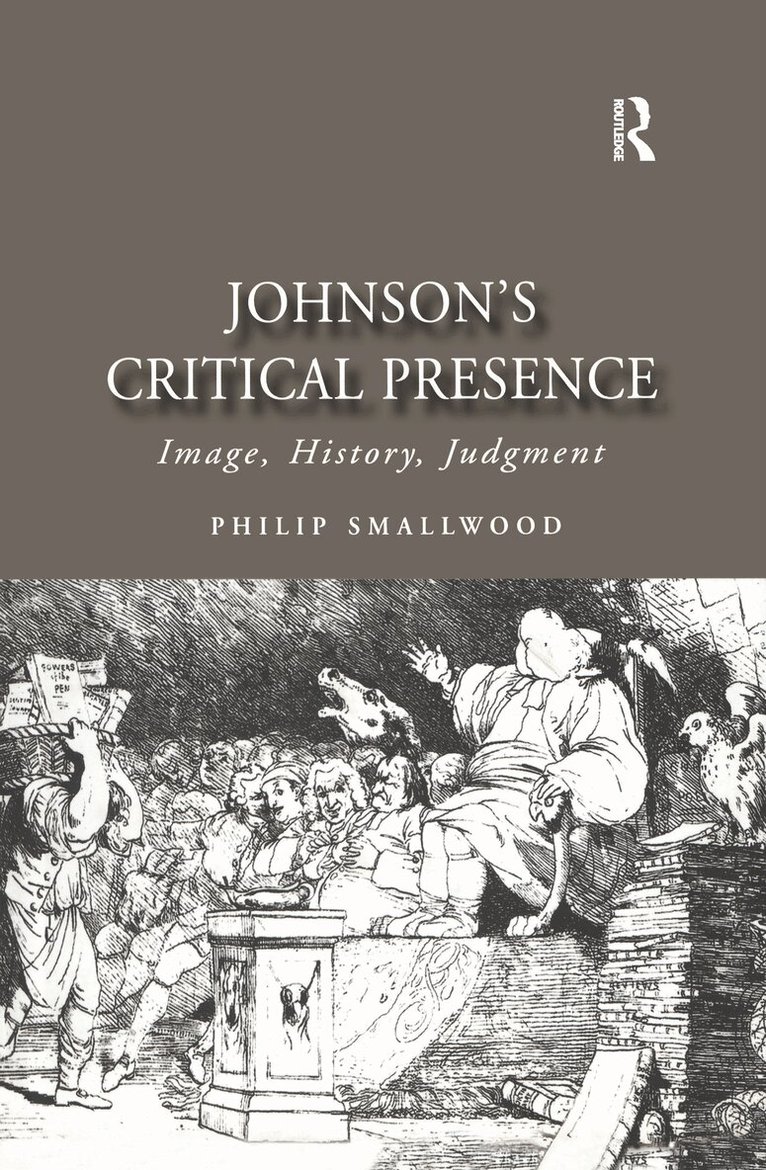
Samuel Johnson remains one of the most frequently discussed and cited of the eighteenth-century critics; but historians of criticism have invariably interpreted his work within conventions that have allowed for little evaluative commerce between the needs of the critical present and the voices of the critical past. Smallwood's argument is that Johnson's alienation from the modern critical scene stems in part from historians' tendency to tell the story of criticism as a narrative of improvement. The image of Johnson conceived by his antagonists in the eighteenth century has been perpetuated by romanticism, by nineteenth-century representational routines and mediated to the present day, most recently, by varieties of 'radical theory'. In Johnson's Critical Presence Smallwood offers a new account of Johnson's major critical writings conceived according to a different kind of historical potential. He suggests that the historicization of eighteenth-century criticism can best be understood in the light of the 'dialogic' and 'translational' historiographies of Collingwood, Gadamer and Ricoeur, and that the explanatory contexts of Johnson's criticism must include poetry in addition to theory; in this his study seeks to displace both the history of ideas as the leading paradigm for the history of criticism and to question the developmental narrative on which it relies. By in-depth analysis of Johnson's response to Shakespeare's plays and to the poetry of Abraham Cowley, Smallwood constructs a non-reductive context of emotional experience for Johnson's criticism. This embraces the dynamic satirical caricatures by James Gillray of Johnson as critic, the irony of Johnson's critical affinities with the major romantics, and is set against twentieth-century responses to the literary 'canon'. Smallwood argues that not only Johnson's emotional sensitivities, but also the ironic voices within the critical text itself, must be fully appreciated before Johnson's current relevance, or even his historical value, can be grasped.
883 kr
Skickas inom 10-15 vardagar
The eighteenth century, commonly described as the age of the novel, is also the golden age of travel narratives. In this English edition of Le Récit de voyage en Angleterre au XVIIIe siècle, the genre of the travel narrative receives a treatment based on its development in close relationship with fiction. The book provides a survey of famous travel narratives: James Boswell's journal of a tour to Corsica and account of his trip to Scotland with Samuel Johnson, Laurence Sterne's enigmatic Sentimental Journey, Tobias Smollett's Travels through France and Italy. Negotiating between inventory and invention, these texts invite a reconsideration of conventional generic distinctions. They open up a literary space in which the full significance of the real and fictional journey motif can be explored.