Studies in the English Renaissance - Böcker
Visar alla böcker i serien Studies in the English Renaissance. Handla med fri frakt och snabb leverans.
9 produkter
9 produkter
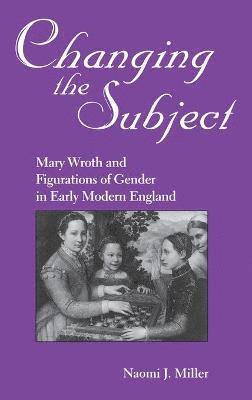
Changing The Subject
Mary Wroth and Figurations of Gender in Early Modern England
Inbunden, Engelska, 1996
567 kr
Skickas inom 3-6 vardagar
Lady Mary Wroth (c. 1587-1653) wrote the first sonnet sequence in English by a woman, one of the first plays by a woman, and the first published work of fiction by an Englishwoman. Yet, despite her status as a member of the distinguished Sidney family, Wroth met with disgrace at court for her authorship of a prose romance, which was adjudged an inappropriate endeavor for a woman and was forcibly withdrawn from publication. Only recently has recognition of Wroth's historical and literary importance been signaled by the publication of the first modern edition of her romance, The Countess of Mountgomeries Urania.Naomi Miller offers an illuminating study of this significant early modern woman writer. Using multiple critical/theoretical perspectives, including French feminism, new historicism, and cultural materialism, she examines gender in Wroth's time. Moving beyond the emphasis on victimization that shaped many previous studies, she considers the range of strategies devised by women writers of the period to establish voices for themselves.Where previous critics have viewed Wroth primarily in relation to her male literary predecessors in the Sidney family, Miller explores Wroth's engagement with a variety of discourses, reading her in relation to a broad range of English and continental authors, both male and female, from Sidney, Spenser, and Shakespeare to Aemilia Lanier, Elizabeth Cary, and Marguerite de Navarre. She also contextualizes Wroth's writing in relation to a variety of nonliterary texts of the period, both political and domestic. Thanks to Miller's sensitive readings, Wroth's writings provide a lens through which to view gender relations in the early modern period.
572 kr
Skickas inom 3-6 vardagar
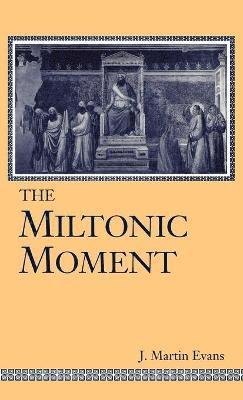
Milton's poems invariably depict the decisive instant in a story, a moment of crisis that takes place just before the action undergoes a dramatic change of course. Such instants look backward to a past that is about to be superseded or repudiated and forward, at the same time, to a future that will immediately begin to unfold. Martin Evans identifies this moment of transition as "the Miltonic Moment." This provocative new study focuses primarily on three of Milton's best known early poems: "On the Morning of Christ's Nativity," "A Mask Presented at Ludlow Castle (Comus)," and "Lycidas." These texts share a distinctive perceptual and cognitive structure, which Evans defines as characteristically Miltonic, embracing a single moment that is both ending and beginning.The poems communicate a profound sense of intermediacy because they seem to take place between the boundaries that separate events. The works illuniated here, which also include Samson Agonistes and Paradise Regained, are all about transition from one form to another: from paganism to Christianity, from youthful inexperience to moral maturity, and from pastoral retirement to heroic engagement. This transformation is often ideological as well as historical or biographical.Evans shows that the moment of transition is characteristic of all Milton's poetry, and he proposes a new way of reading one of the seminal writers of the seventeenth century. Evans concludes that the narrative reversals in Milton's poetry suggest his constant attempts to bring about an intellectual revolution that, at a time of religious and political change in England, would transform an age.
572 kr
Skickas inom 3-6 vardagar
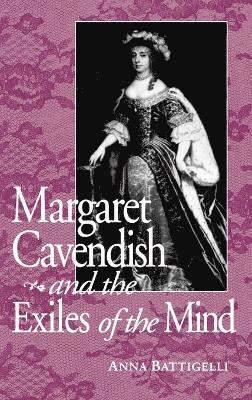
Margaret Cavendish, duchess of Newcastle (1623-1673), led a dramatic life that brought her into contact with kings, queens, and the leading thinkers of her day. The English civil wars forced her into exile, accompanying Queen Henrietta Maria and her court to Paris. From this vantage point, she began writing voluminously, responding to the events and major intellectual movements of the mid-seventeenth century.Cavendish published twenty-three volumes in her lifetime, including plays, romances, poetry, letters, biography, and natural philosophy. In them she explored the political, scientific, and philosophical ideas of her day. While previous biographers of Cavendish have focused almost exclusively on her eccentric public behavior, Anna Battigelli is the first to explore in depth her intellectual life. She dismisses the myth of Cavendish as an isolated and lonely thinker, arguing that the role of exile was a rhetorical stance, one that allowed Cavendish to address and even criticize her world. She, like others writing during the period after the English civil wars, focused squarely on the problem of finding the proper relationship between mind and world. This volume presents Cavendish's writing self, the self she treasured above all others.
492 kr
Skickas inom 3-6 vardagar
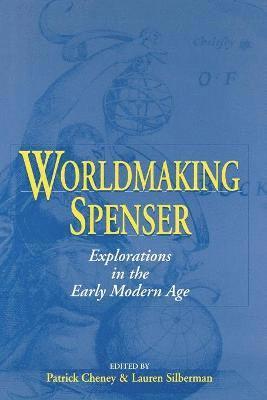
Worldmaking Spenser reexamines the role of Spenser's work in English history and highlights the richness and complexity of his understanding of place. The volume centers on the idea that complex and allusive literary works such as The Faerie Queene must be read in the context of the cultural, literary, political, economic, and ideological forces at play in the highly allegorical poem. The authors define Spenser as the maker of poetic worlds, of the Elizabethan world, and of the modern world. The essays look at Spenser from three distinct vantage points. The contributors explore his literary origins in classical, medieval, and Renaissance continental writings and his influences on sixteenth-century culture. Spenser also had a great impact on later literary figures, including Lady Mary Wroth and Aemilia Lanyer, two of the seventeenth century's most important writers. The authors address the full range of Spenser's work, both long and short poetry as well as prose. The essays unequivocally demonstrate that Spenser occupies a substantial place in a seminal era in English history and European culture.
492 kr
Skickas inom 3-6 vardagar
In this first extensive Jungian treatment of Milton's major poems, James P. Driscoll uses archetypal psychology to explore Milton's great themes of God, man, woman, and evil and offers readers deepened understanding of Jung's profound thoughts on Godhead. The Father, the Son, Satan, Messiah, Samson, Adam, and Eve gain new dimensions of meaning as their stories become epiphanies of the archetypes of Godhead. God and Satan of Paradise Lost are seen as the ego and the shadow of a single unfolding personality whose anima is the Holy Spirit and Milton's muse. Samson carries the Yahweh archetype examined by Jung in Answer to Job, and Messiah and Satan in Paradise Regained embody the hostile brothers archetype. Anima, animus and the individuation drive underlie the psychodynamics of Adam and Eve's fall. Driscoll draws on his critical acumen and scholarly knowledge of Renaissance literature to shed new light on Jung's psychology of religion. The Unfolding God of Jung and Milton illumines Jung's heterodox notion of Godhead as a quarternity rather than a trinity, his revolutionary concept of a divine individuation process, his radical solution to the problem of evil, and his wrestling with the feminine in Godhead. The book's glossary of Jungian terms, written for literary critics and theologians rather than clinicians, is exceptionally detailed and insightful. Beyond enriching our understanding of Jung and Milton, Driscoll's discussion contributes to theodicy, to process theology, and to the study of myths and archetypes in literature.
572 kr
Skickas inom 3-6 vardagar
Literary allegory has deep roots in early reading and interpretation of Scripture and classical epic and myth. In this substantial study, Mindele Treip presents an overview of the history and theory of allegorical exegesis upon Scripture, poetry, and especially the epic from antiquity to the seventeenth and early eighteenth centuries, with close focus on the Renaissance and on the triangular literary relationship of Tasso, Spenser, and Milton.Exploring the different ways in which the term allegory has been understood, Treip finds significant continuities-within-differences in a wide range of critical writings, including texts of postclassical, patristic and rabbinical writers, medieval writers, notably Dante, Renaissance theorists such as Coluccio Salutati, Bacon, Sidney, John Harrington and rhetoricians and mythographers, and the neoclassical critics of Italy, England and France, including Le Bossu. In particular, she traces the evolving theories on allegory and the epic of Torquato Tasso through a wide spectrum of his major discourses, shorter tracts and letters, giving full translations. Treip argues that Milton wrote, as in part did Spenser, within the definitive framework of the mixed historical-allegorical epic erected by Tasso, and she shows Spenser's and Milton's epics as significantly shaped by Tasso's formulations, as well as by his allegorical structures and images in the Gerusalemme liberata. In the last part of her study Treip addresses the complex problematics of reading Paradise Lost as both a consciously Reformation poem and one written within the older epic allegorical tradition, and she also illustrates Milton's innovative use of biblical "Accommodation" theory so as to create a variety of radical allegorical metaphors in his poem. This study brings together a wide range of critical issues -- the Homeric-Virgilian tradition of allegorical reading of epic; early Renaissance theory of all poetry as "translation" or allegorical metaphor; midrashic linguistic techniques in the representation of the Word; Milton's God; neoclassical strictures on Milton's allegory and allegory in general -- all of these are brought together in new and comprehensive perspective.
528 kr
Skickas inom 3-6 vardagar
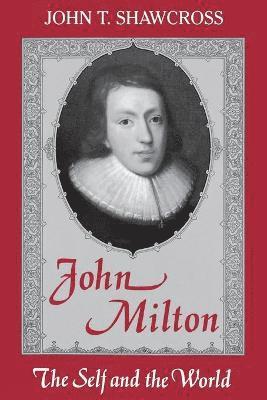
The facts of John Milton's life are well documented, but what of the person Milton -- the man whose poetic and prose works have been deeply influential and are still the subject of opposing readings? John Shawcross's "different" biography depicts the man against a psychological backdrop that brings into relief who he was -- in his works and from his works.While the theories of Freud, Lacan, Kohut, and others underlie this pursuit of Milton's "self," Jung and some of his followers provide the basic understanding by which Shawcross places Milton in the panorama of history. His explorations of the psychological underpinnings of Milton's decision to become a poet, of the homoerotic dimensions of his personality, and of his relationships with father and mother demonstrate the extent to which psychobiography proves itself invaluable as a means to appreciate this complex writer and his complex writings.This biography combines the traditional chronological narrative with a technique akin to that of fiction, "a mixture of times and a triggering of remembrances from various time frames without time differentiations." Such an approach offers a view of Milton "not only in being but in process of being."Shawcross's examination of two current concerns, gender attitudes and political ideologies, ranges Milton's work against the self he exhibits. Specialists and nonspecialists alike will find in this magisterial biography a wealth of new insight into one of the greatest of English poets.
Darke Hierogliphicks
Alchemy in English Literature from Chaucer to the Restoration
Häftad, Engelska, 2008
572 kr
Skickas inom 3-6 vardagar
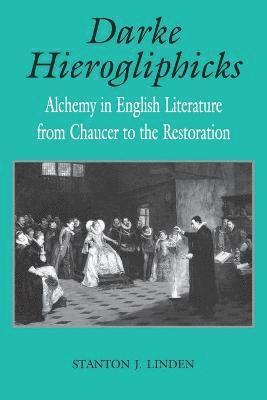
The literary influence of alchemy and hermeticism in the work of most medieval and early modern authors has been overlooked. Stanton Linden now provides the first comprehensive examination of this influence on English literature from the late Middle Ages through the sixteenth and seventeenth centuries. Drawing extensively on alchemical allusions as well as on the practical and theoretical background of the art and its pictorial tradition, Linden demonstrates the pervasiveness of interest in alchemy during this three-hundred-year period. Most writers -- including Langland, Gower, Barclay, Eramus, Sidney, Greene, Lyly, and Shakespeare -- were familiar with alchemy, and references to it appear in a wide range of genres. Yet the purposes it served in literature from Chaucer through Jonson were narrowly satirical. In literature of the seventeenth century, especially in the poetry of Donne, Herbert, Vaughan, and Milton, the functions of alchemy changed. Focusing on Bacon, Donne, Herbert, Vaughan, and Milton -- in addition to Jonson and Butler -- Linden demonstrates the emergence of new attitudes and innovative themes, motifs, images, and ideas. The use of alchemy to suggest spiritual growth and change, purification, regeneration, and millenarian ideas reflected important new emphases in alchemical, medical, and occultist writing. This new tradition did not continue, however, and Butler's return to satire was contextualized in the antagonism of the Royal Society and religious Latitudinarians to philosophical enthusiasm and the occult. Butler, like Shadwell and Swift, expanded the range of satirical victims to include experimental scientists as well as occult charlatans. The literary uses of alchemy thus reveal the changing intellectual milieus of three centuries.
497 kr
Skickas inom 3-6 vardagar
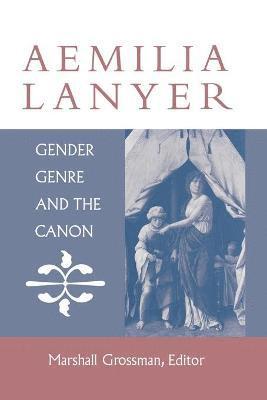
Aemilia Lanyer was a Londoner of Jewish-Italian descent and the mistress of Queen Elizabeth's Lord Chamberlain. But in 1611 she did something extraordinary for a middle-class woman of the seventeenth century: she published a volume of original poems.Using standard genres to address distinctly feminine concerns, Lanyer's work is varied, subtle, provocative, and witty. Her religious poem "Salve Deus Rex Judaeorum" repeatedly projects a female subject for a female reader and casts the Passion in terms of gender conflict. Lanyer also carried this concern with gender into the very structure of the poem; whereas a work of praise usually held up the superiority of its patrons, the good women in Lanyer's poem exemplify worth women in general.The essays in this volume establish the facts of Lanyer's life and use her poetry to interrogate that of her male contemporaries, Donne, Jonson, and Shakespeare. Lanyer's work sheds light on views of gender and class identities in early modern society. By using Lanyer to look at the larger issues of women writers working within a patriarchal system, the authors go beyond the explication of Lanyer's writing to address the dynamics of canonization and the construction of literary history.