Synthesis Lectures on Signal Processing – serie
Visar alla böcker i serien Synthesis Lectures on Signal Processing. Handla med fri frakt och snabb leverans.
20 produkter
20 produkter
Häftad, Engelska, 2007
308 kr
Skickas inom 10-15 vardagar
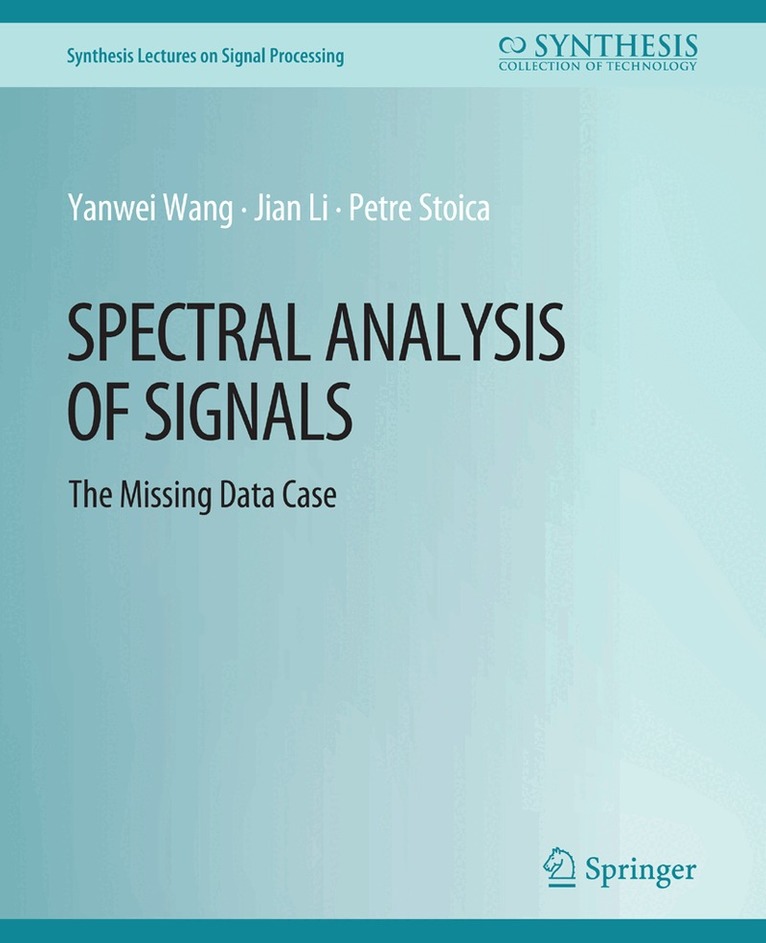
Spectral estimation is important in many fields including astronomy, meteorology, seismology, communications, economics, speech analysis, medical imaging, radar, sonar, and underwater acoustics.
Häftad, Engelska, 2007
362 kr
Skickas inom 10-15 vardagar
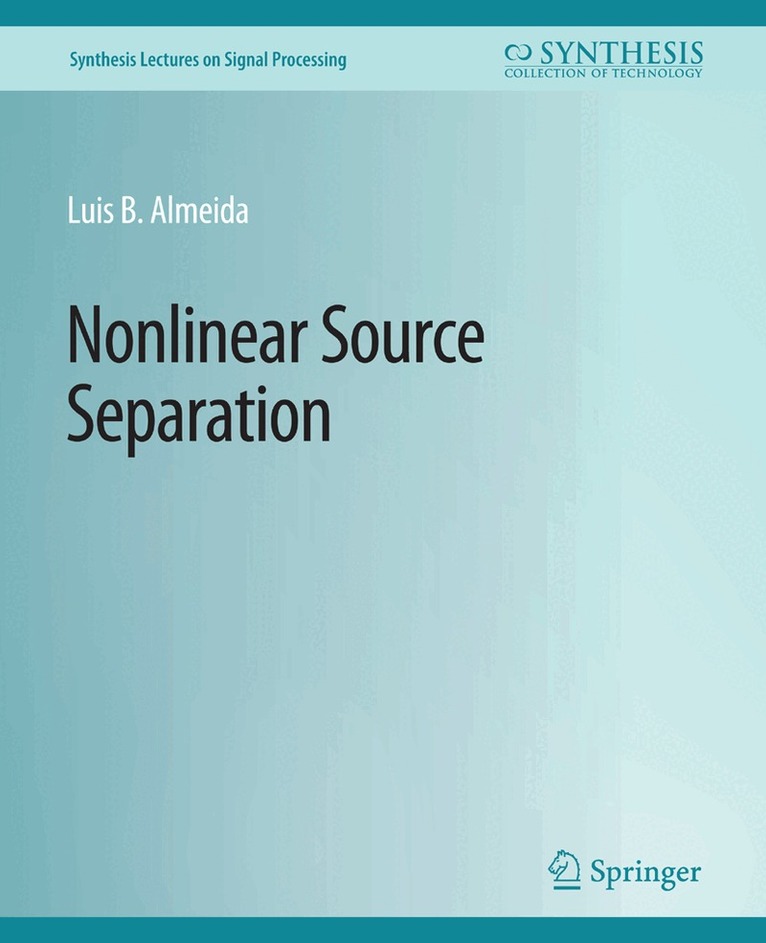
The purpose of this lecture book is to present the state of the art in nonlinear blind source separation, in a form appropriate for students, researchers and developers.
Häftad, Engelska, 2007
362 kr
Skickas inom 10-15 vardagar
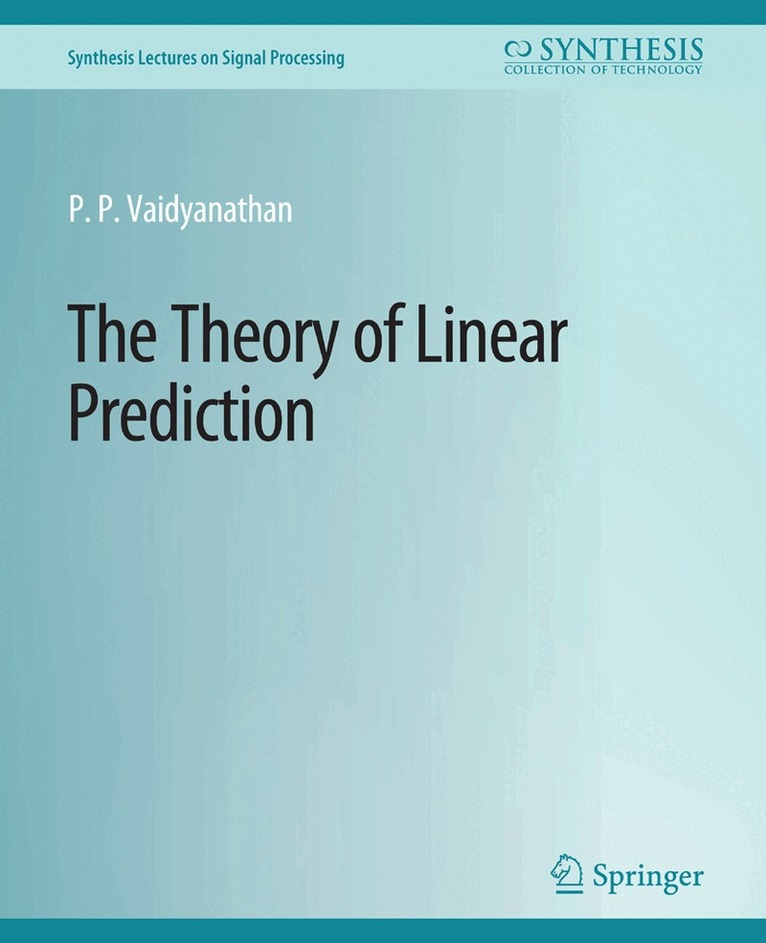
Linear prediction theory has had a profound impact in the field of digital signal processing. Although the theory dates back to the early 1940s, its influence can still be seen in applications today. The theory is based on very elegant mathematics and leads to many beautiful insights into statistical signal processing. Although prediction is only a part of the more general topics of linear estimation, filtering, and smoothing, this book focuses on linear prediction. This has enabled detailed discussion of a number of issues that are normally not found in texts. For example, the theory of vector linear prediction is explained in considerable detail and so is the theory of line spectral processes. This focus and its small size make the book different from many excellent texts which cover the topic, including a few that are actually dedicated to linear prediction. There are several examples and computer-based demonstrations of the theory. Applications are mentioned wherever appropriate, but the focus is not on the detailed development of these applications. The writing style is meant to be suitable for self-study as well as for classroom use at the senior and first-year graduate levels. The text is self-contained for readers with introductory exposure to signal processing, random processes, and the theory of matrices, and a historical perspective and detailed outline are given in the first chapter.Table of Contents: Introduction / The Optimal Linear Prediction Problem / Levinson's Recursion / Lattice Structures for Linear Prediction / Autoregressive Modeling / Prediction Error Bound and Spectral Flatness / Line Spectral Processes / Linear Prediction Theory for Vector Processes / Appendix A: Linear Estimation of Random Variables / B: Proof of a Property of Autocorrelations / C: Stability of the Inverse Filter / Recursion Satisfied by AR Autocorrelations
Häftad, Engelska, 2008
544 kr
Skickas inom 10-15 vardagar
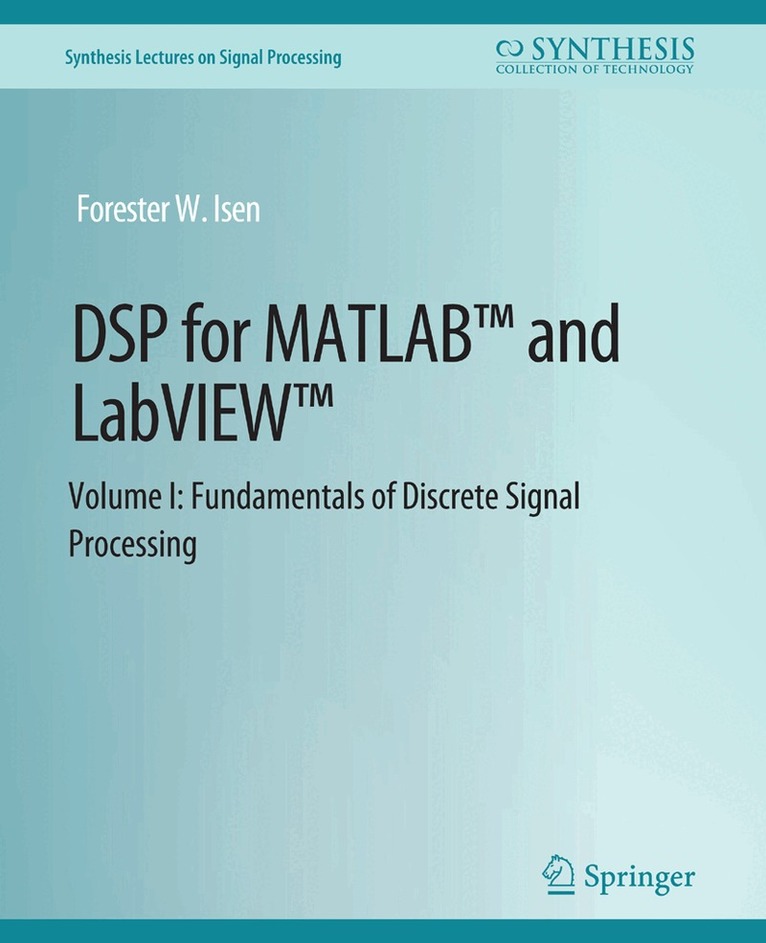
This book is Volume I of the series DSP for MATLAB™ and LabVIEW™. The entire series consists of four volumes that collectively cover basic digital signal processing in a practical and accessible manner, but which nonetheless include all essential foundation mathematics. As the series title implies, the scripts (of which there are more than 200) described in the text and supplied in code form here will run on both MATLAB and LabVIEW. Volume I consists of four chapters. The first chapter gives a brief overview of the field of digital signal processing. This is followed by a chapter detailing many useful signals and concepts, including convolution, recursion, difference equations, LTI systems, etc. The third chapter covers conversion from the continuous to discrete domain and back (i.e., analog-to-digital and digital-to-analog conversion), aliasing, the Nyquist rate, normalized frequency, conversion from one sample rate to another, waveform generation at various sample rates from stored wave data, and Mu-law compression. The fourth and final chapter of the present volume introduces the reader to many important principles of signal processing, including correlation, the correlation sequence, the Real DFT, correlation by convolution, matched filtering, simple FIR filters, and simple IIR filters. Chapter 4, in particular, provides an intuitive or "first principle" understanding of how digital filtering and frequency transforms work, preparing the reader for Volumes II and III, which provide, respectively, detailed coverage of discrete frequency transforms (including the Discrete Time Fourier Transform, the Discrete Fourier Transform, and the z-Transform) and digital filter design (FIR design using Windowing, Frequency Sampling, and Optimum Equiripple techniques, and Classical IIR design). Volume IV, the culmination of the series, is an introductory treatment of LMS Adaptive Filtering and applications. The text for all volumes contains many examples, and many useful computational scripts, augmented by demonstration scripts and LabVIEW Virtual Instruments (VIs) that can be run to illustrate various signal processing concepts graphically on the user's computer screen.Table of Contents: An Overview of DSP / Discrete Signals and Concepts / Sampling and Binary Representation / Transform and Filtering Principles
Häftad, Engelska, 2008
544 kr
Skickas inom 10-15 vardagar
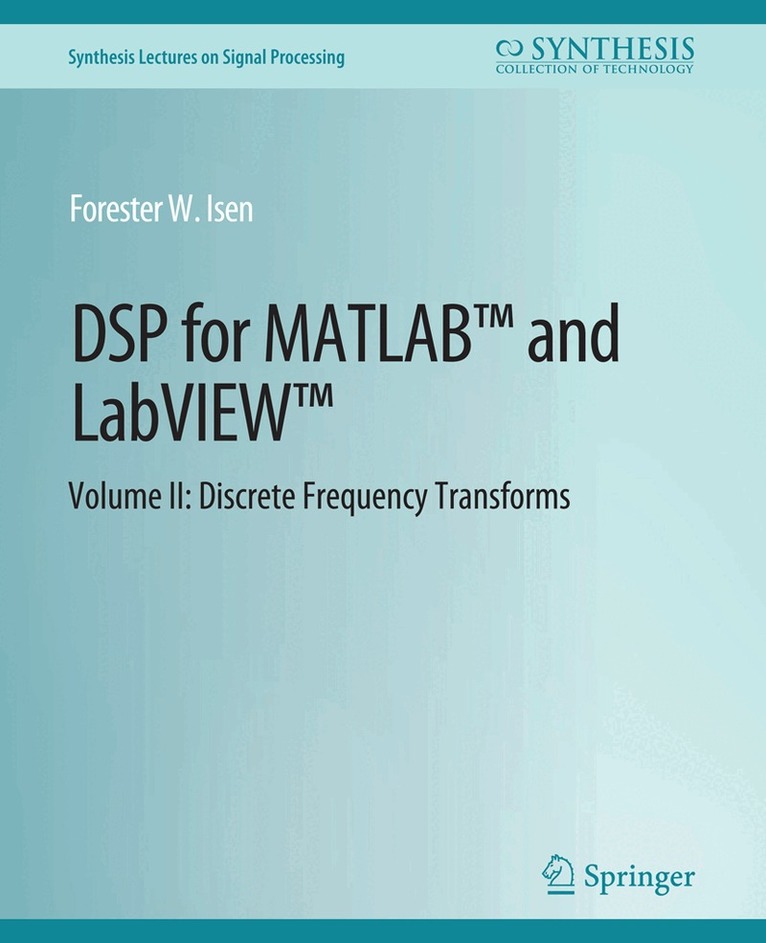
This book is Volume II of the series DSP for MATLAB™ and LabVIEW™. This volume provides detailed coverage of discrete frequency transforms, including a brief overview of common frequency transforms, both discrete and continuous, followed by detailed treatments of the Discrete Time Fourier Transform (DTFT), the z -Transform (including definition and properties, the inverse z -transform, frequency response via z-transform, and alternate filter realization topologies (including Direct Form, Direct Form Transposed, Cascade Form, Parallel Form, and Lattice Form), and the Discrete Fourier Transform (DFT) (including Discrete Fourier Series, the DFT-IDFT pair, DFT of common signals, bin width, sampling duration and sample rate, the FFT, the Goertzel Algorithm, Linear, Periodic, and Circular convolution, DFT Leakage, and computation of the Inverse DFT). The entire series consists of four volumes that collectively cover basic digital signal processing in a practical and accessible manner, but which nonetheless include all essential foundation mathematics. As the series title implies, the scripts (of which there are more than 200) described in the text and supplied in code form here will run on both MATLAB™ and LabVIEW™. The text for all volumes contains many examples, and many useful computational scripts, augmented by demonstration scripts and LabVIEW™ Virtual Instruments (VIs) that can be run to illustrate various signal processing concepts graphically on the user's computer. Volume I consists of four chapters that collectively set forth a brief overview of the field of digital signal processing, useful signals and concepts (including convolution, recursion, difference equations, LTI systems, etc), conversion from the continuous to discrete domain and back (i.e., analog-to-digital and digital-to-analog conversion), aliasing, the Nyquist rate, normalized frequency, sample rate conversion and Mu-law compression, and signal processing principles including correlation, the correlation sequence, the Real DFT, correlation by convolution, matched filtering, simple FIR filters, and simple IIR filters. Chapter 4 of Volume I, in particular, provides an intuitive or ""first principle"" understanding of how digital filtering and frequency transforms work, preparing the reader for the present volume (Volume II). Volume III of the series covers digital filter design (FIR design using Windowing, Frequency Sampling, and Optimum Equiripple techniques, and Classical IIR design) and Volume IV, the culmination of the series, is an introductory treatment of LMS Adaptive Filtering and applications.Table of Contents: The Discrete Time Fourier Transform / The z-Transform / The DFT
Häftad, Engelska, 2008
544 kr
Skickas inom 10-15 vardagar
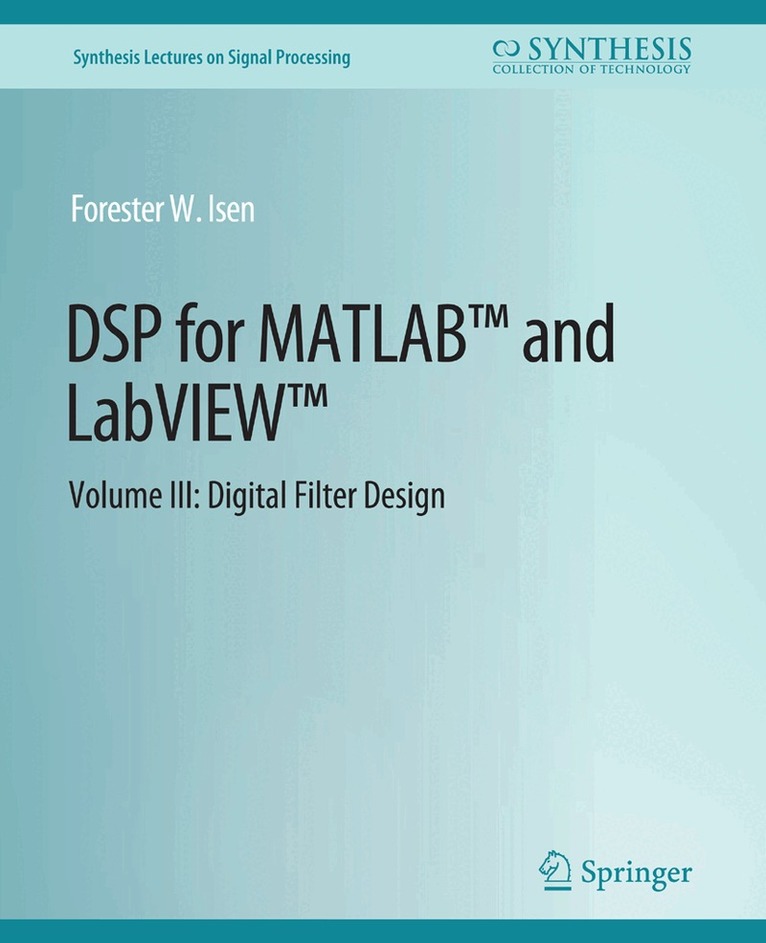
This book is Volume III of the series DSP for MATLAB™ and LabVIEW™. Volume III covers digital filter design, including the specific topics of FIR design via windowed-ideal-lowpass filter, FIR highpass, bandpass, and bandstop filter design from windowed-ideal lowpass filters, FIR design using the transition-band-optimized Frequency Sampling technique (implemented by Inverse-DFT or Cosine/Sine Summation Formulas), design of equiripple FIRs of all standard types including Hilbert Transformers and Differentiators via the Remez Exchange Algorithm, design of Butterworth, Chebyshev (Types I and II), and Elliptic analog prototype lowpass filters, conversion of analog lowpass prototype filters to highpass, bandpass, and bandstop filters, and conversion of analog filters to digital filters using the Impulse Invariance and Bilinear Transform techniques. Certain filter topologies specific to FIRs are also discussed, as are two simple FIR types, the Comb and Moving Average filters. The entire series consists of four volumes that collectively cover basic digital signal processing in a practical and accessible manner, but which nonetheless include all essential foundation mathematics. As the series title implies, the scripts (of which there are more than 200) described in the text and supplied in code form here will run on both MATLAB™ and LabVIEW™.The text for all volumes contains many examples, and many useful computational scripts, augmented by demonstration scripts and LabVIEW™ Virtual Instruments (VIs) that can be run to illustrate various signal processing concepts graphically on the user's computer screen. Volume I consists of four chapters that collectively set forth a brief overview of the field of digital signal processing, useful signals and concepts (including convolution, recursion, difference equations, LTI systems, etc), conversion from the continuous to discrete domain and back (i.e., analog-to-digital and digital-to-analog conversion), aliasing, the Nyquist rate, normalized frequency, sample rate conversion and Mu-law compression, and signal processing principles including correlation, the correlation sequence, the Real DFT, correlation by convolution, matched filtering, simple FIR filters, and simple IIR filters. Chapter four of Volume I, in particular, provides an intuitive or ""first principle"" understanding of how digital filtering and frequency transforms work. Volume II provides detailed coverage of discrete frequency transforms, including a brief overview of common frequency transforms, both discrete and continuous, followed by detailed treatments of the Discrete Time Fourier Transform (DTFT), the z-Transform (including definition and properties, the inverse z-transform, frequency response via z-transform, and alternate filter realization topologies including Direct Form, Direct Form Transposed, Cascade Form, Parallel Form, and Lattice Form), and the Discrete Fourier Transform (DFT) (including Discrete Fourier Series, the DFT-IDFT pair, DFT of common signals, bin width, sampling duration, and sample rate, the FFT, the Goertzel Algorithm, Linear, Periodic, and Circular convolution, DFT Leakage, and computation of the Inverse DFT). Volume IV, the culmination of the series, is an introductory treatment of LMS Adaptive Filtering and applications, and covers cost functions, performance surfaces, coefficient perturbation to estimate the gradient, the LMS algorithm, response of the LMS algorithm to narrow-band signals, and various topologies such as ANC (Active Noise Cancelling) or system modeling, Periodic Signal Removal/Prediction/Adaptive Line Enhancement (ALE), Interference Cancellation, Echo Cancellation (with single- and dual-H topologies), and Inverse Filtering/Deconvolution/Equalization.Table of Contents: Principles
Häftad, Engelska, 2009
544 kr
Skickas inom 10-15 vardagar
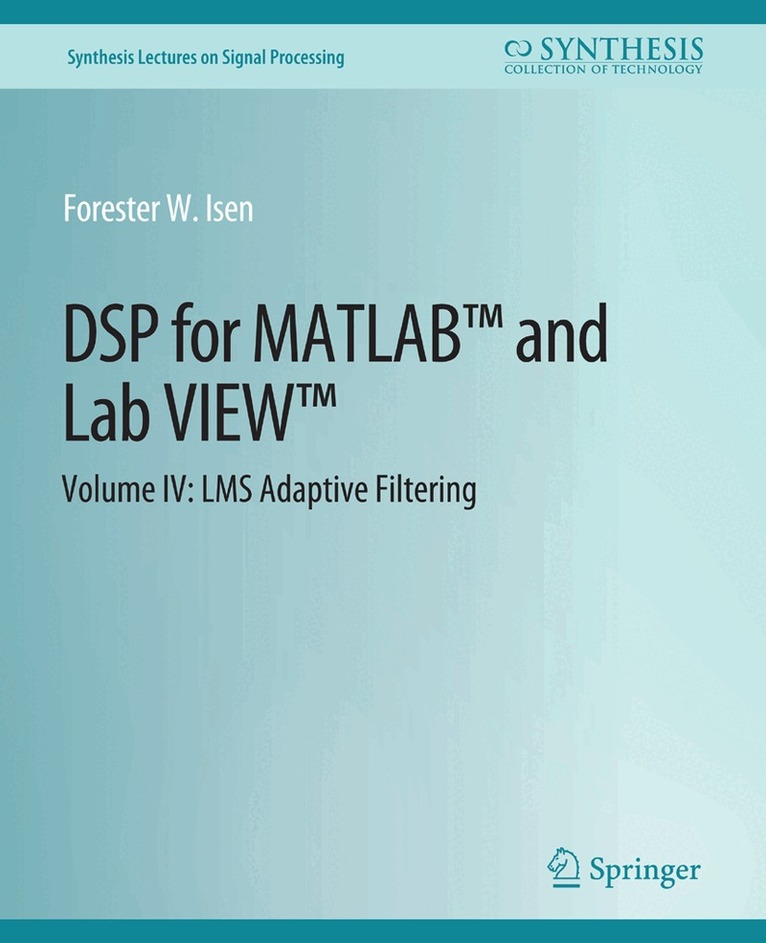
This book is Volume IV of the series DSP for MATLAB™ and LabVIEW™. Volume IV is an introductory treatment of LMS Adaptive Filtering and applications, and covers cost functions, performance surfaces, coefficient perturbation to estimate the gradient, the LMS algorithm, response of the LMS algorithm to narrow-band signals, and various topologies such as ANC (Active Noise Cancelling) or system modeling, Noise Cancellation, Interference Cancellation, Echo Cancellation (with single- and dual-H topologies), and Inverse Filtering/Deconvolution. The entire series consists of four volumes that collectively cover basic digital signal processing in a practical and accessible manner, but which nonetheless include all essential foundation mathematics. As the series title implies, the scripts here will run on both MATLAB™ and LabVIEW™. The text for all volumes contains many examples, and many useful computational scripts, augmented by demonstration scripts and LabVIEW™ Virtual Instruments (VIs) that can be run to illustrate various signal processing concepts graphically on the user's computer screen. Volume I consists of four chapters that collectively set forth a brief overview of the field of digital signal processing, useful signals and concepts (including convolution, recursion, difference equations, LTI systems, etc), conversion from the continuous to discrete domain and back (i.e., analog-to-digital and digital-to-analog conversion), aliasing, the Nyquist rate, normalized frequency, sample rate conversion and Mu-law compression, and signal processing principles including correlation, the correlation sequence, the Real DFT, correlation by convolution, matched filtering, simple FIR filters, and simple IIR filters. Chapter 4 of Volume I, in particular, provides an intuitive or "first principle" understanding of how digital filtering and frequency transforms work. Volume II provides detailed coverage of discrete frequency transforms, including a brief overview of common frequency transforms, both discrete and continuous, followed by detailed treatments of the Discrete Time Fourier Transform (DTFT), the z-Transform (including definition and properties, the inverse z-transform, frequency response via z-transform, and alternate filter realization topologies including Direct Form, Direct Form Transposed, Cascade Form, Parallel Form, and Lattice Form), and the Discrete Fourier Transform (DFT) (including Discrete Fourier Series, the DFT-IDFT pair, DFT of common signals, bin width, sampling duration, and sample rate, the FFT, the Goertzel Algorithm, Linear, Periodic, and Circular convolution, DFT Leakage, and computation of the Inverse DFT). Volume III covers digital filter design, including the specific topics of FIR design via windowed-ideal-lowpass filter, FIR highpass, bandpass, and bandstop filter design from windowed-ideal lowpass filters, FIR design using the transition-band-optimized Frequency Sampling technique (implemented by Inverse-DFT or Cosine/Sine Summation Formulas), design of equiripple FIRs of all standard types including Hilbert Transformers and Differentiators via the Remez Exchange Algorithm, design of Butterworth, Chebyshev (Types I and II), and Elliptic analog prototype lowpass filters, conversion of analog lowpass prototype filters to highpass, bandpass, and bandstop filters, and conversion of analog filters to digital filters using the Impulse Invariance and Bilinear Transform techniques. Certain filter topologies specific to FIRs are also discussed, as are two simple FIR types, the Comb and Moving Average filters.Table of Contents: Introduction To LMS Adaptive Filtering / Applied Adaptive Filtering
Häftad, Engelska, 2009
308 kr
Skickas inom 10-15 vardagar
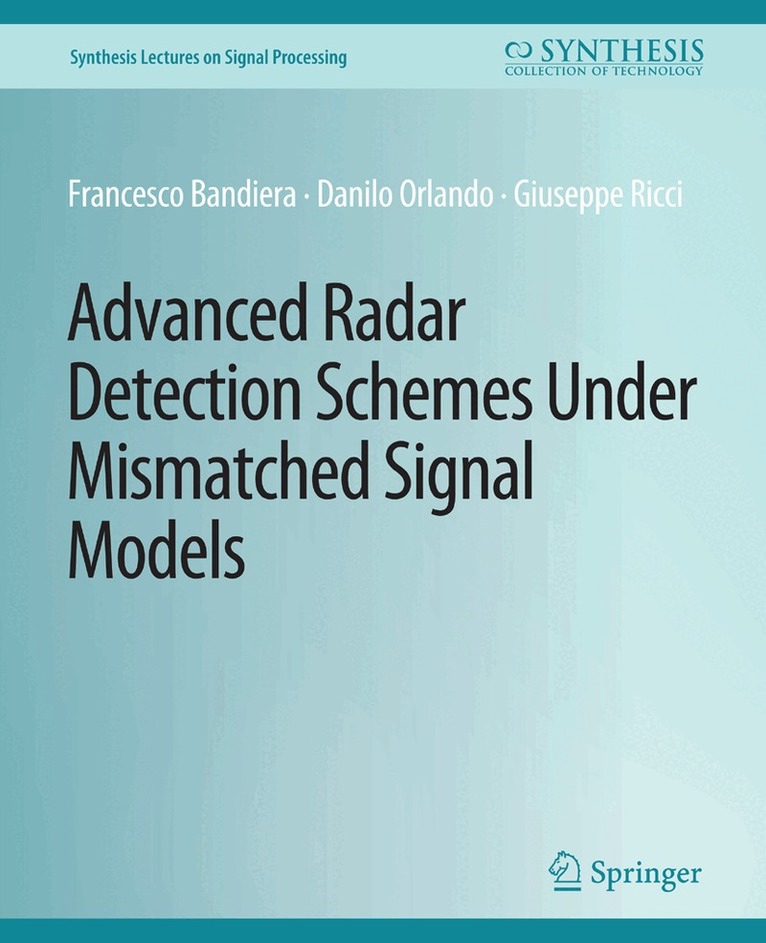
The aim of this book is to present some recent advances in the design of tunable detectors and the focus is on the so-called two-stage detectors, i.e., adaptive algorithms obtained cascading two detectors with opposite behaviors.
Häftad, Engelska, 2009
383 kr
Skickas inom 10-15 vardagar
Table of Contents: Getting Started / DSP Concepts / Random Processes and Noise / Fixed Point Numbers / Quantization Effects: Data and Coefficients / Quantization Effects - Round-Off Noise and Overflow / Limit Cycles
Häftad, Engelska, 2011
362 kr
Skickas inom 10-15 vardagar
Table of Contents: Seismic Data Processing: A Quick Overview / Examination of A Real Seismic Data Set / Quality Control of Real Seismic Data / Seismic Noise Attenuation / Seismic Deconvolution / Carrying the Processing Forward / Static Corrections / Seismic Migration / Concluding Remarks
Häftad, Engelska, 2013
362 kr
Skickas inom 10-15 vardagar
In these notes, we introduce particle filtering as a recursive importance sampling method that approximates the minimum-mean-square-error (MMSE) estimate of a sequence of hidden state vectors in scenarios where the joint probability distribution of the states and the observations is non-Gaussian and, therefore, closed-form analytical expressions for the MMSE estimate are generally unavailable.We begin the notes with a review of Bayesian approaches to static (i.e., time-invariant) parameter estimation. In the sequel, we describe the solution to the problem of sequential state estimation in linear, Gaussian dynamic models, which corresponds to the well-known Kalman (or Kalman-Bucy) filter. Finally, we move to the general nonlinear, non-Gaussian stochastic filtering problem and present particle filtering as a sequential Monte Carlo approach to solve that problem in a statistically optimal way.We review several techniques to improve the performance of particle filters, including importance function optimization, particle resampling, Markov Chain Monte Carlo move steps, auxiliary particle filtering, and regularized particle filtering. We also discuss Rao-Blackwellized particle filtering as a technique that is particularly well-suited for many relevant applications such as fault detection and inertial navigation. Finally, we conclude the notes with a discussion on the emerging topic of distributed particle filtering using multiple processors located at remote nodes in a sensor network.Throughout the notes, we often assume a more general framework than in most introductory textbooks by allowing either the observation model or the hidden state dynamic model to include unknown parameters. In a fully Bayesian fashion, we treat those unknown parameters also as random variables. Using suitable dynamic conjugate priors, that approach can be applied then to perform joint state and parameter estimation.Table of Contents: Introduction / Bayesian Estimation of Static Vectors / The Stochastic Filtering Problem / Sequential Monte Carlo Methods / Sampling/Importance Resampling (SIR) Filter / Importance Function Selection / Markov Chain Monte Carlo Move Step / Rao-Blackwellized Particle Filters / Auxiliary Particle Filter / Regularized Particle Filters / Cooperative Filtering with Multiple Observers / Application Examples / Summary
Häftad, Engelska, 2013
362 kr
Skickas inom 10-15 vardagar
The Kalman filter is the Bayesian optimum solution to the problem of sequentially estimating the states of a dynamical system in which the state evolution and measurement processes are both linear and Gaussian.
Häftad, Engelska, 2019
577 kr
Skickas inom 10-15 vardagar
In this book, we introduce reconstruction-free compressive vision, where image processing and computer vision algorithms are embedded directly in the compressive domain, without the need for first reconstructing the measurements into images or video.
Häftad, Engelska, 2020
652 kr
Skickas inom 10-15 vardagar
The book covers the laboratory experiments that are normally covered in signals and systems courses and discusses how to run MATLAB codes for these experiments as apps on both Android and iOS smartphones, thus enabling a truly mobile laboratory paradigm.
Häftad, Engelska, 2020
598 kr
Skickas inom 10-15 vardagar
Real-time or applied digital signal processing courses are offered as follow-ups to conventional or theory-oriented digital signal processing courses in many engineering programs for the purpose of teaching students the technical know-how for putting signal processing algorithms or theory into practical use.
Häftad, Engelska, 2021
598 kr
Skickas inom 10-15 vardagar
Linear algebra is one of the most basic foundations of a wide range of scientific domains, and most textbooks of linear algebra are written by mathematicians.
Häftad, Engelska, 2021
921 kr
Skickas inom 10-15 vardagar
This book is designed for use as a textbook for a one semester Signals and Systems class. Laplace transform and Z transform are then introduced as tools to analyze systems. The notions of stability of systems and feedback are analyzed using these tools. The book is divided into thirty bite-sized modules.
Häftad, Engelska, 2021
598 kr
Skickas inom 10-15 vardagar
A typical machine learning algorithm involves training, and generally the performance of a machine learning model improves with more training data. The machine learning paradigms presented can be broadly divided into the following three categories: supervised learning, unsupervised learning, and semi-supervised learning.
Inbunden, Engelska, 2023
491 kr
Skickas inom 10-15 vardagar
This book teaches the fundamentals and mathematical formulas of reversible transformations (or transforms) that are used in many source coding and signal processing systems. These mathematical transforms are often necessary or crucial toward reduction of data storage and transmission rate requirements. The author emphasizes the wavelet transform as it is the preferred transform for practical application in many coding and signal processing systems. The book also covers the tap (coefficient) values for some of those filters that satisfy the perfect reconstruction property. Examples of the use of filter-based and matrix-based transforms are also provided. This self-contained work contains insight gained through research and practice, which makes it a valuable reference and tutorial for readers interested in the subject of mathematical transforms.This book:Teaches the fundamentals and mathematical formulas of reversible transformations, as well as theirapplicationsHighlights the wavelet transformation, which is the preferred transform for many practical applicationsContains insight gained through research and practice, making it a valuable resource those interested in the topic
Häftad, Engelska, 2024
491 kr
Skickas inom 10-15 vardagar
This book teaches the fundamentals and mathematical formulas of reversible transformations (or transforms) that are used in many source coding and signal processing systems. These mathematical transforms are often necessary or crucial toward reduction of data storage and transmission rate requirements. The author emphasizes the wavelet transform as it is the preferred transform for practical application in many coding and signal processing systems. The book also covers the tap (coefficient) values for some of those filters that satisfy the perfect reconstruction property. Examples of the use of filter-based and matrix-based transforms are also provided. This self-contained work contains insight gained through research and practice, which makes it a valuable reference and tutorial for readers interested in the subject of mathematical transforms.This book:Teaches the fundamentals and mathematical formulas of reversible transformations, as well as theirapplicationsHighlights the wavelet transformation, which is the preferred transform for many practical applicationsContains insight gained through research and practice, making it a valuable resource those interested in the topic