Mahesh Banavar – författare
Visar alla böcker från författaren Mahesh Banavar. Handla med fri frakt och snabb leverans.
14 produkter
14 produkter
Häftad, Engelska, 2010
276 kr
Skickas inom 10-15 vardagar
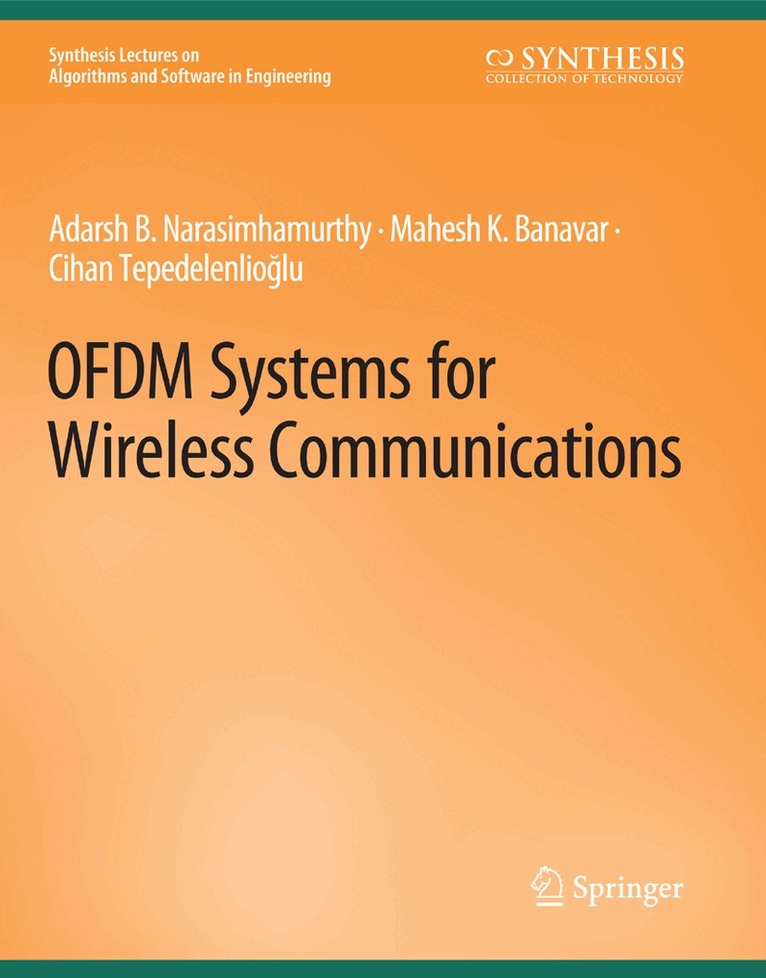
Orthogonal Frequency Division Multiplexing (OFDM) systems are widely used in the standards for digital audio/video broadcasting, WiFi and WiMax. Table of Contents: Introduction / Modeling Wireless Channels / Baseband OFDM System / Carrier Frequency Offset / Peak to Average Power Ratio / Simulation of the Performance of OFDM Systems / Conclusions
Häftad, Engelska, 2008
308 kr
Skickas inom 10-15 vardagar
This book provides an introduction to narrowband array signal processing, classical and subspace-based direction of arrival (DOA) estimation with an extensive discussion on adaptive direction of arrival algorithms.
Häftad, Engelska, 2016
308 kr
Skickas inom 10-15 vardagar
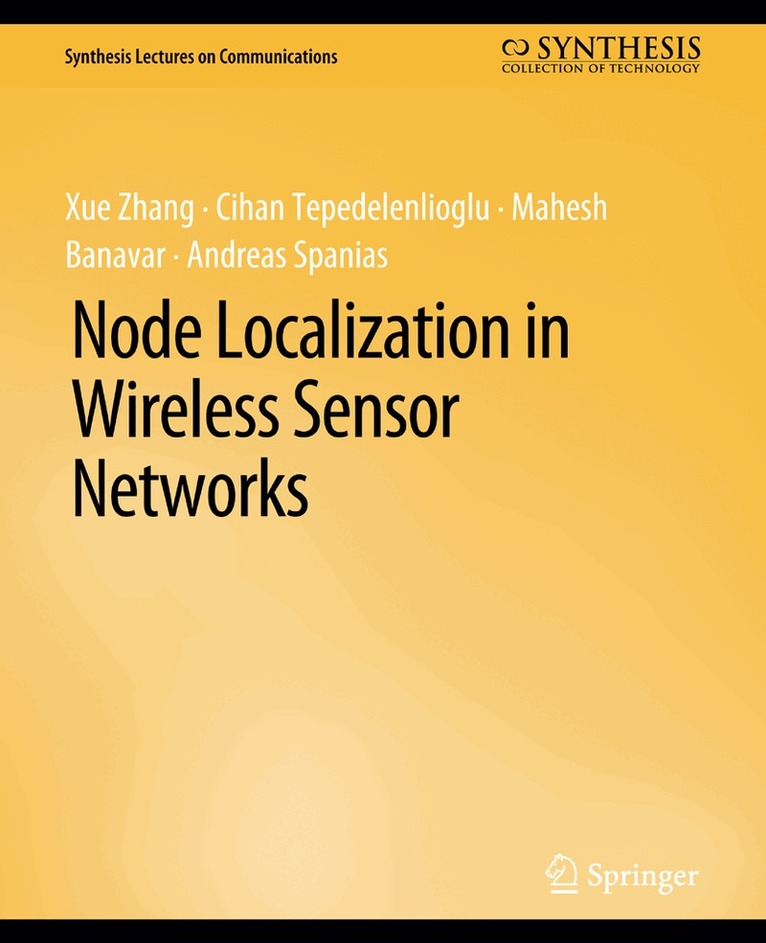
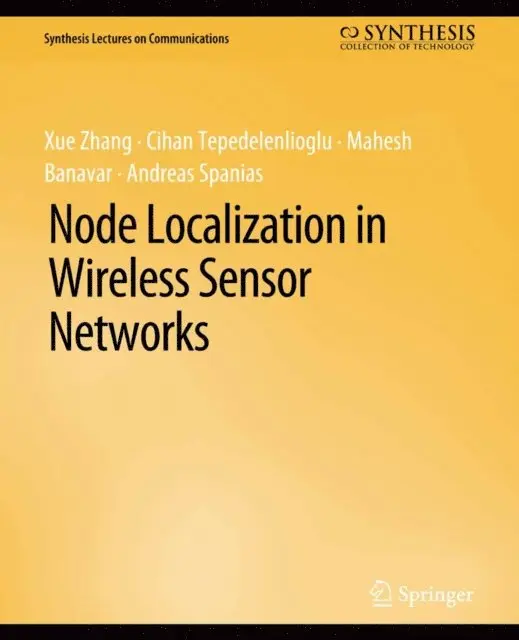
We describe sensor network localization problems in terms of a detection and estimation framework and we emphasize specifically a cooperative process where sensors with known locations are used to localize nodes at unknown locations.
Häftad, Engelska, 2018
577 kr
Skickas inom 10-15 vardagar
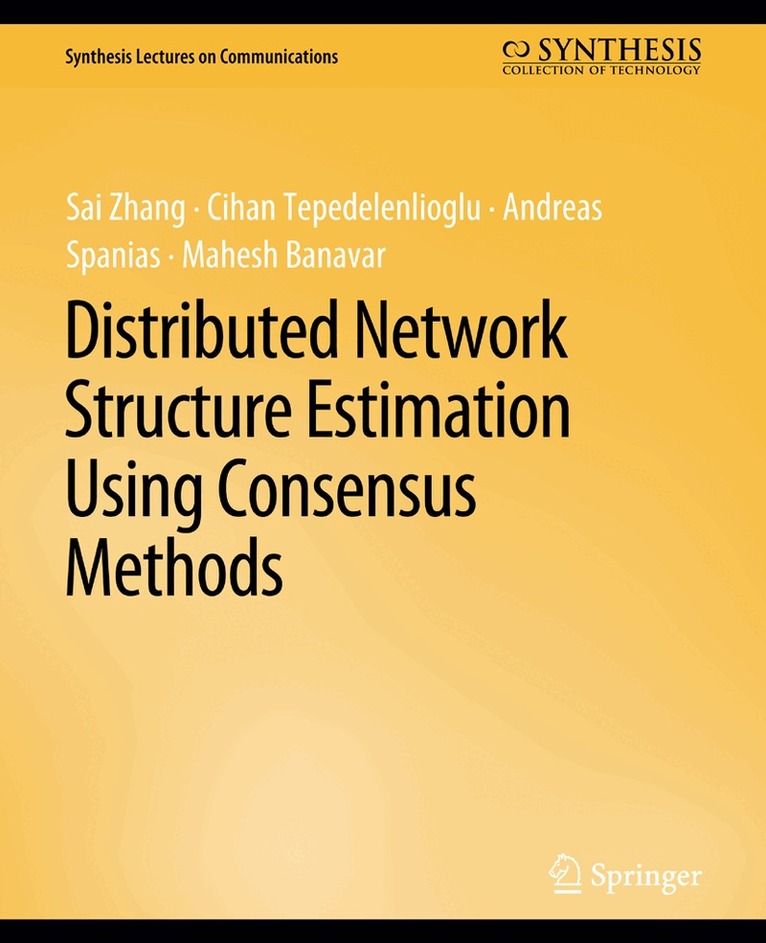
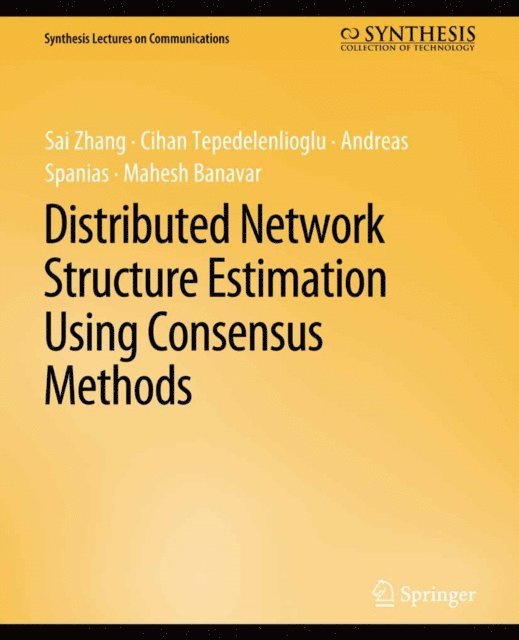
The area of detection and estimation in a distributed wireless sensor network (WSN) has several applications, including military surveillance, sustainability, health monitoring, and Internet of Things (IoT).
Häftad, Engelska, 2011
362 kr
Skickas inom 10-15 vardagar
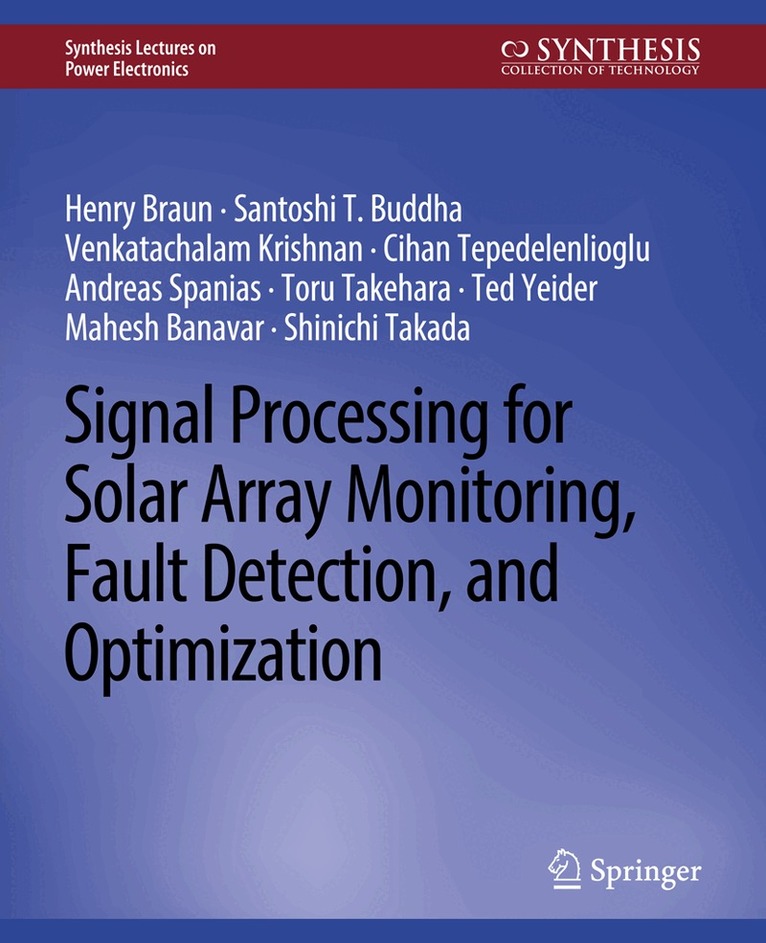
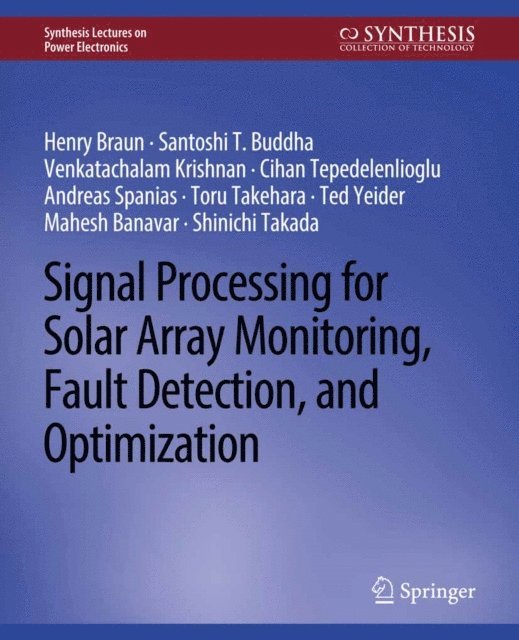
Although the solar energy industry has experienced rapid growth recently, high-level management of photovoltaic (PV) arrays has remained an open problem. Table of Contents: Introduction / Overview of Photovoltaics / Causes Performance Degradation and Outage / Fault Detection Methods / Array Topology Optimization / Monitoring of PV Systems / Summary
Häftad, Engelska, 2013
362 kr
Skickas inom 10-15 vardagar
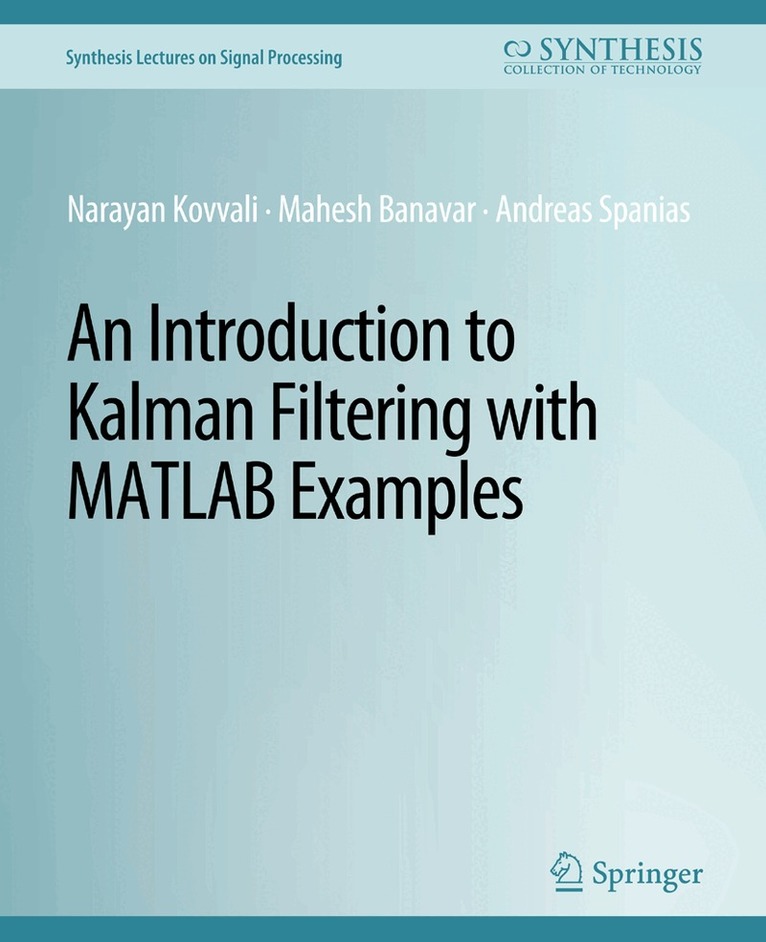
The Kalman filter is the Bayesian optimum solution to the problem of sequentially estimating the states of a dynamical system in which the state evolution and measurement processes are both linear and Gaussian.
E-bok
PDF, Engelska, 2022351 kr
Läs direkt efter köp
Orthogonal Frequency Division Multiplexing (OFDM) systems are widely used in the standards for digital audio/video broadcasting, WiFi and WiMax. Being a frequency-domain approach to communications, OFDM has important advantages in dealing with the frequency-selective nature of high data rate wireless communication channels. As the needs for operating with higher data rates become more pressing, OFDM systems have emerged as an effective physical-layer solution. This short monograph is intended as a tutorial which highlights the deleterious aspects of the wireless channel and presents why OFDM is a good choice as a modulation that can transmit at high data rates. The system-level approach we shall pursue will also point out the disadvantages of OFDM systems especially in the context of peak to average ratio, and carrier frequency synchronization. Finally, simulation of OFDM systems will be given due prominence. Simple MATLAB programs are provided for bit error rate simulation using a discrete-time OFDM representation. Software is also provided to simulate the effects of inter-block-interference, inter-carrier-interference and signal clipping on the error rate performance. Different components of the OFDM system are described, and detailed implementation notes are provided for the programs. The program can be downloaded here. Table of Contents: Introduction / Modeling Wireless Channels / Baseband OFDM System / Carrier Frequency Offset / Peak to Average Power Ratio / Simulation of the Performance of OFDM Systems / Conclusions
E-bok
PDF, Engelska, 2022382 kr
Läs direkt efter köp
This book provides an introduction to narrowband array signal processing, classical and subspace-based direction of arrival (DOA) estimation with an extensive discussion on adaptive direction of arrival algorithms. The book begins with a presentation of the basic theory, equations, and data models of narrowband arrays. It then discusses basic beamforming methods and describes how they relate to DOA estimation. Several of the most common classical and subspace-based direction of arrival methods are discussed. The book concludes with an introduction to subspace tracking and shows how subspace tracking algorithms can be used to form an adaptive DOA estimator. Simulation software and additional bibliography are given at the end of the book.Table of Contents: Introduction / Background on Array Processing / Nonadaptive Direction of Arrival Estimation / Adaptive Direction of Arrival Estimation / Appendix
E-bok
PDF, Engelska, 2022382 kr
Läs direkt efter köp
In sensor network applications, measured data are often meaningful only when the location is accurately known. In this booklet, we study research problems associated with node localization in wireless sensor networks. We describe sensor network localization problems in terms of a detection and estimation framework and we emphasize specifically a cooperative process where sensors with known locations are used to localize nodes at unknown locations. In this class of problems, even if the location of a node is known, the wireless links and transmission modalities between two nodes may be unknown. In this case, sensor nodes are used to detect the location and estimate pertinent data transmission activities between nodes. In addition to the broader problem of sensor localization, this booklet studies also specific localization measurements such as time of arrival (TOA), received signal strength (RSS), and direction of arrival (DOA). The sequential localization algorithm, which uses a subsetof sensor nodes to estimate nearby sensor nodes'' locations is discussed in detail. Extensive bibliography is given for those readers who want to delve further into specific topics.
E-bok
PDF, Engelska, 2022687 kr
Läs direkt efter köp
The area of detection and estimation in a distributed wireless sensor network (WSN) has several applications, including military surveillance, sustainability, health monitoring, and Internet of Things (IoT). Compared with a wired centralized sensor network, a distributed WSN has many advantages including scalability and robustness to sensor node failures. In this book, we address the problem of estimating the structure of distributed WSNs. First, we provide a literature review in: (a) graph theory; (b) network area estimation; and (c) existing consensus algorithms, including average consensus and max consensus. Second, a distributed algorithm for counting the total number of nodes in a wireless sensor network with noisy communication channels is introduced. Then, a distributed network degree distribution estimation (DNDD) algorithm is described. The DNDD algorithm is based on average consensus and in-network empirical mass function estimation. Finally, a fully distributed algorithm forestimating the center and the coverage region of a wireless sensor network is described. The algorithms introduced are appropriate for most connected distributed networks. The performance of the algorithms is analyzed theoretically, and simulations are performed and presented to validate the theoretical results. In this book, we also describe how the introduced algorithms can be used to learn global data information and the global data region.
E-bok
PDF, Engelska, 2022432 kr
Läs direkt efter köp
Although the solar energy industry has experienced rapid growth recently, high-level management of photovoltaic (PV) arrays has remained an open problem. As sensing and monitoring technology continues to improve, there is an opportunity to deploy sensors in PV arrays in order to improve their management. In this book, we examine the potential role of sensing and monitoring technology in a PV context, focusing on the areas of fault detection, topology optimization, and performance evaluation/data visualization. First, several types of commonly occurring PV array faults are considered and detection algorithms are described. Next, the potential for dynamic optimization of an array''s topology is discussed, with a focus on mitigation of fault conditions and optimization of power output under non-fault conditions. Finally, monitoring system design considerations such as type and accuracy of measurements, sampling rate, and communication protocols are considered. It is our hope that the benefits of monitoring presented here will be sufficient to offset the small additional cost of a sensing system, and that such systems will become common in the near future. Table of Contents: Introduction / Overview of Photovoltaics / Causes Performance Degradation and Outage / Fault Detection Methods / Array Topology Optimization / Monitoring of PV Systems / Summary
E-bok
PDF, Engelska, 2022428 kr
Läs direkt efter köp
The Kalman filter is the Bayesian optimum solution to the problem of sequentially estimating the states of a dynamical system in which the state evolution and measurement processes are both linear and Gaussian. Given the ubiquity of such systems, the Kalman filter finds use in a variety of applications, e.g., target tracking, guidance and navigation, and communications systems. The purpose of this book is to present a brief introduction to Kalman filtering. The theoretical framework of the Kalman filter is first presented, followed by examples showing its use in practical applications. Extensions of the method to nonlinear problems and distributed applications are discussed. A software implementation of the algorithm in the MATLAB programming language is provided, as well as MATLAB code for several example applications discussed in the manuscript.
Inbunden, Engelska, 2026
437 kr
Skickas inom 10-15 vardagar
Large Language Models (LLMs) have disruptively changed the world of AI for good and their adoption is near universal. However, how many know that they have a big limitation while processing large numerical quantitative business datasets usually found in ERPs as 1000s of tables. LLMs cannot process 100s of spreadsheets or tables at one time and when they try, they either fail to run or generate inaccurate predictions at best.The authors of this book propose LNMs or Large Numerical Models as a parallel universe to LLMs. LNMs are designed and built for numerical datasets and they offer some significant advantages over LLMs such as very accurate predictions, no hallucinations, improvement in business outcomes and ability to deliver in a "cold start" environment. LNMs are vertically curated and can run on a CPU as opposed to energy guzzling GPUs or water consuming cooling systems that LLMs need.This book introduces LNMs, it's underlying structure and SXI. SXI is to LNM as GPT is to LLMs, the underlying core science and technology. The authors also present specific applications of LNMs in healthcare, fintech, wireless, supplychain, marketing campaigns. Finally, the authors introduce their current research area of LLNMs. LLNM combines both LLM and LNM and has significant potential advantages over either LLM or LNMs.
E-bok
Engelska, 2026535 kr
Läs direkt efter köp
Large Language Models (LLMs) have disruptively changed the world of AI for good and their adoption is near universal. However, how many know that they have a big limitation while processing large numerical quantitative business datasets usually found in ERPs as 1000s of tables. LLMs cannot process 100s of spreadsheets or tables at one time and when they try, they either fail to run or generate inaccurate predictions at best.The authors of this book propose LNMs or Large Numerical Models as a parallel universe to LLMs. LNMs are designed and built for numerical datasets and they offer some significant advantages over LLMs such as very accurate predictions, no hallucinations, improvement in business outcomes and ability to deliver in a "e;cold start"e; environment. LNMs are vertically curated and can run on a CPU as opposed to energy guzzling GPUs or water consuming cooling systems that LLMs need.This book introduces LNMs, its underlying structure and SXI. SXI is to LNM as GPT is to LLMs, the underlying core science and technology. The authors also present specific applications of LNMs in healthcare, fintech, wireless, supplychain, marketing campaigns. Finally, the authors introduce their current research area of LLNMs. LLNM combines both LLM and LNM and has significant potential advantages over either LLM or LNMs.