Texas Legal Studies Series - Böcker
Visar alla böcker i serien Texas Legal Studies Series. Handla med fri frakt och snabb leverans.
4 produkter
4 produkter
511 kr
Skickas inom 7-10 vardagar
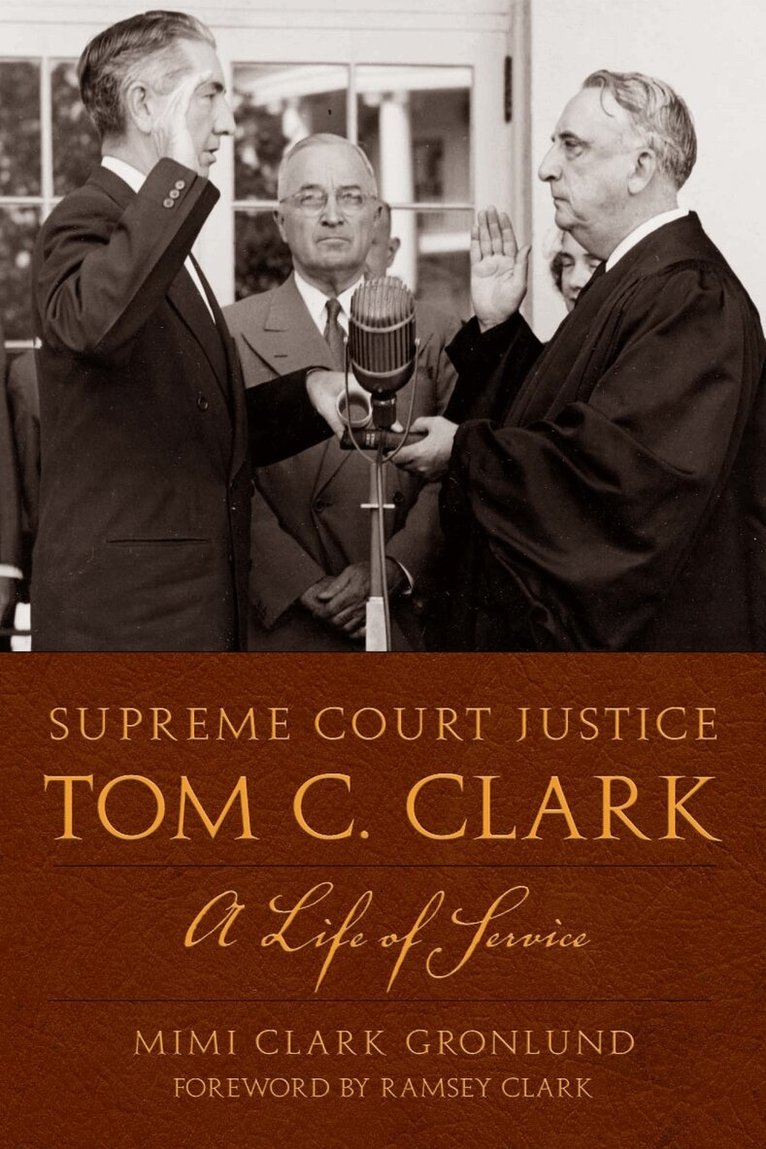
An associate justice on the renowned Warren Court whose landmark ruling in Brown v. Board of Education overturned racial segregation in schools and other public facilities, Tom C. Clark was a crusader for justice throughout his long legal career. Among many tributes Clark received, Supreme Court Chief Justice Warren Burger opined that "no man in the past thirty years has contributed more to the improvement of justice than Tom Clark." Supreme Court Justice Tom C. Clark is the first biography of this important American jurist. Written by his daughter, Mimi Clark Gronlund, and based on interviews with many of Clark's judicial associates, friends, and family, as well as archival research, it offers a well-rounded portrait of a lawyer and judge who dealt with issues that remain in contention today-civil rights, the rights of the accused, school prayer, and censorship/pornography, among them. Gronlund explores the factors in her father's upbringing and education that helped form his judicial philosophy, then describes how that philosophy shaped his decisions on key issues and cases, including the internment of Japanese Americans during World War II, the investigation of war fraud, the Truman administration's loyalty program (an anti-communist effort), the Brown decision, Mapp v. Ohio (protections against unreasonable search and seizure), and Abington v. Schempp (which overturned a state law that required reading from the Bible each day in public schools).
391 kr
Skickas inom 10-15 vardagar
An associate justice on the renowned Warren Court whose landmark ruling in Brown v. Board of Education overturned racial segregation in schools and other public facilities, Tom C. Clark was a crusader for justice throughout his long legal career. Among many tributes Clark received, Supreme Court Chief Justice Warren Burger opined that "no man in the past thirty years has contributed more to the improvement of justice than Tom Clark." Supreme Court Justice Tom C. Clark is the first biography of this important American jurist. Written by his daughter, Mimi Clark Gronlund, and based on interviews with many of Clark's judicial associates, friends, and family, as well as archival research, it offers a well-rounded portrait of a lawyer and judge who dealt with issues that remain in contention today-civil rights, the rights of the accused, school prayer, and censorship/pornography, among them. Gronlund explores the factors in her father's upbringing and education that helped form his judicial philosophy, then describes how that philosophy shaped his decisions on key issues and cases, including the internment of Japanese Americans during World War II, the investigation of war fraud, the Truman administration's loyalty program (an anti-communist effort), the Brown decision, Mapp v. Ohio (protections against unreasonable search and seizure), and Abington v. Schempp (which overturned a state law that required reading from the Bible each day in public schools).
214 kr
Skickas inom 10-15 vardagar
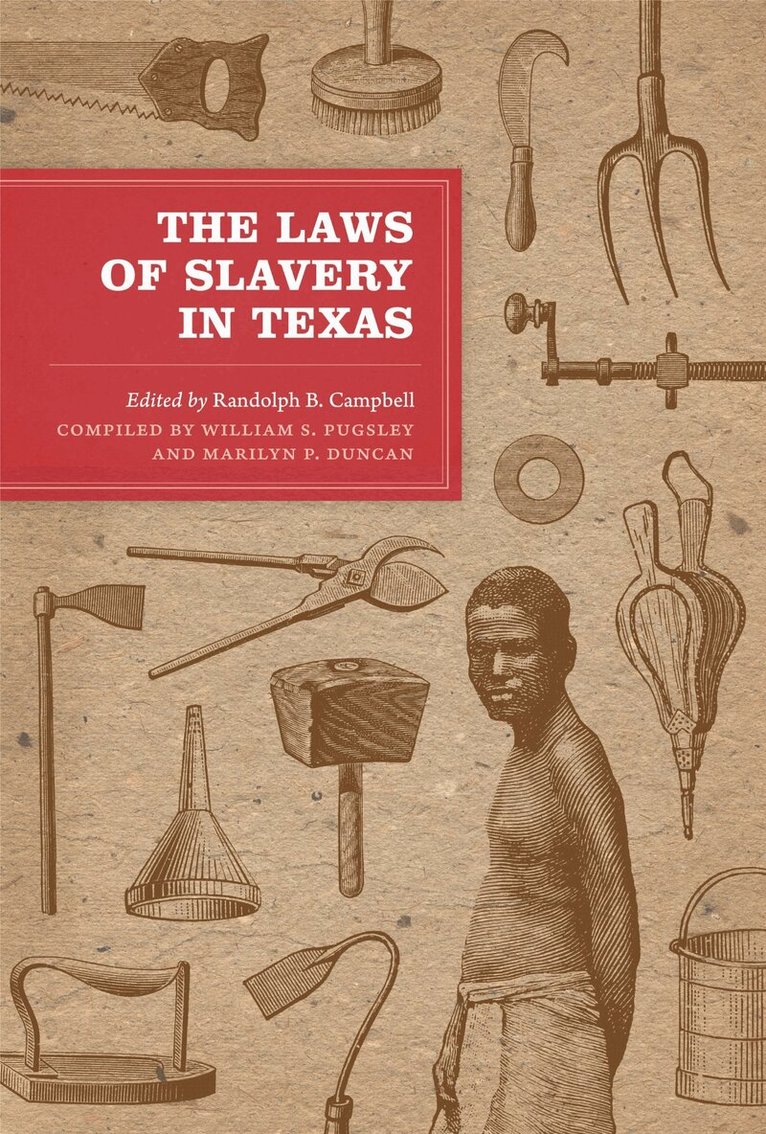
The laws that governed the institution of slavery in early Texas were enacted over a fifty-year period in which Texas moved through incarnations as a Spanish colony, a Mexican state, an independent republic, a part of the United States, and a Confederate state. This unusual legal heritage sets Texas apart from the other slave-holding states and provides a unique opportunity to examine how slave laws were enacted and upheld as political and legal structures changed. The Laws of Slavery in Texas makes that examination possible by combining seminal historical essays with excerpts from key legal documents from the slave period and tying them together with interpretive commentary by the foremost scholar on the subject, Randolph B. Campbell. Campbell's commentary focuses on an aspect of slave law that was particularly evident in the evolving legal system of early Texas: the dilemma that arose when human beings were treated as property. As Campbell points out, defining slaves as moveable property, or chattel, presented a serious difficulty to those who wrote and interpreted the law because, unlike any other form of property, slaves were sentient beings. They were held responsible for their crimes, and in numerous other ways statute and case law dealing with slavery recognized the humanness of the enslaved. Attempts to protect the property rights of slave owners led to increasingly restrictive laws-including laws concerning free blacks-that were difficult to uphold. The documents in this collection reveal both the roots of the dilemma and its inevitable outcome.
339 kr
Skickas inom 10-15 vardagar
“Few people realize that in the area of law, Texas began its American journey far ahead of most of the rest of the country, far more enlightened on such subjects as women’s rights and the protection of debtors.” Thus James Haley begins this highly readable account of the Texas Supreme Court. The first book-length history of the Court published since 1917, it tells the story of the Texas Supreme Court from its origins in the Republic of Texas to the political and philosophical upheavals of the mid-1980s.Using a lively narrative style rather than a legalistic approach, Haley describes the twists and turns of an evolving judiciary both empowered and constrained by its dual ties to Spanish civil law and English common law. He focuses on the personalities and judicial philosophies of those who served on the Supreme Court, as well as on the interplay between the Court’s rulings and the state’s unique history in such areas as slavery, women’s rights, land and water rights, the rise of the railroad and oil and gas industries, Prohibition, civil rights, and consumer protection. The book is illustrated with more than fifty historical photos, many from the nineteenth and early twentieth centuries. It concludes with a detailed chronology of milestones in the Supreme Court’s history and a list, with appointment and election dates, of the more than 150 justices who have served on the Court since 1836.