Texts and Monographs in Physics - Böcker
Visar alla böcker i serien Texts and Monographs in Physics. Handla med fri frakt och snabb leverans.
5 produkter
5 produkter
536 kr
Skickas inom 10-15 vardagar
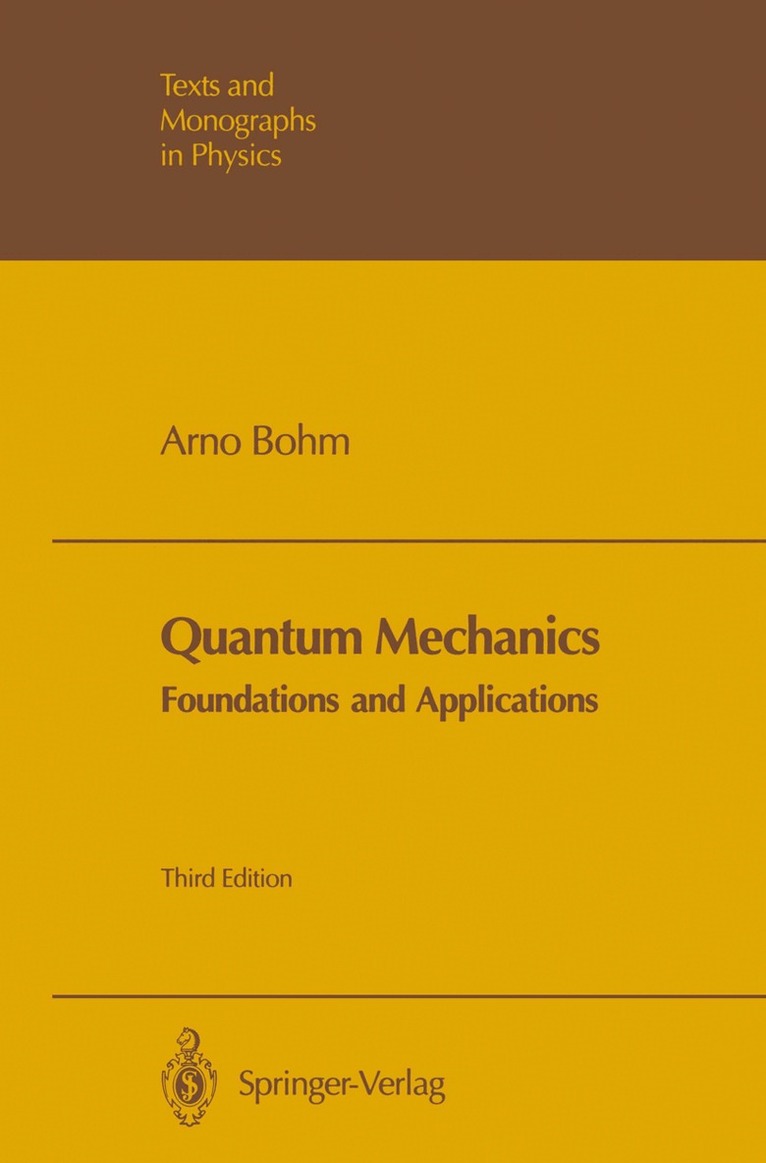
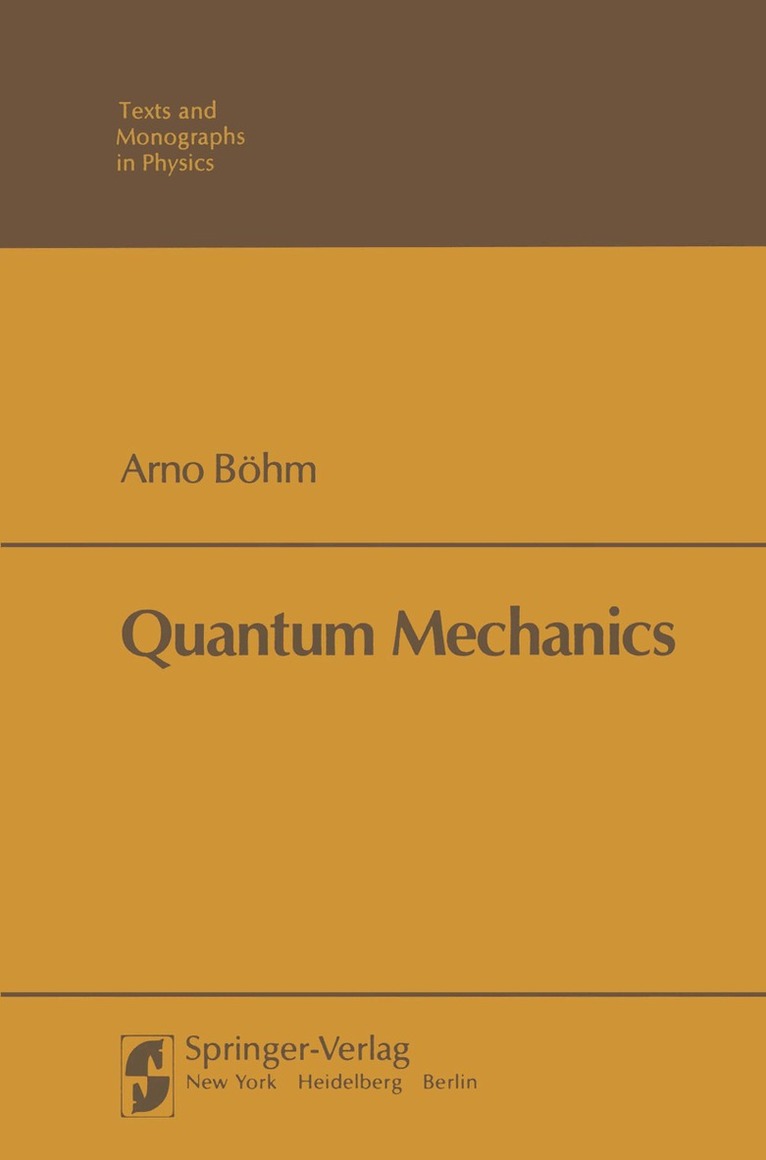
This book was written as a text, although many may consider it a mono graph. As a text it has been used several times in both the one-year graduate quantum-mechanics course and (in its shortened version) in a senior quantum mechanics course that I taught at the University of Texas at Austin. It is self-contained and does not require any prior knowledge of quantum mechanics. It also introduces the mathematical language of quantum mechanics, starting with the definitions, and attempts to teach this language by using it. Therefore, it can, in principle, be read without prior knowledge of the theory of linear operators and linear spaces, though some familiarity with linear algebra would be helpful. Prerequisites are knowledge of calculus and of vector algebra and analysis. Also used in a few places are some elementary facts of Fourier analysis and differential equations. Most physical examples are taken from the fields of atomic and molecular physics, as it is these fields that are best known to students at the stage when they learn quantum mechanics. This book may be considered a monograph because the presentation here is different from the usual treatment in many standard textbooks on quantum mechanics. It is not that a "different kind" of quantum mechanics is pre sented here; this is conventional quantum mechanics (" Copenhagen inter pretation ").
852 kr
Skickas inom 10-15 vardagar
This is a detailed and pedagogical exposition of the effective Lagrangian techniques and their applications to high-energy physics. It covers the main theoretical ideas and describes how to use them in different fields, such as chiral perturbation theory and the symmetry breaking sector of the standard model and even low-energy quantum gravity. The book is written in the language of modern quantum field theory. Some of the theoretical topics treated are: decoupling; the Goldstone theorem; the non-linear model; anomalies; the Wess-Zumino-Witten term; and the equivalence theorem.
536 kr
Skickas inom 7-10 vardagar
This edition differs from the second chiefly in the addition of about 100 pages devoted to the quantum (or geometric, or Berry) phase, a subject that did not exist when this book was written. The changes in the remainder of the book consist of corrections of a small number of misprints. While it may seem that adding two chapters on the quantum phase is overemphasizing a currently fashionable subject, they actually complete the development of quantum theory as given in this book. We start with simple models, synthesizing them into complicated "molecules." With the new chap ters. we end with complicated "molecules," dividing them into simpler parts. This process of dividing a complex system into parts quite naturally gives rise to a gauge theory, of which the geometric phase is a manifestation - with consequences not only in theory, but observable in experiments. For this rea son, the geometric phase is not a mere fashion, but a discovery that will retain its importance forever and must be discussed in textbooks on quantum mechanics. to acknowledge help and advice from Mark Loewe with the I would like writing and also of the new part of the book. In addition, I would like to express my gratitude to J. Anandan, M. Berry, and c.A. Mead, who have read parts or all of the new material and have provided valuable advice.
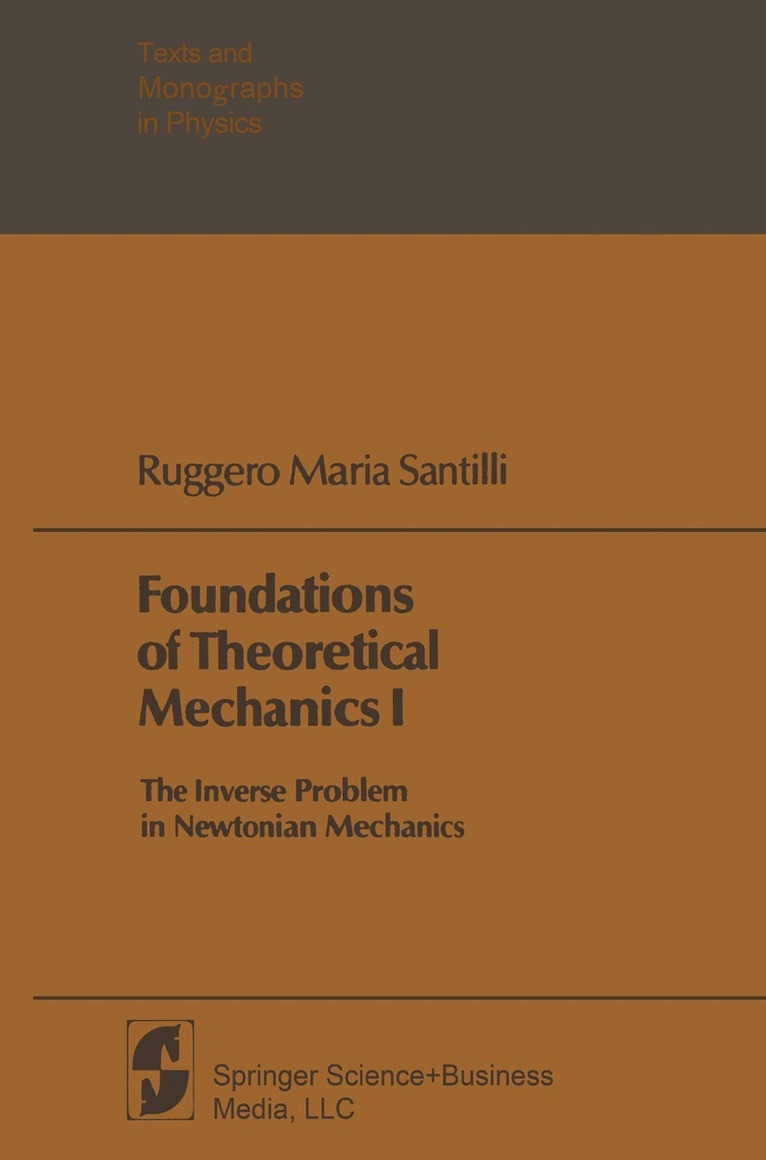
Foundations of Theoretical Mechanics I
The Inverse Problem in Newtonian Mechanics
Häftad, Engelska, 1984
536 kr
Skickas inom 10-15 vardagar
The objective of this monograph is to present some methodological foundations of theoretical mechanics that are recommendable to graduate students prior to, or jointly with, the study of more advanced topics such as statistical mechanics, thermodynamics, and elementary particle physics. A program of this nature is inevitably centered on the methodological foundations for Newtonian systems, with particular reference to the central equations of our theories, that is, Lagrange's and Hamilton's equations. This program, realized through a study of the analytic representations in terms of Lagrange's and Hamilton's equations of generally nonconservative Newtonian systems (namely, systems with Newtonian forces not necessarily derivable from a potential function), falls within the context of the so-called Inverse Problem, and consists of three major aspects: l. The study of the necessary and sufficient conditions for the existence of a Lagrangian or Hamiltonian representation of given equations of motion with arbitrary forces; 2. The identification of the methods for the construction of a Lagrangian or Hamiltonian from given equations of motion verifying conditions 1; and 3 The analysis of the significance of the underlying methodology for other aspects of Newtonian Mechanics, e. g. , transformation theory, symmetries, and first integrals for nonconservative Newtonian systems. This first volume is devoted to the foundations of the Inverse Problem, with particular reference to aspects I and 2.
1 064 kr
Skickas inom 10-15 vardagar
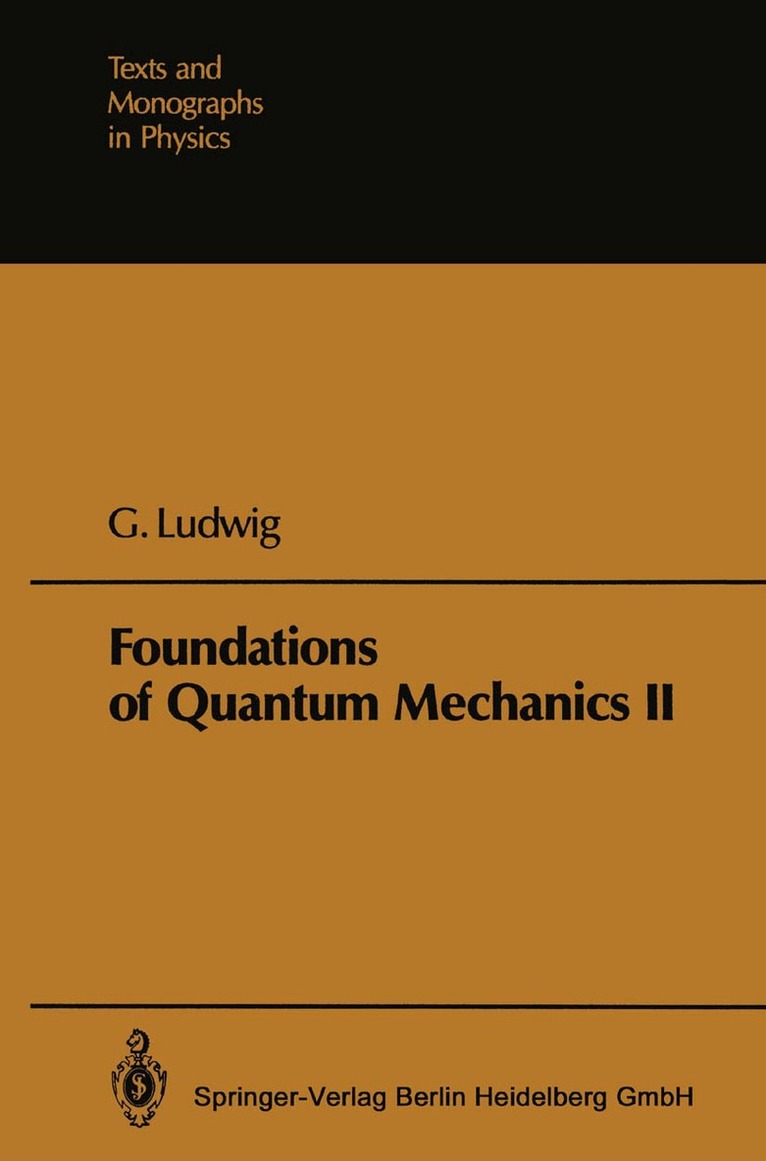
In this second volume on the Foundations of Quantum Mechanics we shall show how it is possible, using the methodology presented in Volume I, to deduce some of the most important applications of quantum mechanics. These deductions are concerned with the structures of the microsystems rather than the technical details of the construction of preparation and registration devices. Accordingly. the only new axioms (relative to Volume I) which are introduced are concerned with the relationship between ensemble operators W, effect operators F, and certain construction principles of the preparation and registration devices. The applications described here are concerned with the measurement of atomic and molecular structure and of collision experiments. An additional and essential step towards a theoretical description of the preparation and registration procedures is carried out in Chapter XVII. Here we demonstrate how microscopic collision processes (that is, processes which can be described by quantum mechanics) can be used to obtain novel preparation and registration procedures if we take for granted the knowledge of only a few macroscopic preparation and registration procedures. By clever use of collision processes we are often able to obtain very precise results for the operators Wand F which describe the total procedures from a very imprecise knowledge of the macroscopic parts of the preparation and regis tration processes. In this regard experimental physicists have done brilliant work. In this sense Chapter XVII represents a general theoretical foundation for the procedures used by experimental physicists.