The Complete Works of Oscar Wilde – serie
Visar alla böcker i serien The Complete Works of Oscar Wilde. Handla med fri frakt och snabb leverans.
2 produkter
2 produkter
3 273 kr
Skickas inom 5-8 vardagar
This edition collects and prints all of Oscar Wilde's short fiction, principally the three collections of tales published in the late 1880s and early 1890s. The first of these was The Happy Prince (1888), a volume which was aimed at the children's market, and which capitalized on the growing popularity of fairy stories in nineteenth-century Britain. This edition then prints Lord Arthur Savile's Crime (1891), Wilde's volume of short tales satirizing the manners and morals of London's elite in the last decades of the nineteenth century--those 'upper ten thousand', as Max Beerbohm later called them. In many ways these stories anticipate both the themes and the devices of Wilde's later and highly successful society comedies, including Lady Windermere's Fan and The Importance of Being Earnest. This edition also includes Wilde's second volume of fairy stories, A House of Pomegranates (1891); this volume comprised tales written for adults, and contained Decadent and what can be seen as highly sexualized themes. The textual and printing history of each of these volumes is described and explored in detail. The substantial commentary provides a full critical annotation of each story.Wilde also wrote stories which were not collected, most importantly a jeu d'esprit on the identity of the addressee of Shakespeare's Sonnets--'The Portrait of Mr W.H.', a piece which appeared in periodical form in the late 1880s. Wilde expanded his story, turning it into a hybrid of fiction and criticism, and in the process used it as a vehicle to describe his view of the relationship--physical, artistic, and spiritual--between Shakespeare and a (fictitious) boy-actor in his company, the 'Mr W.H.' of the title and of the dedication of the first printing of Shakespeare's Sonnets. This revised and expanded piece, which remained unpublished in Wilde's lifetime, represents his most sustained and eloquent exploration of male-male desire. The edition prints in full for the first time Wilde's manuscript of that story. Like the other works it prints, the edition also contains full critical annotation which documents Wilde's reading on Renaissance philosophy and theatre history. The lengthy introduction describes in detail Wilde's metamorphosis from a jobbing journalist, whose work often appeared anonymously in the penny press of the 1880s, to an accomplished writer of fiction.
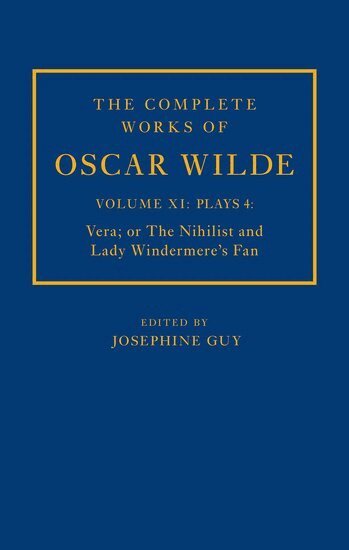
The Complete Works of Oscar Wilde: Volume XI Plays 4: Vera; or The Nihilist and Lady Windermere's Fan
Inbunden, Engelska, 2021
3 793 kr
Skickas inom 5-8 vardagar
Volume IX in the Complete Works of Oscar Wilde brings together Wilde's first performed play, Vera; or, The Nihilist, and his first West End success, Lady Windermere's Fan. Two texts are provided for each play: a reconstruction of the first performance text of each work, based on marked-up scripts that were used during rehearsals, and which are collated in the Textual Notes with all other extant versions (including manuscripts, typescripts, and where relevant, authoritative acting editions); as well as, for Vera, a complete transcription of an early manuscript and manuscript fragment, and for Lady Windermere's Fan, a reproduction of the familiar 1893 Bodley Head 'reading text' of the play. Also provided are two lengthy Introductions to the plays describing the history of their composition, staging, reception and (where relevant) publication, and in which special attention is given to Wilde's relationships with the actor-managers who starred in and produced these works: Marie Prescott and George Alexander. Commentaries identify references, allusions, and possible source materials Wilde drew upon. A notable feature of the edition in this respect is the attention given to a range of contemporary Nihilist-themed works, fictional and non-fictional, to which Vera is compared, as well as to the intricate codes of contemporary etiquette, upon which much of the humour of Lady Windermere's Fan is reliant.