The Masters of Sociological Theory – Serie
Visar alla böcker i serien The Masters of Sociological Theory. Handla med fri frakt och snabb leverans.
3 produkter
3 produkter
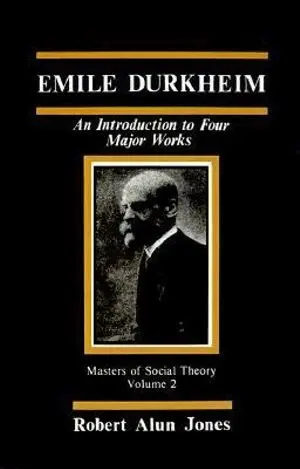
Del 2 - The Masters of Sociological Theory
Emile Durkheim
An Introduction to Four Major Works
Häftad, Engelska, 1986
2 304 kr
Skickas inom 3-6 vardagar
This volume focuses on the four books by Durkheim which are generally accorded "classic" status: The Division of Labor in Society (1893), The Rules of Sociological Method (1895), Suicide (1897), and The Elementary Forms of the Religious Life (1912). In considering each of these works, Jones gives an account of Durkheim's intentions and beliefs, and why he held these beliefs, taking into consideration their social and historical context. In this discussion Jones also explains how Durkheim held some beliefs because he held other beliefs, in the sense that some beliefs provided his reasons for holding other beliefs. The author then follows this with a critical assessment of Durkheim's beliefs, indicating where these reasons were or were not insufficient, either by Durkheim's standards or our own. This book provides an excellent introduction to these four works in particular, and to Durkheim's sociological theories in general. It will be useful to upper-division undergraduates, as well as graduate students in sociology, philosophy, and intellectual history. Researchers and instructors will find it a valuable resource for lectures and research. "A remarkable work. . . . From presuppositions to conclusions, the presentation of Durkheimian thought is exceptionally clear, concise and pertinent. Jones succeeds in avoiding the traps associated with a summary, staying true to the essential ideas of the sociologist." --Archives de Sciences Sociales des Religions (Translated from French) " 'Translating' Durkheim's central ideas into undeniably more accessible language. Jones always stays close to the texts, and, in tune with his first goal, his work is a relatively accurate account of Durkheim's ideas. In addition, Emile Durkheim is a helpful reference for specific points and definitions." --Contemporary Sociology
2 699 kr
Skickas inom 3-6 vardagar
A concise overview of sociology's greatest classic thinker. Weber emerges as a multisided intellectual personality, whose intellectual ambivalence is related to a neurotic breakdown in mid career and to the compromises he was forced to make among the conflicting politievanscal and intellectual currents of his time. Here we see what kinds of philosophical idealism Weber favored and what kinds he rejected, as well as his position on the "battle of methods" among the economists of his day. Weber's famous "Protestant Ethic" thesis is put in proper perspective as an intellectual gambit in one particular period of his life, rather than as his central achievement. Weber's overall view of social change is examined, drawing on several of his crucial but little-known works, on the sociology of ancient agrarian societies and on the long chain of organizational conditions that finally led to modern capitalism. Also treated are Weber's major works on the sociology of religion and his contributions to systematic theory, especially social stratification. The many strands of Weber's theorizing, and his tremendous scope of comparisons across world history, are here brought into a clear and manageable focus. "Randall Collins is the leading sociological theorist of his generation. He has also done more than anyone else to use and develop Weberian sociology. Accordingly we expect much from Collins on Weber and Max Weber does not disappoint." --Whitney Pope, Indiana University "A lively, efficient, reliable interpretation, captivating for the novice, provocative for the expert. . . . Typical Collins." --Alan Sica, University of Kansas "A good introductory survey of Weber's major writings. It is interesting reading and highly informative." --Contemporary Sociology "A good capsule biography . . . very readable . . . honors clarity, style, and the value of popular understanding." --The Madison Independent Books in Review "Ideal for an introductory course on Weber." --Ethics
1 738 kr
Skickas inom 3-6 vardagar
A concise overview of sociology's greatest classic thinker. Weber emerges as a multisided intellectual personality, whose intellectual ambivalence is related to a neurotic breakdown in mid career and to the compromises he was forced to make among the conflicting politievanscal and intellectual currents of his time. Here we see what kinds of philosophical idealism Weber favored and what kinds he rejected, as well as his position on the "battle of methods" among the economists of his day. Weber's famous "Protestant Ethic" thesis is put in proper perspective as an intellectual gambit in one particular period of his life, rather than as his central achievement. Weber's overall view of social change is examined, drawing on several of his crucial but little-known works, on the sociology of ancient agrarian societies and on the long chain of organizational conditions that finally led to modern capitalism. Also treated are Weber's major works on the sociology of religion and his contributions to systematic theory, especially social stratification. The many strands of Weber's theorizing, and his tremendous scope of comparisons across world history, are here brought into a clear and manageable focus. "Randall Collins is the leading sociological theorist of his generation. He has also done more than anyone else to use and develop Weberian sociology. Accordingly we expect much from Collins on Weber and Max Weber does not disappoint." --Whitney Pope, Indiana University "A lively, efficient, reliable interpretation, captivating for the novice, provocative for the expert. . . . Typical Collins." --Alan Sica, University of Kansas "A good introductory survey of Weber's major writings. It is interesting reading and highly informative." --Contemporary Sociology "A good capsule biography . . . very readable . . . honors clarity, style, and the value of popular understanding." --The Madison Independent Books in Review "Ideal for an introductory course on Weber." --Ethics