Theoretical Perspectives in Law - Böcker
Visar alla böcker i serien Theoretical Perspectives in Law. Handla med fri frakt och snabb leverans.
4 produkter
4 produkter
331 kr
Skickas inom 5-8 vardagar
Alignment between governmental outputs and popular preferences is a core democratic value. For the people genuinely to rule, their government should heed their wishes. Yet alignment is not appreciated by election law scholarship, much of which focuses on other democratic goals. Nor do the courts consider alignment when deciding election law cases. Aligning Election Law fills this gap, providing a new theoretical perspective on election law and showing how alignment theory would operate in practice, in both litigation and legislation.Nicholas O. Stephanopoulos examines alignment from a variety of angles, including its democratic value, its place in legal doctrine, its rarity in modern American politics, and its application to particular election law topics. The book also engages with issues facing American constitutional law and society, including voting restrictions, political parties, partisan gerrymandering, minority representation, and campaign finance, and how alignment theory would tackle these. The book's orientation is normative, suggesting how judicial (and nonjudicial) institutions should approach electoral regulations, not how they have addressed them in the past. By thoroughly canvassing the democratic theory, empirical political science, and election law literatures, the book argues that alignment should be a tenet of the law of democracy. Accordingly, Aligning Election Law will be valuable not just to scholars, students, and practitioners of election law, but to anyone wishing to understand how the law of democracy could better achieve the values of democracy.
399 kr
Skickas inom 5-8 vardagar
Procedural due process guarantees to individual members of the polity that government will treat each of them with fairness and respect when seeking to take their life, liberty, or property. Although enshrined in the US Constitution's Fifth and Fourteenth Amendments, the scope of those guarantees has long been a source of public and academic debate.Due Process as American Democracy develops an entirely new approach to the procedural due process, grounded in foundational precepts of American political theory. It argues that American political thought comes from an adversarial understanding of democracy where individuals need to protect their own interests, because no one else can be trusted to do so. This skeptical democracy informs the separation of powers and operates as the protector of liberal democracy. When applied to procedural due process, adversary democracy dictates a skepticism of both judges and those who seek unilaterally to represent the individuals' interests. The end result is a demand for strong protections of judicial neutrality and independence far beyond what is presently required and imposition of serious restrictions on the ability of courts to appoint others to protect individuals' legally protected interests. The book applies these underlying democratic premises to areas of modern civil procedure and constitutional law, urging dramatic alterations in both.Original and provocative,Due Process as American Democracy provides a fresh view of the constitutional guarantee of due process and will appeal to legal scholars, practitioners, and political theorists alike.
585 kr
Skickas inom 3-6 vardagar
Human rights movements and organizations all over the world cite the pursuit and preservation of dignity as one of their goals, but the legal implications of this term are highly contested. In Dignity and Judicial Authority, Rachel Bayefsky offers a theory of dignity that emphasizes respect for status, non-domination, and control over self-presentation to others. The book explains how US courts can recognize the loss of dignity as a legally actionable harm and provide remedies for this harm. In applying these ideas, the book explores a host of corresponding legal topics, including constitutional standing doctrine, the “dignitary torts,” and court-mandated apologies. It demonstrates the connections between dignity and subjects such as jurisdiction and remedies, which help to delineate the bounds of judicial authority.This inquiry sheds light not only on the nature of dignity, but also on the power of courts and their proper functions in a constitutional democracy. How can judges decide whether dignity has been violated, especially when these decisions risk embroiling them in contentious social disputes? Will accepting dignitary claims burst open the proverbial “floodgates of litigation”? Through theoretical analysis and detailed doctrinal discussion, Bayefsky explains how courts can integrate dignity into legal determinations in a thoughtful and principled manner. Exploring the subject from theoretical and practical perspectives, Dignity and Judicial Authority presents a cogent argument for when and how courts should use their powers to protect and preserve human dignity.
381 kr
Skickas inom 5-8 vardagar
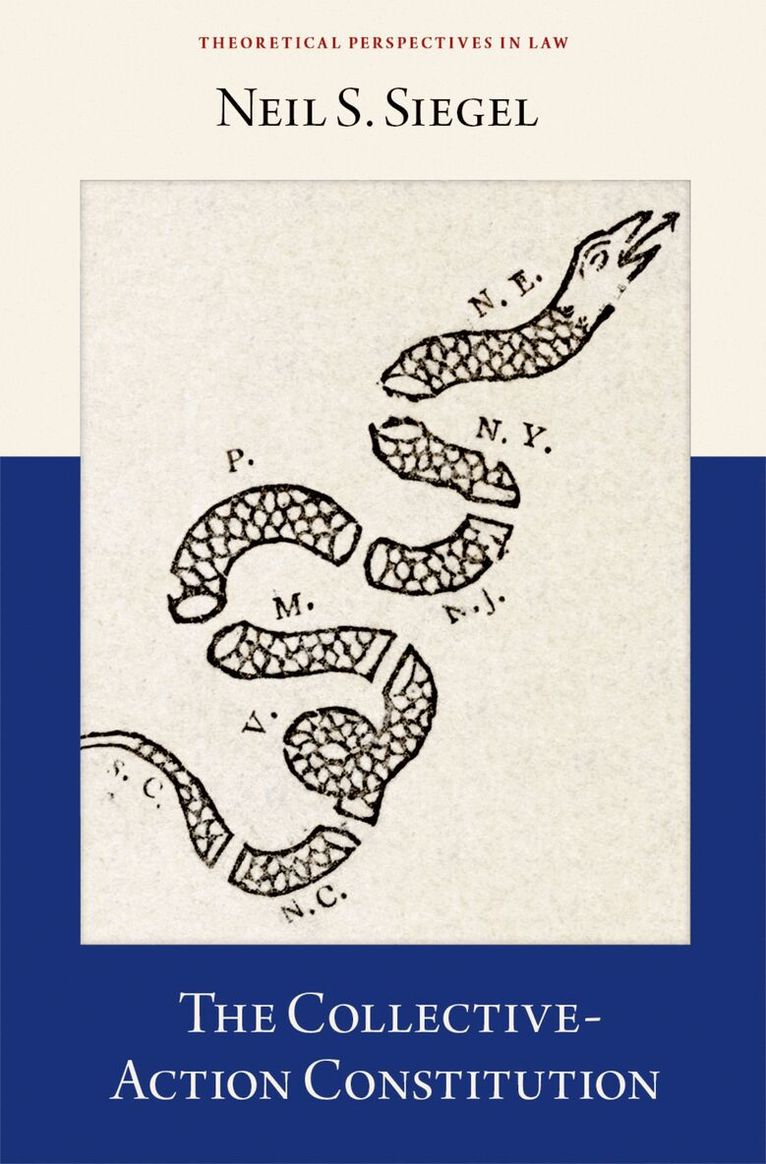
The United States Constitution was established primarily because of the widely recognized failures of its predecessor, the Articles of Confederation, to adequately address "collective-action problems" facing the states. These problems included funding the national government, regulating foreign and interstate commerce, and defending the nation from attack. Meeting such challenges required the states to cooperate or coordinate their behavior, but they often struggled to do so both inside and outside the Confederation Congress. By empowering Congress to solve collective-action problems, and by creating a national executive and judiciary to enforce federal law, the Constitution promised a substantially more effective federal government. An important read for scholars, lawyers, judges, and students alike, Neil Siegel's The Collective-Action Constitution addresses how the U.S. Constitution is, in a fundamental sense, the Collective-Action Constitution. Any faithful account of what the Constitution is for and how it should be interpreted must include the primary structural purpose of empowering the federal government to solve collective-action problems for the states and preventing them from causing such problems. This book offers a thorough examination of the collective-action principles animating the structure of the Constitution and how they should be applied to meet many of the most daunting challenges facing American society today.