Theory in Practice (O'Reilly) - Böcker
Visar alla böcker i serien Theory in Practice (O'Reilly). Handla med fri frakt och snabb leverans.
4 produkter
4 produkter
286 kr
Skickas inom 7-10 vardagar
Radio Frequency Identification (RFID) is rapidly changing the way businesses track inventory and assets. From Wal-Mart and Tesco to the U.S. Department of Defense, early efforts are already showing benefits, but software, integration, and data processing for RFID still present a challenge. If you are a developer or an architect charged with developing an RFID system, this book is for you. Drawing on extensive experience, Bill Glover and Himanshu Bhatt provide you with essential information on this emerging technology. With the knowledge you gain in these pages, you will possess the information and understanding you need to start designing, building, or integrating with RFID systems.In RFID Essentials you will find information on: * Tags and tag protocols, including the Electronic Product Code (EPC) * Readers and reader protocols * RFID middleware * Security and privacy * Managing RFID devices * RFID's impact on your architecture Bill Glover has been writing software since 1981 and has worked as a programmer, lead developer, or architect on systems of all sizes, from small, automated systems controlling dams and feedmills up to a complete redesign and reimplementation of one of the world's busiest travel web sites. Bill first worked with RFID in 1995, tracking individual cattle using ear tags. He is currently a Senior Java Architect with Sun Microsystems, Inc., and works with Sun's RFID consulting practice and the RFID Test Center. Himanshu Bhatt heads the U.S. RFID Practice and Software Technology Lab for Sun Microsystems, Inc. Prior to assuming this role, Himanshu was responsible for business development and consulting in emerging areas of technology. Himanshu has over 16 years of experience in the architecture and development of distributed, multitier systems using a host of technologies for Fortune 1000 companies.Himanshu has spoken at industry conferences such as JavaOne and the LoneStar Symposium and has published articles on Java/J2EE technologies. "The Information Age is over. We're entering an era where network connectivity is almost ubiquitous - it's participate or perish." --Jonathan Schwartz, President and COO, Sun Microsystems, Inc. "Unique competitive advantage erupts from enterprises that couple the RFID technologies laid out in RFID Essentials with modern business integration using service-oriented architectures. This is the book to read in order to understand this new landscape." --Mark Bauhaus, Senior Vice President, Sun Microsystems, Inc. "This is a must read for RFID Software and Solution architects and is highly recommended for anyone needing to gain more insight into the myriad of components, standards and technologies that make up an RFID solutions environment." --Bryan Tracey, Chief Architect, GlobeRanger Corporation "The authors have done a commendable job of covering a lot of ground in the RFID space, including the infrastructure needed to share the volumes of data RFID will likely generate." --Graham Gillen, Senior Product Manager, VeriSign
330 kr
Skickas inom 7-10 vardagar
How do the experts solve difficult problems in software development? In this unique and insightful book, leading computer scientists offer case studies that reveal how they found unusual, carefully designed solutions to high-profile projects. You will be able to look over the shoulder of major coding and design experts to see problems through their eyes. This is not simply another design patterns book, or another software engineering treatise on the right and wrong way to do things. The authors think aloud as they work through their project's architecture, the tradeoffs made in its construction, and when it was important to break rules. "Beautiful Code" is an opportunity for master coders to tell their story. All author royalties will be donated to Amnesty International. The book includes the following contributions: "Beautiful Brevity: Rob Pike's Regular Expression Matcher" by Brian Kernighan, Department of Computer Science, Princeton University; "Subversion's Delta Editor: Interface as Ontology" by Karl Fogel, editor of "QuestionCopyright.org", Co-founder of Cyclic Software, the first company offering commercial CVS support; "The Most Beautiful Code I Never Wrote" by Jon Bentley, Avaya Labs Research; "Finding Things" by Tim Bray, Director of Web Technologies at Sun Microsystems, co-inventor of XML 1.0; "Correct, Beautiful, Fast (In That Order): Lessons From Designing XML Validators" by Elliotte Rusty Harold, Computer Science Department at Polytechnic University, author of "Java I/O, Java Network Programming", and "XML in a Nutshell" (O'Reilly); and, "The Framework for Integrated Test: Beauty through Fragility" by Michael Feathers, consultant at Object Mentor, author of "Working Effectively with Legacy Code" (Prentice Hall). It also includes: "Beautiful Tests" by Alberto Savoia, Chief Technology Officer, Agitar Software Inc; "On-the-Fly Code Generation for Image Processing" by Charles Petzold, author "Programming Windows and Code: The Hidden Language of Computer Hardware and Software" (both Microsoft Press); "Top Down Operator Precedence" by Douglas Crockford, architect at Yahoo!Inc, Founder and CTO of State Software, where he discovered JSON; "Accelerating Population Count" by Henry Warren, currently works on the Blue Gene petaflop computer project Worked for IBM for 41 years; "Secure Communication: The Technology of Freedom" by Ashish Gulhati, Chief Developer of Neomailbox, an Internet privacy service Developer of Cryptonite, an OpenPGP-compatible secure webmail system; and, "Growing Beautiful Code in BioPerl" by Lincoln Stein, investigator at Cold Spring Harbor Laboratory - develops databases and user interfaces for the Human Genome Project using the Apache server and its module API.It also includes: "The Design of the Gene Sorter" by Jim Kent, Genome Bioinformatics Group, University of California Santa Cruz; "How Elegant Code Evolves With Hardware: The Case Of Gaussian Elimination" by Jack Dongarra, University Distinguished Professor of Computer Science in the Computer Science Department at the University of Tennessee, also distinguished Research Staff member in the Computer Science and Mathematics Division at Oak Ridge National Laboratory (ORNL) and Piotr Luszczek, Research Professor at the University of Tennessee; "Beautiful Numerics" by Adam Kolawa, co-founder and CEO of Parasoft; and, "The Linux Kernel Driver Model" by Greg Kroah-Hartman, SuSE Labs/Novell, Linux kernel maintainer for driver subsystems, author of "Linux Kernel in a Nutshell", co-author of "Linux Device Drivers, 3rd Edition" (O'Reilly).It also includes: "Another Level of Indirection" by Diomidis Spinellis, Associate Professor at the Department of Management Science and Technology at the Athens University of Economics and Business, Greece; "An Examination of Python's Dictionary Implementation" by Andrew Kuchling, longtime member of the Python development community, and a director of the Python Software Foundation; "Multi-Dimensional Iterators in NumPy" by Travis Oliphant, Assistant Professor in the Electrical and Computer Engineering Department at Brigham Young University; and, "A Highly Reliable Enterprise System for NASAs Mars Rover Mission" by Ronald Mak, co-founder and CTO of Willard & Lowe Systems, Inc, formerly a senior scientist at the Research Institute for Advanced Computer Science on contract to NASA Ames.It also includes: "ERP5: Designing for Maximum Adaptability" by Rogerio de Carvalho, researcher at the Federal Center for Technological Education of Campos (CEFET Campos), Brazil and Rafael Monnerat, IT Analyst at CEFET Campos, and an offshore consultant for Nexedi SARL; "A Spoonful of Sewage" by Bryan Cantrill, Distinguished Engineer at Sun Microsystems, where he has spent most of his career working on the Solaris kernel; "Distributed Programming with MapReduce" by Jeff Dean and Sanjay Ghemawat, Google Fellows in Google's Systems Infrastructure Group; "Beautiful Concurrency" by Simon Peyton Jones, Microsoft Research, key contributor to the design of the functional language Haskell, and lead designer of the Glasgow Haskell Compiler (GHC); and, "Syntactic Abstraction: The syntax-case expander" by Kent Dybvig, Developer of Chez Scheme and author of the Scheme Programming Language. It also includes: "Object-Oriented Patterns and a Framework for Networked Software" by William Otte, a Ph.D. student in the Department of Electrical Engineering and Computer Science (EECS) at Vanderbilt University and Doug Schmidt, Full Professor in the Electrical Engineering and Computer Science (EECS) Department, Associate Chair of the Computer Science and Engineering program, and a Senior Research Scientist at the Institute for Software Integrated Systems (ISIS) at Vanderbilt University; "Integrating Business Partners the RESTful Way" by Andrew Patzer, Director of the Bioinformatics Program at the Medical College of Wisconsin; and, "Beautiful Debugging" by Andreas Zeller, computer science professor at Saarland University, author of "Why Programs Fail: A Guide to Systematic Debugging" (Morgan Kaufman).It also includes: "Code That's Like an Essay" by Yukihiro Matsumoto, inventor of the Ruby language; "Designing Interfaces Under Extreme Constraints: the Stephen Hawking editor" by Arun Mehta, professor and chairman of the Computer Engineering department of JMIT, Radaur, Haryana, India; "Emacspeak: The Complete Audio Desktop" by TV Raman, Research Scientist at Google where he focuses on web applications; "Code in Motion" by Christopher Seiwald, founder and CTO of Perforce Software and Laura Wingerd, vice president of product technology at Perforce Software, author of "Practical Perforce" (O'Reilly); and, "Writing Programs for 'The Book'" by Brian Hayes who writes the Computing Science column in American Scientist magazine, author of "Infrastructure: A Field Guide to the Industrial Landscape"(W.W. Norton).
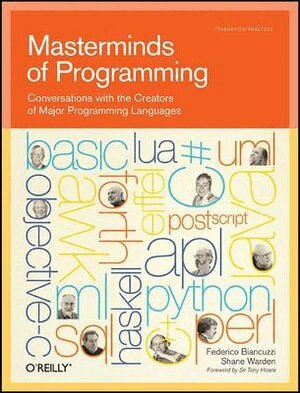
Masterminds of Programming
Conversations with the Creators of Major Programming Languages
Häftad, Engelska, 2009
294 kr
Skickas inom 7-10 vardagar
"Masterminds of Programming" features exclusive interviews with the creators of several historic and highly influential programming languages. In this unique collection, you'll learn about the processes that led to specific design decisions, including the goals they had in mind, the trade-offs they had to make, and how their experiences have left an impact on programming today. "Masterminds of Programming" includes individual interviews with: Adin D. Falkoff: APL; Thomas E. Kurtz: BASIC; Charles H. Moore: FORTH; Robin Milner: ML; Donald D. Chamberlin: SQL; Alfred Aho, Peter Weinberger, and Brian Kernighan: AWK; Charles Geschke and John Warnock: PostScript; Bjarne Stroustrup: C++; Bertrand Meyer: Eiffel; Brad Cox and Tom Love: Objective-C; Larry Wall: Perl; Simon Peyton Jones, Paul Hudak, Philip Wadler, and John Hughes: Haskell; Guido van Rossum: Python; Luiz Henrique de Figueiredo and Roberto Ierusalimschy: Lua; James Gosling: Java; Grady Booch, Ivar Jacobson, and James Rumbaugh: UML; and, Anders Hejlsberg: Delphi inventor and lead developer of C#.If you're interested in the people whose vision and hard work helped shape the computer industry, you'll find "Masterminds of Programming" fascinating.
294 kr
Skickas inom 7-10 vardagar
Anyone who develops software for a living needs a proven way to produce it better, faster, and cheaper. "The Productive Programmer" offers critical timesaving and productivity tools that you can adopt right away, no matter what platform you use. Master developer Neal Ford not only offers advice on the mechanics of productivity-how to work smarter, spurn interruptions, get the most out your computer, and avoid repetition-he also details valuable practices that will help you elude common traps, improve your code, and become more valuable to your team.You'll learn to: write the test before you write the code; manage the lifecycle of your objects fastidiously; build only what you need now, not what you might need later; apply ancient philosophies to software development; question authority, rather than blindly adhere to standards; make hard things easier and impossible things possible through meta-programming; be sure all code within a method is at the same level of abstraction; and, pick the right editor and assemble the best tools for the job. This isn't theory, but the fruits of Ford's real-world experience as an Application Architect at the global IT consultancy ThoughtWorks.Whether you're a beginner or a pro with years of experience, you'll improve your work and your career with the simple and straightforward principles in The Productive Programmer.