To the Last Smoke - Böcker
Visar alla böcker i serien To the Last Smoke. Handla med fri frakt och snabb leverans.
8 produkter
8 produkter
183 kr
Skickas inom 11-20 vardagar
With its scattered mountains and high rims, its dry air and summer lightning, its rising tier of biomes from desert grasses to alpine conifers, and its aggressive exurban sprawl, something in The Southwest is ready to burn each year and some high-value assets seem ever in their path. But the past 20 years have witnessed an uptake in savagery, as routine surface burns have mutated into megafires and overrun nearly a quarter of the region’s forests. What happened, and what does it mean for the rest of the country? Through a mixture of journalism, history, and literary imagination, fire expert Stephen J. Pyne provides a lively survey of what makes this region distinctive, moving us beyond the usual conversations of science and policy. Pyne explores The Southwest’s sacred mountains, including the Jemez, Mogollon, Huachucas, and Kaibab; its sky islands, among them the Chiricahuas, Mount Graham, and Tanque Verde; and its famous rims and borders. Together, the essays provide a cross-section of how landscape fire looks in the early years of the 21st century, what is being done to manage it, and how fire connects with other themes of southwestern life and culture.
191 kr
Skickas inom 7-10 vardagar
The coastal sage and shrublands of California burn. The mountain-encrusting chaparral burns. The conifer forests of the Sierra Nevada, Cascades, and Trinity Alps burn. The rain-shadowed deserts after watering by El Niño cloudbursts and the thick forests of the rumpled Coast Range—all burn according to local rhythms of wetting and drying. Fire season, so the saying goes, lasts 13 months. In this collection of essays on the region, Stephen J. Pyne colorfully explores the ways the region has approached fire management and what sets it apart from other parts of the country. Pyne writes that what makes California's fire scene unique is how its dramatically distinctive biomes have been yoked to a common system, ultimately committed to suppression, and how its fires burn with a character and on a scale commensurate with the state's size and political power. California has not only a ferocity of flame but a cultural intensity that few places can match. California's fires are instantly and hugely broadcast. They shape national institutions, and they have repeatedly defined the discourse of fire's history. No other place has so sculpted the American way of fire. California is part of the multivolume series describing the nation's fire scene region by region. The volumes in To the Last Smoke also cover Florida, the Northern Rockies, the Great Plains, the Southwest, and several other critical fire regions. The series serves as an important punctuation point to Pyne's fifty-year career with wildland fire—both as a firefighter and a fire scholar. These unique surveys of regional pyrogeography are Pyne's way of ""keeping with it to the end,"" encompassing the directive from his rookie season to stay with every fire ""to the last smoke.
183 kr
Skickas inom 11-20 vardagar
It’s a place of big skies and big fires, big burns like those of 1910 and 1988 that riveted national attention. Conflagrations like those of 1934 and 2007 that reformed national policy. Blowups like that in Mann Gulch that shaped the literature of American fire. Big fires mostly hidden in the backcountry like the Fitz Creek and Howler fires that inspired the practice of managed wildfires. Until the fire revolution of the 1960s, no region so shaped the American way of fire.The Northern Rockies remain one of three major hearths for America’s fire culture. They hold a major fire laboratory, an equipment development center, an aerial fire depot, and a social engagement with fire—even a literature. Missoula is to fire in the big backcountry what Tallahassee is to prescribed burning and what Southern California is to urban-wildland hybrids. On its margins, Boise hosts the National Interagency Fire Center. In this structured collection of essays on the region, Stephen J. Pyne explores what makes The Northern Rockies distinctive and what sets it apart from other regions of the country. Surprisingly, perhaps, the story is equally one of big bureaucracies and of generations that encounter the region’s majestic landscapes through flame.
183 kr
Skickas inom 11-20 vardagar
Early descriptions of the Great Plains often focus on a vast, grassy expanse that was either burnt or burning. The scene continued to burn until the land was plowed under or grazed away and broken by innumerable roads and towns. Yet, where the original landscape has persisted, so has fire, and where people have sought to restore something of that original setting, they have had to reinstate fire. This has required the persistence or creation of a fire culture, which in turn inspired schools of science and art that make the Great Plains today a regional hearth for American fire.Volume 5 of To the Last Smoke introduces a region that once lay at the geographic heart of American fire and today promises to reclaim something of that heritage. After all these years, the Great Plains continue to bear witness to how fires can shape contemporary life, and vice versa. In this collection of essays, Stephen J. Pyne explores how this once most regularly and widely burned province of North America, composed of various sub-regions and peoples, has been shaped by the flames contained within it and what fire, both tame and feral, might mean for the future of its landscapes.Included in this volume:How wildland and rural fire have changed from the 19th century to the 21st centuryHow fire is managed in the nation’s historic tallgrass prairies, from Texas to South Dakota, from Illinois to NebraskaHow fire connects with other themes of Great Plains life and cultureHow and why Texas has returned to the national narrative of landscape fire
191 kr
Skickas inom 7-10 vardagar
Its fires help give to the Interior West a peculiar character, fundamental both to its natural and human histories. While a general aridity unites the region, defined here as the states of Nevada, Utah, and western Colorado, its fires illuminate the ways its various parts show profoundly different landscapes, biotas, and human settlement experiences.In this book, fire historian Stephen J. Pyne explains the relevance of the region to the national fire scene. The Interior West offered the first scientific inquiry into landscape fire in the United States, including a map of Utah burns published in 1878 as part of John Wesley Powell’s arid lands report. Then its significance faded and by the 20th century, the region had become the hole in the national donut of fire management. Pyne discusses the region’s more recent return to prominence due to fires along its front ranges; to invasive species, both exotics like cheatgrass and unleashed natives like mountain pine beetle; and to its fatality fires, notably at South Canyon in 1994.The Interior West shows the variety of fire issues in the region and their significance to the country overall through thoughtful framing and lively essays.
191 kr
Skickas inom 7-10 vardagar
Fire is special. Even among the ancient elements, fire is different because it alone is a reaction. It synthesizes its surroundings; it takes its character from its context. It varies by place, by culture, and by time. It has no single expression. There is no single way to understand it. The latest book in the To the Last Smoke series, Here and There explores how singular moments create prisms by which to understand fire. In this collection of essays, historian and renowned fire expert Stephen J. Pyne offers his reflections on national and global wildland fire management, explains how fire policy has changed within the United States and how it differs from other countries, muses on the next wave of fire research, explains the history of one of the most famous fire paintings of all time, and distills the long saga of fire on Earth and its role in underwriting an Anthropocene that might equally be called a Pyrocene. Presented through a mixture of journalism, history, and literary imagination, Here and There moves the discussion of fire beyond the usual formations of science and policy within a national narrative to one of thoughtful interpretation, analysis, and commentary. Centered on the unique complexities of fire management in a global world, Here and There offers a punctuation point to our understanding of wildfire.
183 kr
Skickas inom 11-20 vardagar
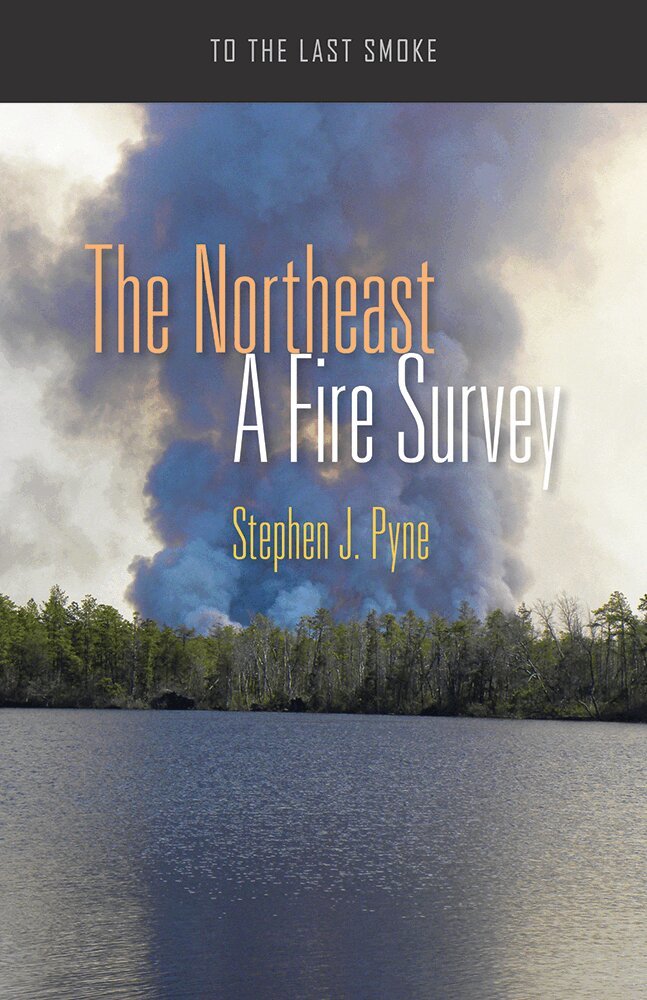
Repeatedly, if paradoxically, the Northeast has led national developments in fire. Its intellectuals argued for model preserves in the Adirondacks and at Yellowstone, oversaw the first mapping of the American fire scene for the 1880 census, staffed the 1896 National Academy of Sciences forest commission that laid down guidelines for the national forests, and spearheaded legislation that allowed those reserves to expand by purchase. It trained the leaders who staffed those protected areas and produced most of America's first environmentalists.The Northeast has its roster of great fires, beginning with dark days in the late 18th century, followed by a chronicle of conflagrations continuing as late as 1903 and 1908, with a shocking after-tremor in 1947. It hosted the nation's first forestry schools. It organized the first interstate (and international) fire compact. And it was the Northeast that pioneered the transition to the true Big Burn—industrial combustion—as America went from burning living landscapes to burning lithic ones.In this new book in the To the Last Smoke series, renowned fire expert Stephen J. Pyne narrates this history and explains how fire is returning to a place not usually thought of in America's fire scene. He examines what changes in climate and land use mean for wildfire, what fire ecology means for cultural landscapes, and what experiments are underway to reintroduce fire to habitats that need it. The region's great fires have gone; its influence on the national scene has not.The Northeast: A Fire Survey samples the historic and contemporary significance of the region and explains how it fits into a national cartography and narrative of fire.Included in this volume:How the region shaped America's understanding and policy toward fireHow fire fits into the region today and what that means for the country overallWhat changes in climate, land use, and institutions may mean for northeastern fire, both wild and tame
370 kr
Skickas inom 7-10 vardagar
From boreal Alaska to subtropical Florida, from the chaparral of California to the pitch pine of New Jersey, America boasts nearly a billion burnable acres. In nine previous volumes, Stephen J. Pyne has explored the fascinating variety of flame region by region. In To the Last Smoke: An Anthology he selects a sampling of the best from each.To the Last Smoke offers a unique and sweeping view of the nation's fire scene by distilling observations on Florida, California, the Northern Rockies, the Great Plains, the Southwest, the Interior West, the Northeast, Alaska, the oak woodlands, and the Pacific Northwest into a single, readable volume. The anthology functions as a color-commentary companion to the play-by-play narrative offered in Pyne's Between Two Fires: A Fire History of Contemporary America. The series is Pyne's way of 'keeping with it to the end,' encompassing the directive from his rookie season to stay with every fire 'to the last smoke.'