Topics in the Contemporary Pacific - Böcker
Visar alla böcker i serien Topics in the Contemporary Pacific. Handla med fri frakt och snabb leverans.
4 produkter
4 produkter
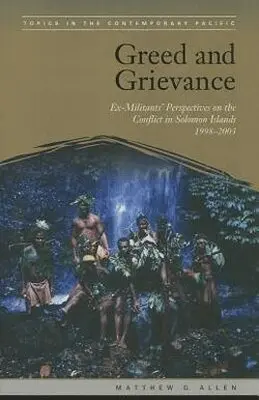
Greed and Grievance
Ex-Militants' Perspectives on the Conflict in Solomon Islands, 1998-2003
Inbunden, Engelska, 2013
585 kr
Skickas inom 7-10 vardagar
This work offers important new perspectives on the violence and unrest that gripped Solomon Islands between late 1998 and mid-2003, a period known as the Ethnic Tension. Based on in-depth interviews and documents associated with the “Tension Trials”, it is the first detailed account of the conflict that engages directly with the voices of the men who joined the rival militant groups. These contemporary voices are presented against the backdrop of the socioeconomic and cultural history of Solomon Islands. The findings provide a refreshing corrective to the pervasive framing of the Isatabu uprising and the Malaitan response as essentially criminal and apolitical activities driven by the self-interest of those who participated in them. Alternative motives for the men who participated in the Solomons conflict are elucidated, foremost of which are their own conceptions of history and of the places of their respective peoples in the historical processes of colonization, development, and nation-building. Uneven development, relative deprivation and rapid socioeconomic and cultural change are highlighted as salient structural causes of the unrest.
885 kr
Skickas inom 10-15 vardagar
Women are significantly underrepresented in politics in the Pacific Islands, given that only one in twenty Pacific parliamentarians are female, compared to one in five globally. A common, but controversial, method of increasing the number of women in politics is the use of gender quotas, or measures designed to ensure a minimum level of women’s representation. In those cases where quotas have been effective, they have managed to change the face of power in previously male-dominated political spheres.How do political actors in the Pacific islands region make sense of the success (or failure) of parliamentary gender quota campaigns? To answer the question, Kerryn Baker explores the workings of four campaigns in the region. In Samoa, the campaign culminated in a “safety net” quota to guarantee a minimum level of representation, set at five female members of Parliament. In Papua New Guinea, between 2007 and 2012 there were successive campaigns for nominated and reserved seats in parliament, without success, although the constitution was amended in 2011 to allow for the possibility of reserved seats for women. In post-conflict Bougainville, women campaigned for reserved seats during the constitution-making process and eventually won three reserved seats in the House of Representatives, as well as one reserved ministerial position. Finally, in the French Pacific territories of New Caledonia, French Polynesia, and Wallis and Futuna, Baker finds that there were campaigns both for and against the implementation of the so-called “parity laws.” Baker argues that the meanings of success in quota campaigns, and related notions of gender and representation, are interpreted by actors through drawing on different traditions, and renegotiating and redefining them according to their goals, pressures, and dilemmas. Broadening the definition of success thus is a key to an understanding of realities of quota campaigns. Pacific Women in Politics is a pathbreaking work that offers an original contribution to gender relations within the Pacific and to contemporary Pacific politics.
885 kr
Skickas inom 10-15 vardagar
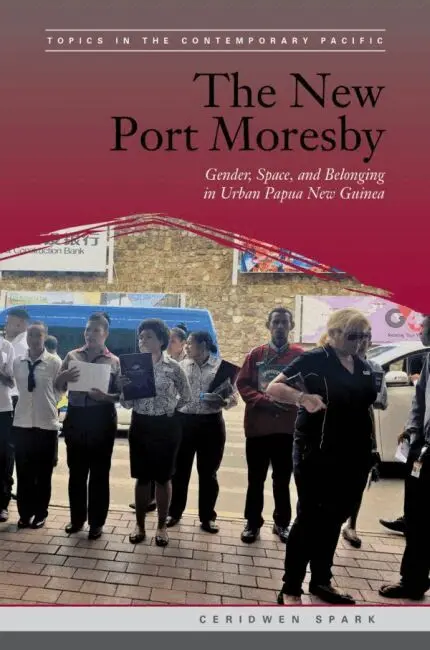
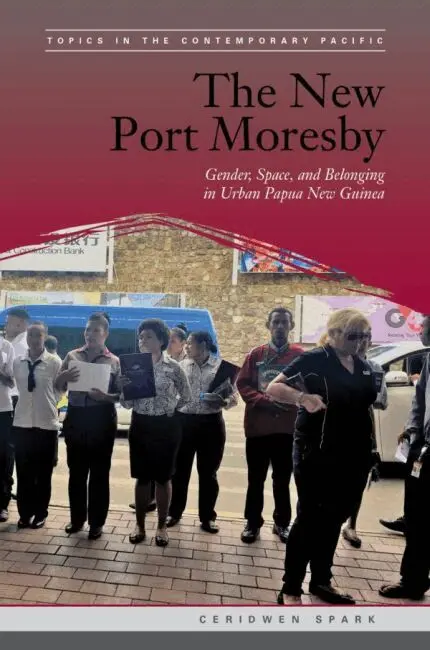
The New Port Moresby: Gender, Space, and Belonging in Urban Papua New Guinea explores the ways in which educated, professional women experience living in Port Moresby, the burgeoning capital of Papua New Guinea. Drawing on postcolonial and feminist scholarship, the book adds to an emerging literature on cities in the “Global South” as sites of oppression, but also resistance, aspiration, and activism. Taking an intersectional feminist approach, the book draws on a decade of research conducted among the educated professional women of Port Moresby, offering unique insight into class transitions and the perspectives of this small but significant cohort. The New Port Moresby expands the scope of research and writing about gendered experiences in Port Moresby, moving beyond the idea that the city is an exclusively hostile place for women. Without discounting the problems of uneven development, the author argues that the city’s new places offer women a degree of freedom and autonomy in a city predominantly characterized by fear and restriction. In doing so, it offers an ethnographically rich perspective on the interaction between the “global” and the “local” and what this might mean for feminism and the advancement of equity in the Pacific and beyond. The New Port Moresby will find an audience among anthropologists, particularly those interested in the urban Pacific, feminist geographers committed to expanding research to include cities in the Global South and development theorists interested in understanding the roles played by educated elites in less economically developed contexts. There have been few ethnographic monographs about Port Moresby and those that do exist have tended to marginalize or ignore gender. Yet as feminist geographers make clear, women and men are positioned differently in the world and their relationship to the places in which they live is also different. The book has no predecessors and stands alone in the Pacific as an account of this kind. As such, The New Port Moresby should be read by scholars and students of diverse disciplines interested in urbanization, gender, and the Pacific.
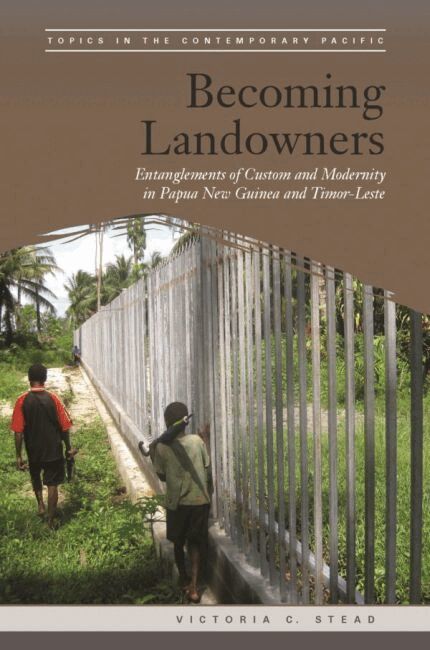
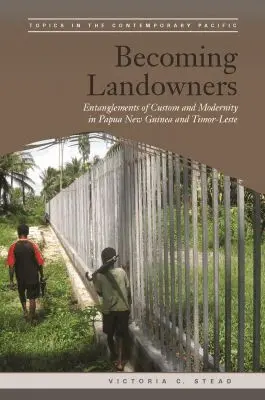
Becoming Landowners
Entanglements of Custom and Modernity in Papua New Guinea and Timor-Leste
Häftad, Engelska, 2022
291 kr
Skickas inom 7-10 vardagar
Across Melanesia, the ways in which people connect to land are being transformed by processes of modernization—globalization, the building of states and nations, practices and imaginaries of development, the legacies of colonialism, and the complexities of postcolonial encounters. Melanesian peoples are becoming landowners, Stead argues, both in the sense that these processes of change compel forms of property relations, and in the sense that "landowner" and "custom landowner" become identities to be wielded against the encroachment of both state and capital. In places where customary forms of land tenure have long been dominant, deeply intertwined with senses of self and relationships with others, land now becomes a crucible upon which social relations, power, and culture are reconfigured and reimagined. Employing a multi-sited ethnographic approach, Becoming Landowners explores these transformations to land and life as they unfold across two Melanesian countries. The chapters move between coasts and inland mountain ranges, between urban centers and rural villages, telling the stories of people and places who are always situated and particular but who also share powerful commonalities of experience. These include a subsistence-based community shaped by the legacies of colonialism and occupation in remote Timor-Leste, villagers in Papua New Guinea resisting a mining operation and the government agents supporting it, an urban East Timorese settlement resisting eviction by the nation-state its residents hoped would represent them in the post-independence era, and people and groups in both countries who are struggling for, with, and sometimes against the formal codification of their claims to land and place. In each of these instances, customary and modern forms of connection to land are propelled into complex and dynamic configurations, theorized here in an innovative way as entanglements of custom and modernity. Moving between multiple sites, scales, and forms of collectivity, Becoming Landowners reveals entanglements as spaces of deep ambivalence. Here, structures of power are destabilized in ways that can lend themselves to the diminishing of local autonomy in the face of the state and capital. At the same time, the destabilization of power also creates new possibilities for the reassertion of that autonomy, and of the customary forms of connection to land in which it is grounded.