Van Nostrand Reinhold Electrical/Computer Science and Engineering Series - Böcker
Visar alla böcker i serien Van Nostrand Reinhold Electrical/Computer Science and Engineering Series. Handla med fri frakt och snabb leverans.
17 produkter
17 produkter
2 642 kr
Skickas inom 10-15 vardagar
1 588 kr
Skickas inom 10-15 vardagar
1 588 kr
Skickas inom 10-15 vardagar
1 588 kr
Skickas inom 10-15 vardagar
The porous structure of molecular sieves, combined with their chemical composition, makes them uniquely suitable for use as catalysts or catalytic supports, and as such the materials find use in a range of chemical reactions such as acid catalysis, oxidation and reduction reactions, and as components of formulated products. The shape selectivity of the materials further enhances their chemical usefulness, and exploitation of their unique absorption properties holds the key to further improving their catalytic properties. To that end, efforts are being made to find new or different molecular sieves, with altered or tailored structures or chemical composition. In a thorough overhaul of the first edition of this book, the author guides the reader in the basics of sieve structure, synthesis and characterization, and points the way to the development of improved sieve materials. Covering both the principles and practical aspects of sieve synthesis and characterization, this book serves as a guide to the state of mid-to-late-1990s understanding of the subject. It should be of interest to professional chemists, particularly those involved in industrial research and development.
2 338 kr
Skickas inom 5-8 vardagar
1 091 kr
Skickas inom 10-15 vardagar
This book contains material that should interest students of electrical engineering and computer science specializing in digital communications and also practicing electrical engineers who apply digital communications techni ques to telecommunication systems, digital radio, digital satellites, fiber optics, and the physical layer of computer networks. This book is an outgrowth of lecture notes prepared over a number of years at various universities. In the earlier years I benefited immensely from t 5 the excellent textbooks and monographs in preparing my notes. - With passing time I had to rely more and more on the current periodical literature, mainly the IEEE Transactions and the Bell System Technical Journal. Although the book is intended mainly for those who have already had an introduction to communications, as usually taught in an undergraduate course, it can also be used without this background. For that purpose I concentrated most of the necessary mathematics in Chapter I. If the mathematics is not an obstacle, the reader can start with Chapter 2. I tried, as far as possible, to make each chapter independent of the other chapters, and for that reason many concepts and notations have been defined several times. To keep the book at a reasonable length, however, it was impossible, in most cases, not to rely on derivations and results of previous chapters.
1 059 kr
Skickas inom 10-15 vardagar
In the development of telecommunication networks throughout the world, digital transmission has now replaced analog transmission as the predominant choice for new transmission facilities. This trend began in the early 1960s when the American Telephone and Telegraph Company first introduced pulse code modulation as a means of increasing capacity in their cable plant. Since that time, digital transmission applications have grown dramatically, notably in the United States, Canada, Japan, and Western Europe. With the rapidity of digital transmission developments and imple mentation, however, there has been a surprising lack of textbooks written on the subject. This book grew out of my work, research, and teaching in digital transmission systems. My objective is to provide an overview of the subject. To accomplish this end, theory has been blended with practice in order to illustrate how one applies theoretical principles to actual design and imple mentation. The book has abundant design examples and references to actual systems. These examples have been drawn from common carriers, manufac turers, and my own experience. Considerable effort has been made to include up-to-date standards, such as those published by the CCITT and CCIR, and to interpret their recommendations in the context of present-day digital transmission systems.
534 kr
Skickas inom 10-15 vardagar
The action of enzymes fascinated mankind long before they were rec ognized for the complex chemicals that they are. The first application of these remarkable compounds to produce ethanol by fermentation is lost to antiquity. Payer and Persoz (Ann. Chim. Phys. , 53, 73 (1833ii)) appear to have provided the first step toward understanding this com plex area when they reported the isolation of diastase in 1833. These workers showed that diastase could catalyze the hydrolysis of starches to sugars. Somewhat earlier Kirchhoff (Schwigger's Journal, 4, 108 (1812)) had shown that a small amount of dilute acid could hydrolyze a seemingly endless amount of starch to sugars. The genius of Berzelius recognized the commonality of these two observations in connection with a few other isolated observations and in 1834 coined the term catalysis to describe such actions. Professor Leibig was one of the giants of the chemical world in 1840. In addition to his own work, Liebig was training the world's next generation of chemists in his laboratory in Giessen. This cadre of chemists were very impressed by the master teacher so that is it only natural that Liebig's views should dominate with this next generation of chemists. Leibig was, in the 1830s and 1840s, developing his mastery of agricultural chemistry. The mechanism of putrefication was of great concern to Leibig, and he turned to the newly defined area of catalysis for an explanation.
534 kr
Skickas inom 10-15 vardagar
Catalysis involves just about every field of scientific study. This means that a multidisciplinary approach is needed in catalytic studies. Catalysis involves breaking and forming new bonds and this requires an under standing of either adsorption by bonding to an extended structures or bonding in a coordination sphere. Any understanding of catalytic action must necessarily involve an understanding of this bonding. Even 200 years ago scientists were aware that a properly treated mate rial, such as charcoal, could adsorb an enormous quantity of gas. In 1812, de Sassasure (English translation, Annal Philosphy, 6, 241 (1815» pro posed that the ability of a material to increase the rate of chemical reac tion was due to adsorption of the material in the fine structure of the solid so that the concentrations of the reactants were significantly increased, and this increase in concentration led to an increase in reaction rate. During the 1800s, little advance was made in the understanding of adsorp tion.
534 kr
Skickas inom 10-15 vardagar
Antennas are part of every radar, every communications system, and every electronic warfare system. Therefore antennas are an important technical subject. The number of antenna books that have been published in the last 5 years alone attest to this fact. But why another book about antennas? What does this book offer that is different from all the others? The answer is: accessibility. Most of the technical literature on antennas is written for those with extensive backgrounds in electromagnetic theory and familiarity with the mathematical language of vector analysis, differential equations, and special functions. This puts much of the antenna literature out of reach for the nonspecialist who needs to understand the subject but cannot afford the time required to become familiar with all the background material. With the rapid expansion of technical knowledge, the number of engi neering students who find themselves attracted to "classical" subjects, such as electromagnetic theory, is on the decline, making it increasingly difficult to train engineers in areas involving antennas. Some authors in other technical fields have recognized this problem. For example, books on solid-state elec tronic devices that do not require an extensive background in quantum me chanics are available, useful, and informative. This book fulfills a similar Ileed in the area of antennas.
1 046 kr
Skickas inom 10-15 vardagar
The objective of the book is to provide sufficient background and understand ing to enable its readers to design and apply switched capacitor circuits whether these are to be implemented as discrete circuits or by MOS technol ogy. Since this is the first book devoted entirely to the subject of switched capacitor circuits, it has no pattern to follow. Fortunately, it was developed in an environment where many of the circuits and concepts it discusses could actually be integrated as MOS integrated circuits. It is hoped that this environ ment has created a selection process that has enhanced the contents. Switched capacitor circuits provide an example of the influence that technol ogy can have on the field of electrical engineering. Only seven years ago, the problem of building analog circuits and systems using standard MOS technology was still unsolved. Although analog circuits and systems were implemented by means of integrated circuit technology, they were neither economical nor competitive. The act of combining analog sampled data tech niques with MOS technology has solved this difficulty. As a result, the field of switched capacitor circuits has developed into maturity in a relatively short period of time.
1 061 kr
Skickas inom 10-15 vardagar
Since its invention in 1962, the semiconductor laser has come a long way. Advances in material purity and epitaxial growth techniques have led to a variety of semiconductor lasers covering a wide wavelength range of 0. 3- 100 ILm. The development during the 1970s of GaAs semiconductor lasers, emitting in the near-infrared region of 0. 8--0. 9 ILm, resulted in their use for the first generation of optical fiber communication systems. However, to take advantage of low losses in silica fibers occurring around 1. 3 and 1. 55 ILm, the emphasis soon shifted toward long-wavelength semiconductor lasers. The material system of choice in this wavelength range has been the quaternary alloy InGaAsP. During the last five years or so, the intense development effort devoted to InGaAsP lasers has resulted in a technology mature enough that lightwave transmission systems using InGaAsP lasers are currently being deployed throughout the world. This book is intended to provide a comprehensive account of long-wave length semiconductor lasers. Particular attention is paid to InGaAsP lasers, although we also consider semiconductor lasers operating at longer wave lengths. The objective is to provide an up-to-date understanding of semicon ductor lasers while incorporating recent research results that are not yet available in the book form. Although InGaAsP lasers are often used as an example, the basic concepts discussed in this text apply to all semiconductor lasers, irrespective of their wavelengths.
534 kr
Skickas inom 10-15 vardagar
Semiconductors have been used widely in signal-level or "brain" applications. Since their invention in 1948, transistors have revolutionized the electronics industry in computers, information processing, and communications. Now, however, semiconductors are being used more and more where consid erable "brawn" is required. Devices such as high-power bipolar junction tran sistors and power field-effect transistors, as well as SCRs, TRlACs, GTOs, and other semiconductor switching devices that use a p-n-p-n regenerative effect to achieve bistable action, are expanding the power-handling horizons of semicon ductors and finding increasing application in a wide range of products including regulated power supplies, lamp dimmers, motor drives, pulse modulators, and heat controls. HVDC and electric-vehicle propulsion are two additional areas of application which may have a very significant long range impact on the tech nology. The impact of solid-state devices capable of handling appreciable power levels has yet to be fully realized. Since it first became available in late 1957, the SCR or silicon-controlled rec tifier (also called the reverse blocking triode thyristor) has become the most popular member of the thyristor family. At present, SCRs are available from a large number of manufacturers in this country and abroad. SCR ratings range from less than one ampere to over three thousand amperes with voltage ratings in excess of three thousand volts.
1 061 kr
Skickas inom 10-15 vardagar
Chapter I describes deposition as a basic microelectronics technique. Plasma enhanced chemical vapor deposition (PECVD) is a technique widely accepted in microelectronics for the deposition of amorphous dielectric films such as silicon nitride and silicon oxide. The main advantage of PECVD stems from the intro duction of plasma energy to the CVD environment, which makes it possible to promote chemical reactions at relatively low temperatures. A natural extension of this is to use this plasma energy to lower the temperature required to obtain a crystalline deposit. This chapter discusses the PECVD technique and its ap plication to the deposition of dielectric, semiconductor, and conductor films of interest to microelectronics. Chapter 2 acquaints the reader with the technology and capabilities of plasma processing. Batch etching reactors and etching processes are approaching ma turity after more than ten years of development. Requirements of anisotropic and selective etching have been met using a variety of reactor configurations and etching gases. The present emphasis is the integration of plasma etching processes into the overall fabrication sequence. Chapter 3 reviews recent advances in high pressure oxidation technology and its applications to integrated circuits. The high pressure oxidation system, oxi dation mechanisms, oxidation-induced stacking faults, impurity segregation, and oxide quality are described. Applications to bipolar and MOS devices are also presented.
534 kr
Skickas inom 10-15 vardagar
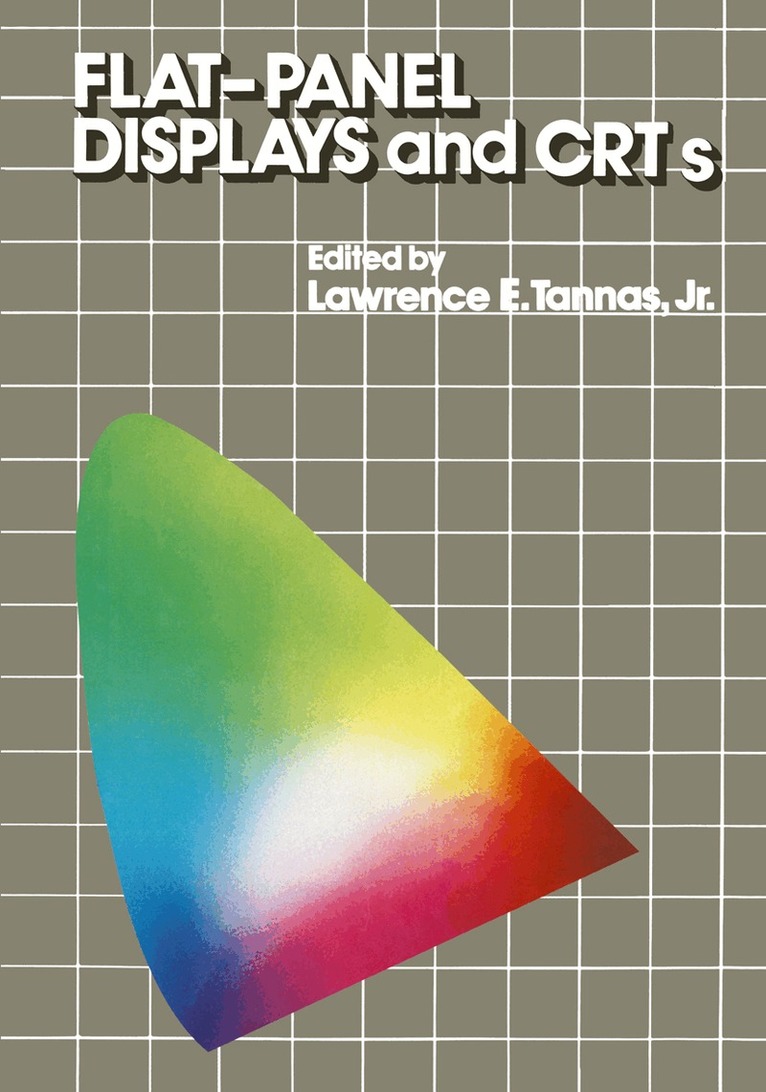
Flat-Panel Displays and CRTs, a review of electronic information display devices, is the first sys tematic and comprehensive coverage of the subject. It is intended to distill our wealth of knowledge of flat-panel displays and CRTs from their beginnings to the present state of the art. Historical perspective, theory of operation, and specific applications are all thoroughly covered. The field of display engineering is a multidisciplined technical pursuit with the result that its individual disciplines suffer from a lack of communications and limited perspective. Many previ ously developed standards for, and general understanding of, one technology are often inappro priate for another. Care has been taken here to document the old, incorporate the new, and emphasize commonalities. Criteria for performance have been standardized to enable an expert in one display technology, such as liquid crystals, to compare his device performance with that offered by another technology, such as electroluminescence. This book has been written with a second purpose in mind, to wit, to be the vehicle by means of which a new scientist or engineer can be introduced into the display society. It is organized to be tutorial for use in instructional situations. The first chapters begin with first principles and defini tions; the middle chapters set out requirements and criteria; and the last chapters give a complete description of each major technology.
534 kr
Skickas inom 10-15 vardagar
Joseph F. White has studied, worked, and taught in all aspects of microwave semiconductor materials, control diodes, and circuit applications. He is thoroughly grounded in the physics and math ematics of the field, but has primarily the engineer's viewpoint, combining basic knowledge with experience and ingenuity to gen erate practical designs under constraints of required performance and costs of development and production. As a result of his teach ing experience and numerous technical papers and oral presenta tions, he has developed a clear, well-organized writing style that makes this book easy to use as a self-teaching text, a reference volume, and a design handbook. Dr. White believes that an engineer must have a good understand ing of semiconductor physics, a thorough knowledge of microwave circuit theory, at least an elementary acquaintance with transistor drivers, and the ability to check and refine a microwave circuit on a computer terminal to be qualified for modern, creative design of microwave semiconductor control components. These subjects are well covered in approximately the first half of the book; the second half treats the general and specific design of switches, at tenuators, limiters, duplexers, and phase shifters, with many ex amples drawn from his experience and that of others.
534 kr
Skickas inom 10-15 vardagar
As each area of technology with a potential for significantly impacting any major segment of the electronics industry evolves, it often is accompanied by the development of a succession of new circuits. Each new circuit indeed appears different, employing different components in differing configurations, and claims an assortment of distinct features of "improved performance. " Without a considerable investment of laboratory time to construct, evaluate, and compare each candidate circuit, it usually is difficult to realistically appraise the relative merits of one approach over another. It often is even more difficult to identify the underlying principles which point up basic similarities and differences. Such is the situation in the new and rapidly expanding area known as electronic power processing or switching mode power supplies. The area of switching power supplies has been spurred by the need for power sources of higher performance, smaller volume, and lighter weight in order to achieve compatibility with the shrinking size of all forms of communication and data handling systems, and particularly with the portable battery-operated equipment in everything from horne appliances and handtools to mobile com munication equipment. Static dc-to-dc converters and dc-to-ac inverters provide a natural interface with the new direct energy sources such as solar cells, fuel cells, thermoelectric generators, and the like, and form the central ingredient in most uninterruptable power sources.