Wadsworth & Brooks/Cole Mathematics Series - Böcker
Visar alla böcker i serien Wadsworth & Brooks/Cole Mathematics Series. Handla med fri frakt och snabb leverans.
5 produkter
5 produkter
534 kr
Skickas inom 10-15 vardagar
This book should be of interest to post-graduates on courses in harmonic analysis.
798 kr
Skickas inom 10-15 vardagar
"!the text is user friendly to the topics it considers and should be very accessible!Instructors and students of statistical measure theoretic courses will appreciate the numerous informative exercises; helpful hints or solution outlines are given with many of the problems. All in all, the text should make a useful reference for professionals and students."--The Journal of the American Statistical Association
534 kr
Skickas inom 10-15 vardagar
This is a compact mtroduction to some of the pnncipal tOpICS of mathematical logic . In the belief that beginners should be exposed to the most natural and easiest proofs, I have used free-swinging set-theoretic methods. The significance of a demand for constructive proofs can be evaluated only after a certain amount of experience with mathematical logic has been obtained. If we are to be expelled from "Cantor's paradise" (as nonconstructive set theory was called by Hilbert), at least we should know what we are missing. The major changes in this new edition are the following. (1) In Chapter 5, Effective Computability, Turing-computabIlity IS now the central notion, and diagrams (flow-charts) are used to construct Turing machines. There are also treatments of Markov algorithms, Herbrand-Godel-computability, register machines, and random access machines. Recursion theory is gone into a little more deeply, including the s-m-n theorem, the recursion theorem, and Rice's Theorem. (2) The proofs of the Incompleteness Theorems are now based upon the Diagonalization Lemma. Lob's Theorem and its connection with Godel's Second Theorem are also studied. (3) In Chapter 2, Quantification Theory, Henkin's proof of the completeness theorem has been postponed until the reader has gained more experience in proof techniques. The exposition of the proof itself has been improved by breaking it down into smaller pieces and using the notion of a scapegoat theory. There is also an entirely new section on semantic trees.
534 kr
Skickas inom 10-15 vardagar
527 kr
Skickas inom 10-15 vardagar
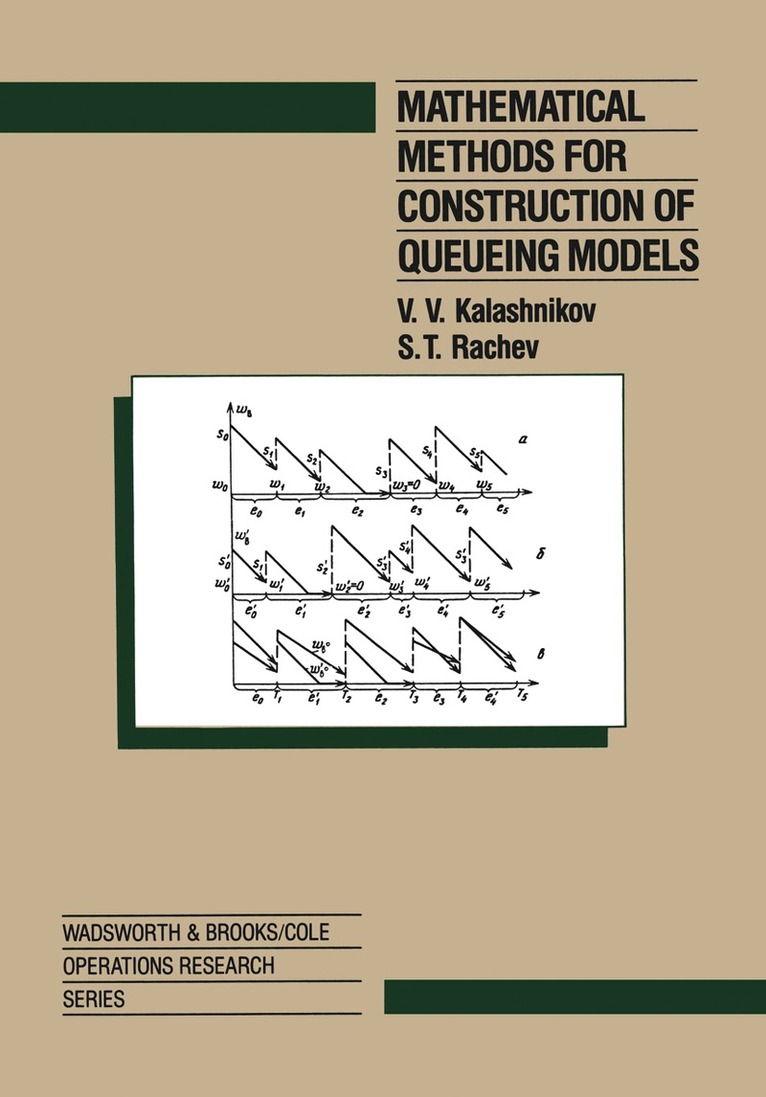
to the English edition Many processes that describe the operation of engineering, economic, organiza tional, and other systems are represented as sequences of operations performed on material, information, or other types of flows. Typical examples are processes of connection of telephone users, data transmission and processing, calculation at multi user computer centers, and queueing at service centers. The models studied by the theory of service systems, or queueing theory, are used to describe such processes. The more pessimistic term "queueing theory" is used more often in the non-Soviet literature. Random arrivals (requests for service), probability distributions defining queueing processes (distributions of service times and acceptable waiting times), and structure parameters (customer priorities, parameters that delimit acceptable queues, parameters that define paths of customers, etc.) are characteristic com ponents of queueing models. Typical output characteristics of queueing models are the probability distributions of queue lengths, waiting times, lengths of busy periods, and so forth.