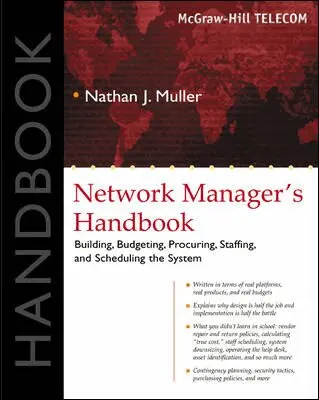
Network Manager's Handbook
601 kr
Beställningsvara. Skickas inom 3-6 vardagar. Fri frakt över 249 kr.
Beskrivning
A job manual for the person in charge of the corporate network, explaining its operations and procedures. Topics include: vendor repair and return policies; calculating "true cost"; staff scheduling; system downsizing; asset identification; contingency planning; security tactics; and more.
Produktinformation
- Utgivningsdatum:2002-10-11
- Mått:183 x 231 x 45 mm
- Vikt:1 160 g
- Format:Häftad
- Språk:Engelska
- Serie:McGraw-Hill Networking Profess
- Antal sidor:572
- Förlag:McGraw-Hill Education - Europe
- Medarbetare:NathanJ. Muller
- ISBN:9780071405676
Utforska kategorier
Mer om författaren
Nathan J. Muller is an independent consultant specializing in advanced technology marketing, research, and education. He has more than 25 years of experience in the field, and previously held technical and marketing positions with General DataComm Industries, Planning Research Corp., and ITT Telecom. Mr. Muller is on the editorial board of the International Journal of Network Management, is a frequent contributor to major professional journals, and is author of such top-selling technical books as Desktop Encyclopedia of Voice and Data Networking and Desktop Encyclopedia of the Internet.
Innehållsförteckning
- ContentsPrefacePart 1 Assembling the InfrastructureChapter 1 Role of the Communications Department1.1 Introduction1.2 Network Planning and Design1.2.1 Responsibilities1.2.2 Alternatives to In-House Staff1.3 Network Management1.3.1 Fault Detection1.3.2 Maintenance Tracking1.3.3 Performance Measurement1.3.4 Configuration Management1.3.5 Applications Management1.3.6 Security1.3.7 Inventory and Accounting1.4 Help Desk1.5 Administration1.5.1 Moves, Adds, and Changes1.5.2 Software Distribution and License Management1.5.3 Network Backup and Data Recovery1.6 Record Keeping1.7 Training1.8 Technical Support1.9 Operations Management1.10 Importance of Staff Continuity1.11 Role of the CIO1.12 ConclusionChapter 2 The Procurement Process2.1 Introduction2.2 Managing Change2.3 Organizational Objectives2.4 Needs Assessment2.5 Selecting Potential Vendors2.5.1 Financial and Credit Information2.5.2 Product Development2.5.3 Integration and Engineering2.5.4 Quality Control2.5.5 Interoperability Testing2.5.6 Repair and Return2.5.7 Customer Service2.5.8 Technical Documentation2.5.9 Customer Training2.5.10 Primary Line of Business2.5.11 Vendor References2.5.12 Escrow Protection2.6 Select the Vendor2.7 The Action Plan2.8 Feedback2.9 Coping with Change2.9.1 Tracking New Technologies2.9.2 Pursuing New Products and Services2.9.3 Selling Soft-Dollar Benefits2.9.4 Pilot Testing2.9.5 High-Impact Activities2.10 ConclusionChapter 3 Writing the Request for Proposal3.1 Introduction3.2 Needs Assessment3.3 General Information3.3.1 Purpose3.3.2 Scope3.3.3 Schedule of Events3.4 Contract Terms and Conditions3.4.1 Liabilities3.4.2 Mechanical Clauses3.4.3 Technical Specifications3.4.4 Project Support3.4.5 Costs and Charges3.4.6 Reliability and Warranty3.4.7 Maintenance3.4.8 Product Delivery3.4.9 Rights and Options3.4.10 Relocation3.5 Proposal Specifications3.5.1 Letter of Transmittal3.5.2 Proposal Format and Content3.6 Technical Requirements3.6.1 General Considerations3.6.2 Equipment Specifications3.6.3 Appendixes3.7 RFP Alternatives3.8 ConclusionChapter 4 Financial Planning4.1 Introduction4.2 Asset versus Expense Management4.3 The Planning Process4.3.1 Needs Assessment4.3.2 Calculating True Costs4.3.3 Time Value of Money4.3.4 Discounted Cash Flow Analysis4.3.5 Impacts on Cash Flow4.3.6 Loan Amortization4.4 Return on Investment4.5 Procurement Alternatives4.5.1 Cash Purchase4.5.2 Installment Loan4.5.3 Leasing4.5.4 Types of Leases4.6 Financial Management of Communications4.7 Requirements for Strategic Operation4.8 Opportunity Assessment4.8.1 Cost Reporting4.8.2 Budgeting and Control4.8.3 Financial Operations4.8.4 How to Start4.9 Assessing Vendor Stability4.9.1Debt/Equity Ratio (Total Debt/Total Equity)4.10 ConclusionChapter 5 Managing, Evaluating, and Scheduling Technical Staff5.1 Introduction5.2 Structuring the Setting5.2.1 Making Time5.2.2 Ensuring Privacy5.2.3 Physical Setting5.3 Managing the Process5.3.1 Comfort5.3.2 Rapport5.3.3 Trust5.4 A Closer Look At Bridging Skills5.4.1 Body Language5.4.2 Mental Attention5.4.3 Respect5.4.4 Invitations5.4.5 Acknowledgments5.5 Integrating the Information5.5.1 Reflection5.5.2 Self-Disclosure5.5.3 Immediacy5.5.4 Probing5.5.5 Checking5.5.6 Confrontation5.6 Support5.6.1 Problem Definition5.6.2 Problem Ownership5.6.3 Developing Action Plans5.7 Withdrawal5.7.1 Centering5.7.2 Appreciation5.8 Why Bother?5.9 Staff Expectations5.10 Employee Evaluations5.10.1 Reasons to Evaluate5.10.2 Information Gathering5.10.3 Common Traps5.10.4 Review Methods5.10.5 Computerized Evaluation Tools5.11 Computerized Scheduling Tools5.12 ConclusionChapter 6 Outsourcing Infrastructure6.1 Introduction6.2 Reasons to Outsource6.3 Approaches to Outsourcing6.4 Outsourcing Trends6.5 What to Outsource6.6 Typical Outsourcing Services6.6.1 Moves, Adds, Changes6.6.2 Systems and Network Integration6.6.3 Project Management6.6.4 Trouble Ticket Administration6.6.5 Management of Vendor-Carrier Relations6.6.6 Maintenance, Repair, and Replacement6.6.7 Disaster Recovery6.6.8 Technology Migration Planning6.6.9 Training6.6.10 Equipment Leasing6.6.11 LAN Administration and Management6.6.12 WAN Administration and Management6.6.13 Network Security6.6.14 Enterprise Applications6.7 Decision to Outsource6.8 Vendor Evaluation Criteria6.9 Structuring the Relationship6.10 Negotiations6.11 ConclusionPart 2 Organizing Technology AssetsChapter 7 Downsizing and Distributing Information Resources7.1 Introduction7.2 Benefits of Downsizing7.3 Opportunity Assessment7.3.1 Senior Management Perspective7.3.2 Systems Designer Perspective7.3.3 Systems Developer Perspective7.3.4 Systems Designers and Developers7.3.5 IT Management Perspective7.4 Making the Transition7.5 Distributed Processing Environment7.5.1 Dedicated Application Servers7.5.2 Minicomputers7.5.3 Super Servers7.5.4 Server Clusters7.5.5 Mainframes7.5.6 Client-Server7.5.7 Thin-Client Architecture7.5.8 Cooperative Processing7.5.9 Peer-to-Peer Data Sharing7.6 Transition Aids7.6.1 Working with Objects7.6.2 Working with CASE Tools7.6.3 Distributed Network Management7.6.4 Role of SNMP7.7 Organizational Issues7.7.1 Mainframe Mindset7.7.2 PC Mindset7.7.3 Addressing the "Soft" Issues7.8 Implementation7.8.1 Success Factors7.8.2 Risk Factors7.8.3 Setting Objective Criteria7.9 Assuming a Leadership Role7.10 Collocation Arrangements7.11 ConclusionChapter 8 Network Service and Facility Selection8.1 Introduction8.2 Transmission Media8.2.1 Twisted-Pair Wiring8.2.2 Coaxial Cable8.2.3 Optical Fiber8.2.4 Wireless Communications8.2.5 Broadband Wireless8.2.6 Satellite8.2.7 Free-Space Laser8.3 Analog Services and Lines8.4 Digital Subscriber Line8.5 T-Carrier Facilities8.6 Centrex8.7 ISDN8.8 Packet Data Services8.8.1 Internet Protocol8.8.2 Frame Relay8.8.3 Asynchronous Transfer Mode8.9 Bundled Services8.9.1 Bundle Examples8.9.2 Decision Criteria8.10 ConclusionChapter 9 Systems Integration9.1 Introduction9.2 Systems Integration Defined9.3 Role of Business Process Reengineering9.3.1 Predecision Services9.3.2 Preinstallation Services9.3.3 Installation and Implementation Services9.3.4 Postinstallation Services9.3.5 Life Cycle Services9.4 Types of Integrators9.4.1 Data Communications Service Providers9.4.2 Consultants9.4.3 Information Technology Shops9.4.4 Traditional Service Firms9.4.5 Equipment Vendors, Vars, Distributors9.5 Evaluation Criteria9.5.1 Technological Leadership9.5.2 Digital Transport Systems9.5.3 Network Design9.5.4 Microwave and Fiber-Optic Interfacing9.5.5 Network Management9.5.6 Project Management9.5.7 Facilities Engineering9.5.8 Carrier Services and Pricing9.5.9 Telco Practices and Procedures9.5.10 Contemporary and Future Technologies9.5.11 Project Pricing Considerations9.6 Alternative Arrangements9.7 ConclusionChapter 10 Help Desk Operations10.1 Introduction10.2 Help Desk Functions10.3 Types of Help Desks10.4 Help Desk Installation10.5 Infrastructure Requirements10.6 Operation10.6.1 Remote Control Software10.6.2 Security10.7 Staffing10.8 Staff Responsibilities10.9 Help Desk Tools10.10 Role of Expert Systems10.10.1 Intelligent Text Retrieval10.10.2 Case Based Reasoning10.10.3 Rule Based Expert Systems10.10.4 Neural Networks10.11 Delivering Support Via the Internet10.12 Outsourcing the Help Desk10.13 NMS-Integrated Help Desks10.14 ConclusionChapter 11 Network Integration11.1 Introduction11.2 Internetworking Devices11.2.1 Bridges11.2.2 Routers11.2.3 Gateways11.3 Methods of Integration11.3.1 Translation11.3.2 Encapsulation11.3.3 Segmentation11.3.4 Emulation11.3.5 Speed Matching11.4 Terminal Emulation11.5 SNA-LAN Integration11.5.1 Integration Issues11.5.2 Integration Approaches11.5.3 Advanced Solutions11.6 Outsourcing Network Integration11.7 ConclusionChapter 12 Navigating Service Level Agreements12.1 Introduction12.2 Enterprise SLAs12.2.1 Performance Baselining12.2.2 SLA Development Considerations12.2.3 SLA Components12.2.4 Service Level Enforcement12.3 Service Provider SLAs12.3.1 Performance Metrics12.3.2 Sample SLA12.3.3 SLA Tools12.4 Types of SLAs12.4.1 Internet SLA12.4.2 Collocation Services12.4.3 Shared Hosting SLA12.4.4 Managed Hosting Services12.4.5 Web-Enabled Call Centers12.4.6 Managed Firewall Services12.5 Issues to Consider12.6 ConclusionChapter 13 Technology Asset Management13.1 Introduction13.2 Types of Assets13.2.1 Hardware Assets13.2.2 Software Assets13.2.3 Web-Based Asset Management13.2.4 Network Assets13.2.5 Cable Assets13.3 Methods of Implementation13.3.1 Stand-Alone Applications13.3.2 Help Desk13.3.3 Network Management Systems13.3.4 Third-Party Subscription Services13.4 The Cost of Asset Management13.5 Standards13.5.1 Desktop Management Task Force13.5.2 Plug and Play13.6 ConclusionPart 3 Keeping the Network HealthyChapter 14 Maintenance and Support Planning14.1 Introduction14.2 Service and Support offerings14.3 In-House Approach14.3.1 Staffing Requirements14.3.2 User Support14.3.3 Technical Support14.3.4 Operations Management14.4 Reporting Requirements14.5 Equipment Requirements14.5.1 Spares Inventory14.5.2 Test Equipment14.5.3 Technical References14.6 Vendor and Carrier Services14.7 Third-Party Maintenance Firms14.8 Cooperative Arrangements14.9 Cabling and Rewiring Considerations14.9.1 Premises Wiring14.9.2 Treating the Cable Plant as an Asset14.9.3 Cable Planning14.10 Other Planning Activities14.11 ConclusionChapter 15 Network Monitoring and Testing15.1 Introduction15.2 Protocol Analyzers15.2.1 Features15.3 Breakout Boxes15.4 Bit Error Rate Testers15.5 Analog Line Impairment Testers15.6 DSL Testing15.7 T-Carrier Testing15.8 ISDN Testing15.8.1 Physical Link Problems15.8.2 Data Link Problems15.8.3 Network Layer Problems15.9 Digital Data Service Testing15.10 Testing Frame Relay Networks15.11 X.25 Testing15.12 Testing ATM Networks15.13 ConclusionChapter 16 Network Management16.1 Introduction16.2 Network Management System Functions16.2.1 Topology Mapping16.2.2 Administration16.2.3 Performance Measurement16.2.4 Control and Diagnostics16.2.5 Configuration Management16.2.6 Applications Management16.2.7 Security16.3 Network Management System16.3.1 Simple Network Management Protocol16.3.2 Management Information Base16.3.3 Network Manager16.4 SNMP Integration16.4.1 Intelligent Hubs16.4.2 Carrier Services16.5 Remote Monitoring Management Information Base16.5.1 Advantages of RMON16.5.2 Remote Monitoring Applications16.5.3 Ethernet Object Groups16.5.4 Token Ring Extensions16.6 RMON II16.7 ConclusionChapter 17 Network Design and Optimization17.1 Introduction17.2 Data Acquisition17.3 Network Simulation17.4 Bill of Materials17.5 Network Drawing Tools17.6 Drawing Techniques17.6.1 Device Library17.6.2 Template Usage17.7 Embedded Intelligence17.8 Bandwidth Optimization17.8.1 Approaches17.8.2 Traffic Shaping17.8.3 Load Balancing17.8.4 Caching17.8.5 Client-Aware Acceleration17.8.6 Queuing17.8.7 Outsourcing Content Delivery17.9 Optimization Issues17.10 New Directions17.10.1 Differentiated Services17.10.2 Multiprotocol Label Switching17.11 Selection Criteria17.12 ConclusionChapter 18 Managing Technology Transitions18.1 Introduction18.2 The Transition Plan18.3 Transition Methodology18.3.1 Participative Planning18.3.2 Education18.3.3 Develop Solution Design18.3.4 Evaluating Alternatives18.3.5 Risk Assessment18.3.6 Project Time Line18.4 Role of Outsourcing18.5 Role of Process Reorganization18.6 Topology Considerations18.6.1 Impact on Existing Networks18.6.2 Impact on Existing Applications18.6.3 Performance Measurement Tools18.7 Support Issues18.7.1 Systems Reliability18.7.2 Systems Integration18.7.3 Training18.8 Management18.9 ConclusionPart 4 Protecting the BusinessChapter 19 Network Security19.1 Introduction19.2 Risk Assessment19.2.1 Securing the Work Environment19.2.2 Securing the Network19.3 Access Controls19.3.1 Password Security19.3.2 Single Point Log-On19.4 Other Security Measures19.4.1 Key and Card Systems19.4.2 Biometrics19.4.3 Disk and Drive Controls19.5 Data Encryption19.5.1 Symmetric versus Asymmetric19.5.2 Digital Encryption Standard19.6 Virus Protection19.7 Firewalls19.8 Remote Access Security19.8.1 Security Measures19.8.2 Callback Security Systems19.8.3 Link Level Protocols19.9 Policy-Based Security19.10 Security Planning19.11 ConclusionChapter 20 Business Continuity Planning20.1 Introduction20.2 Planning Process20.3 Staff Roles20.3.1 Overall Responsibilities20.3.2 Project Initiation and Management20.3.3 Risk Evaluation and Control20.3.4 Business Impact Analysis20.3.5 Develop Business Recovery Strategies20.3.6 Emergency Response20.3.7 Awareness and Training Programs20.3.8 Maintenance and Testing20.3.9 Crisis Coordination20.3.10 Coordination with Local Authorities20.4 Security Risk Assessment20.4.1 Layered Approach20.4.2 Security Benchmarks20.4.3 Security Information Resources20.5 Outsourcing Business Continuity20.5.1 Enterprise Solutions Providers20.5.2 Telecommunications Carriers20.5.3 Storage Service Providers20.6 Training20.7 Development Tools20.8 ConclusionIndex
Hoppa över listan


Mer från samma författare
Minimum Risk Strategy for Acquiring Communications Equipment and Service
Nathan J. Muller
Inbunden, 1988
1 808 kr
Hoppa över listan


Du kanske också är intresserad av
Minimum Risk Strategy for Acquiring Communications Equipment and Service
Nathan J. Muller
Inbunden, 1988
1 808 kr
- -19%