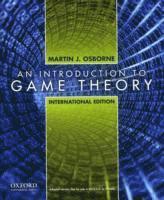
2 262 kr
Beställningsvara. Skickas inom 5-8 vardagar. Fri frakt över 249 kr.
Beskrivning
Produktinformation
- Utgivningsdatum:2003-10-02
- Mått:198 x 242 x 30 mm
- Vikt:1 120 g
- Format:Inbunden
- Språk:Engelska
- Antal sidor:560
- Förlag:OUP OXFORD
- ISBN:9780195128956
Utforska kategorier
Recensioner i media
"This is a textbook to be enjoyed both by professors and students, full of clever and often original applications and examples. Serious students who use this text are likely to emerge with a new way of thinking about much of what they see in the real world."--Ted Bergstrom, Professor of Economics, University of California, Santa Barbara "The book is just superb. I anticipate (based both on my own reading of the book, and comments from colleagues at other institutions) that this will be the standard text for introductory courses in game theory in political science departments for the foreseeable future."--Scott Gehlbach, Assistant Professor of Political Science, University of Wisconsin "What distinguishes this book from other texts is its remarkable combination of rigor and accessibility. The central concepts of game theory are presented with the mathematical precision suitable for a graduate course, but with an abundance of wide-ranging examples that will give undergraduate students a concrete understanding of what the concepts mean and how they may be used."--Charles A. Wilson, Professor of Economics, New York University "A great book, by far the best out there in the market in thoroughness and structure."--Dorothea Herreiner, Assistant Professor of Economics, Bowdoin College "The ideal textbook for applied game theory . . . . It teaches basic game theory from the ground up, using just enough clearly defined technical terminology and ranging from traditional basics to the most modern tools."--Randy Calvert, Professor of Political Science, Washington University in St. Louis "The approach is intuitive, yet rigorous. Key concepts are explained through a series of examples to guide students through analysis. The examples are then followed by interesting and challenging questions. The main strength is the impressive set of exercises . . . they are extremely well organized and incredibly broad, ranging from easy questions to those for adventurous students."--In-Koo Cho, William Kinkead Distinguished Professor of Economics, University of Illinois "The gentle pace of the material along with the plethora of examples drawn from economics (mainly) and political science seems to work very well with students."-Branislav L. Slantchev,Assistant Professor of Political Science, University of California, San Diego "The book is excellent. It is chock full of exercises that are both interesting and applicable to real issues, allowing me great flexibility in focusing on specific examples to illustrate the theory."--Christopher Proulx, Assistant Professor of Economics, University of California, Santa Barbara "This book provides a simple yet precise introduction into game theory, suitable for the undergraduate level. Author Martin J. Osborne makes use of a wide variety of examples from social and behavioral sciences to convey game-theoretic reasoning. Readers can expect to gain a thorough understanding without any previous knowledge of economics, political science, or any other social or behavioral science. No mathematics is assumed beyond that of basic high school."--Journal of Macroeconomics

Innehållsförteckning
- PrefaceEach chapter ends with notes.1. Introduction1.1. What is Game Theory?1.1.1. An Outline of the History of Game Theory1.1.2. John von Neumann1.2. The Theory of Rational Choice1.3. Coming Attractions: Interacting Decision-MakersI. GAMES WITH PERFECT INFORMATION2. Nash Equilibrium: Theory2.1. Strategic Games2.2. Example: The Prisoner's Dilemma2.3. Example: Bach or Stravinsky?2.4. Example: Matching Pennies2.5. Example: The Stag Hunt2.6. Nash Equilibrium2.6.1. John F. Nash, Jr.2.6.2. Studying Nash Equilibrium Experimentally2.7. Examples of Nash Equilibrium2.7.1. Experimental Evidence on the Prisoner's Dilemma2.7.2. Focal Points2.8. Best Response Functions2.9. Dominated Actions2.10. Equilibrium in a Single Population: Symmetric Games and Symmetric Equilibria3. Nash Equilibrium: Illustrations3.1. Cournot's Model of Oligopoly3.2. Bertrand's Model of Oligopoly3.2.1. Cournot, Bertrand, and Nash: Some Historical Notes3.3. Electoral Competition3.4. The War of Attrition3.5. Auctions3.5.1. Auctions from Babylonia to eBay3.6. Accident Law4. Mixed Strategy Equilibrium4.1. Introduction4.1.1. Some Evidence on Expected Payoff Functions4.2. Strategic Games in Which Players May Randomize4.3. Mixed Strategy Nash Equilibrium4.4. Dominated Actions4.5. Pure Equilibria When Randomization is Allowed4.6. Illustration: Expert Diagnosis4.7. Equilibrium in a Single Population4.8. Illustration: Reporting a Crime4.8.1. Reporting a Crime: Social Psychology and Game Theory4.9. The Formation of Players' Beliefs4.10. Extension: Finding All Mixed Strategy Nash Equilibria4.11. Extension: Games in Which Each Player Has a Continuum of Actions4.12. Appendix: Representing Preferences by Expected Payoffs5. Extensive Games with Perfect Information: Theory5.1. Extensive Games with Perfect Information5.2. Strategies and Outcomes5.3. Nash Equilibrium5.4. Subgame Perfect Equilibrium5.5. Finding Subgame Perfect Equilibria of Finite Horizon Games: Backward Induction5.5.1. Ticktacktoe, Chess, and Related Games6. Extensive Games With Perfect Information: Illustrations6.1. The Ultimatum Game, the Holdup Game, and Agenda Control6.1.1. Experiments on the Ultimatum Game6.2. Stackelberg's Model of Duopoly6.3. Buying Votes6.4. A Race7. Extensive Games With Perfect Information: Extensions and Discussion7.1. Allowing for Simultaneous Moves7.1.1. More Experimental Evidence on Subgame Perfect Equilibrium7.2. Illustration: Entry into a Monopolized Industry7.3. Illustration: Electoral Competition with Strategic Voters7.4. Illustration: Committee Decision-Making7.5. Illustration: Exit from a Declining Industry7.6. Allowing for Exogenous Uncertainty7.7. Discussion: Subgame Perfect Equilibrium and Backward Induction7.7.1. Experimental Evidence on the Centipede Game8. Coalitional Games and the Core8.1. Coalitional Games8.2. The Core8.3. Illustration: Ownership and the Distribution of Wealth8.4. Illustration: Exchanging Homogeneous Horses8.5. Illustration: Exchanging Heterogeneous Houses8.6. Illustration: Voting8.7. Illustration: Matching8.7.1. Matching Doctors with Hospitals8.8. Discussion: Other Solution ConceptsII. GAMES WITH IMPERFECT INFORMATION9.1. Motivational Examples9.2. General Definitions9.3. Two Examples Concerning Information9.4. Illustration: Cournot's Duopoly Game with Imperfect Information9.5. Illustration: Providing a Public Good9.6. Illustration: Auctions9.6.1. Auctions of the Radio Spectrum9.7. Illustration: Juries9.8. Appendix: Auctions with an Arbitrary Distribution of Valuations10. Extensive Games with Imperfect Information10.1. Extensive Games with Imperfect Information10.2. Strategies10.3. Nash Equilibrium10.4. Beliefs and Sequential Equilibrium10.5. Signaling Games.10.6. Illustration: Conspicuous Expenditure as a Signal of Quality10.7. Illustration: Education as a Signal Of Ability10.8. Illustration: Strategic Information Transmission10.9. Illustration: Agenda Control with Imperfect InformationIII. VARIANTS AND EXTENSIONS11. Strictly Competitive Games and Maxminimization11.1. Maxminimization11.2. Maxminimization and Nash Equilibrium11.3. Strictly Competitive Games11.4. Maxminimization and Nash Equilibrium in Strictly Competitive Games11.4.1. Maxminimization: Some History11.4.2. Empirical Tests: Experiments, Tennis, and Soccer12. Rationalizability12.1. Rationalizability12.2. Iterated Elimination of Strictly Dominated Actions12.3. Iterated Elimination of Weakly Dominated Actions12.4. Dominance Solvability13. Evolutionary Equilibrium13.1. Monomorphic Pure Strategy Equilibrium13.1.1. Evolutionary Game Theory: Some History13.2. Mixed Strategies and Polymorphic Equilibrium13.3. Asymmetric Contests13.3.1. Side-blotched lizards13.3.2. Explaining the Outcomes of Contests in Nature13.4. Variation on a Theme: Sibling Behavior13.5. Variation on a Theme: The Nesting Behavior of Wasps13.6. Variation on a Theme: The Evolution of the Sex Ratio14. Repeated Games: The Prisoner's Dilemma14.1. The Main Idea14.2. Preferences14.3. Repeated Games14.4. Finitely Repeated Prisoner's Dilemma14.5. Infinitely Repeated Prisoner's Dilemma14.6. Strategies in an Infinitely Repeated Prisoner's Dilemma14.7. Some Nash Equilibria of an Infinitely Repeated Prisoner's Dilemma14.8. Nash Equilibrium Payoffs of an Infinitely Repeated Prisoner's Dilemma14.8.1. Experimental Evidence14.9. Subgame Perfect Equilibria and the One-Deviation Property14.9.1. Axelrod's Tournaments14.10. Some Subgame Perfect Equilibria of an Infinitely Repeated Prisoner's Dilemma14.10.1. Reciprocal Altruism Among Sticklebacks14.11. Subgame Perfect Equilibrium Payoffs of an Infinitely Repeated Prisoner's Dilemma14.11.1. Medieval Trade Fairs14.12. Concluding Remarks15. Repeated Games: General Results15.1. Nash Equilibria of General Infinitely Repeated Games15.2. Subgame Perfect Equilibria of General Infinitely Repeated Games15.3. Finitely Repeated Games15.4. Variation on a Theme: Imperfect Observability16. Bargaining16.1. Bargaining as an Extensive Game16.2. Illustration: Trade in a Market16.3. Nash's Axiomatic Model16.4. Relation Between Strategic and Axiomatic Models17. Appendix: Mathematics17.1. Numbers17.2. Sets17.3. Functions17.4. Profiles17.5. Sequences17.6. Probability17.7. Proofs
Mer från samma författare
Models in Political Economy: Collective Choice, Voting, Elections, Bargaining, and Rebellion
Martin J. Osborne
712 kr
Models in Political Economy: Collective Choice, Voting, Elections, Bargaining, and Rebellion
Martin J. Osborne
908 kr
Du kanske också är intresserad av
- Signerad!
- Signerad!
- Signerad!
- Nyhet
- -30%
- Nyhet
Hjärnans akilleshälar : hur din hjärna lurar dig, och vad du kan göra åt det
Anders Hansen
289 kr
- -22%
- Nyhet
- Signerad!