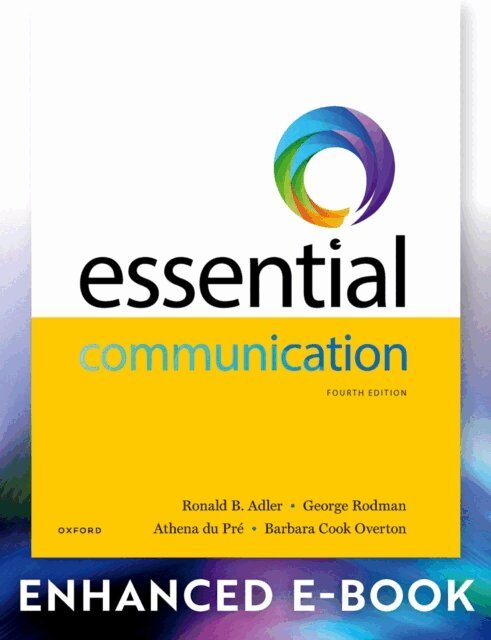
Essential Communication
AvRonald B. Adler,George Rodman
1 060 kr
Beställningsvara. Skickas inom 3-6 vardagar. Fri frakt över 249 kr.
Beskrivning
Produktinformation
- Utgivningsdatum:2025-11-03
- Mått:216 x 279 x undefined mm
- Format:Häftad
- Språk:Engelska
- Antal sidor:312
- Upplaga:4
- Förlag:OUP USA
- ISBN:9780197757314
Utforska kategorier
Mer om författaren
Ronald B. Adler is Professor of Communication, Emeritus, at Santa Barbara City College. George Rodman is Professor in the Department of Television and Radio at Brooklyn College, City University. Athena du Pré is a Distinguished University Professor of Communication at the University of West Florida. Barbara Cook Overton is affiliated with Louisiana State University.
Recensioner i media
“Adler, et. al. shine with a conversational, manageable introduction to human/interpersonal communication and add public speaking support for introductory students.” Ellen Bremen, Highline College
Innehållsförteckning
- Chapter 1: The Importance of Communication1.1 Communication DefinedCommunication is symbolic.Communication is a process.Communication is irreversible.Communication is collaborative. 1.2 Transactional Model of CommunicationMessagesCommunicatorsChannelsNoiseEnvironment 1.3 Communication CompetenceCompetence varies by situation.There is no <"ideal> " communication style.Competent communicators are flexible.Competence reflects cultural expectations.Competence is relational.Competence can be developed.Competent communicators are empathic.Competent communicators self-monitor.About You: What Type of Communicator are You? 1.4 Communication ContextsIntrapersonal CommunicationDyadic CommunicationInterpersonal CommunicationSmall Group CommunicationOrganizational CommunicationPublic CommunicationMass CommunicationSocial Media 1.5 Communication and Social MediaSocial media is entertaining.Social media is EL social.Social media is a means of identity management.Social media can hijack your time.Social media is distracting.Social media can make you feel bad.Tips & Reminders: 6 Tips for Healthy Use of Social Media 1.6 Misconceptions About CommunicationMyth 1: Communication requires complete understanding.Myth 2: Communication can solve all problems.Myth 3: Communication is good.Myth 4: Meanings are in words.Myth 5: Communication is simple.Myth 6: More communication is always better.Communication Take-Aways: The Importance of CommunicationPutting It All Together: Show Your Communication Know-HowPublic Speaking Practice Chapter 2: The Self, Perception, and Communication2.1 The Self-Concept DefinedSelf-ConceptSelf-EsteemPersonality 2.2 Communication and the Self-ConceptReflected AppraisalPersonal ExpectationsSocial ComparisonCommunication as Cause and EffectTips & Reminders: 4 Ways to Reverse Self-Defeating Thinking 2.3 Mistaken Attributions and CommunicationPeople typically judge themselves more charitably than they judge others.People often pay more attention to negative feedback than to positive.People tend to overgeneralize.People gravitate to the familiar.Tips & Reminders: 3 Steps to Engage in Perception Checking 2.4 Emotional IQ and CommunicationSelf-AwarenessSelf-Regulation of EmotionsInternal MotivationEmpathySocial SkillsAbout You: How Emotionally Intelligent Are You? 2.5 Identity ManagementIndividuals have public and private selves.People engage in facework to manage identities.Identity management is collaborative.People have multiple identities.Identity management may be deliberate or unconscious.People differ in their degree of identity management.Identity management isn't necessarily dishonest. 2.6 Identity Management and Social MediaSocial media can help reveal your <"ideal> " self.Social media can boost or damage self-esteem.Being genuine matters most.Communication Take-Aways: The Self, Perception, and CommunicationPutting It All Together: Show Your Communication Know-HowPublic Speaking Practice Chapter 3: Culture and Communication3.1 Culture and Group MembershipCultureCoculturesIntersecting IdentitiesCultural SalienceIn-Group and Out-GroupTips & Reminders: 4 Ways to Learn More About Other Cultures 3.2 Effective Intercultural CommunicationOvercoming PrejudiceCoping with Culture Shock 3.3 Cultural Values and NormsIndividualism and CollectivismHigh and Low ContextUncertainty AvoidancePower DistanceAbout You: How Much Do You Know About Other Cultures? 3.4 Discussing Religion and PoliticsReligionPolitics 3.5 Talking About RaceExpect strong emotions.Put yourself in the other person's shoes.Don't debate.Learn and apologize, if appropriate.Don't force the issue. 3.6 Myths About Gendered CommunicationMyth 1: Sex and gender are the same.Myth 2: Communication styles are either masculine or feminine.Myth 3: Gender and sexual orientation are the same.Myth 4: Gender is rooted in biology.Tips & Reminders: 3 Ways to Communicate Respectfully About Gender 3.7 Communicating About DisabilitiesAct the way you normally do.Be cautious about supposed euphemisms.Avoid judgments.Don't overcompensate.Don't presume that disabled people need help.Don't be nosy.Don't express surprise about the disability. 3.8 Bridging Age GapsIdeas about aging change over time.Stereotypes discourage open communication.Being young has its challenges.Workplace differences may not be as great as you think.Communication Take-Aways: Culture and CommunicationPutting It All Together: Show Your Communication Know-HowPublic Speaking Practice4 Language 4.1 The Nature of LanguageLanguage is symbolic.Meanings are in people, not in words.Words affect and reflect reality.Language is governed by rules. 4.2 The Power of LanguageNamesAccents and DialectsAssertive and Collaborative LanguageAffiliative Language 4.3 What's in a NamePronunciation MattersUnwanted NicknamesDeadnaming 4.4 MisunderstandingsLanguage is equivocal.Meaning is relative.Language differs by community.Language is nuanced.Tips and Reminders: 6 Ways to Avoid Misunderstandings 4.5 Facts, Inferences, and OpinionsDistinguish between fact and opinion.Don't confuse facts with inferences.Don't present emotions as facts.Don't resort to insults.Tips and Reminders: 3 Ways to Distinguish Between Facts and Opinions 4.6 Microaggressive LanguageExamine your own assumptions.Inquire.Use humor.Point out the underlying assumption.Be an ally.Avoid casting individuals as <"spokespersons.> "Choose your battles.Apologize if you mess up.Communication Take-Aways: LanguagePutting It All Together: Show Your Communication Know-HowPublic Speaking Practice Chapter 5: Listening5.1 The Importance of ListeningListening makes you a better friend and romantic partner.Good listeners aren't easily fooled.People with good listening skills are more likely than others to be hired and promoted.Asking for and listening to advice makes you look good.Listening is a leadership skill. 5.2 Misconceptions About ListeningMyth 1: Hearing and listening are the same thing.Myth 2: People only listen with their ears.Myth 3: Listening is a natural process.Myth 4: All listeners receive the same message. 5.3 The Listening ProcessHearingUnderstandingRememberingInterpretingEvaluatingResponding 5.4 Barriers to ListeningMessage OverloadPsychological NoisePhysical NoiseCultural DifferencesTips & Reminders: 3 Ways to Limit Social Media Distractions 5.5 Hurtful Listening HabitsPretending to ListenTuning In and OutActing DefensivelyAvoiding the IssueIgnoring Underlying IssuesBeing Self-CenteredTalking Too MuchDividing Attention 5.6 Skills for Different Types of ListeningRelational Listening.Supportive ListeningTask-Oriented ListeningAnalytical ListeningCritical ListeningTips & Reminders: 5 Tips for Listening MindfullyAbout You: What Are Your Listening Strengths?Communication Take-Aways: Listening EffectivelyPutting It All Together: Show Your Communication Know-HowPublic Speaking Practice Chapter 6: Nonverbal Communication6.1 The Nature of Nonverbal CommunicationNonverbal communication is impossible to avoid.Nonverbal behavior is part of identity management.Nonverbal cues help define relationships.Nonverbal behavior is ambiguous.Nonverbal communication is influenced by culture and gender.Nonverbal expectations are sometimes violated.Nonverbal communication is essential to success. 6.2 Functions of Nonverbal CommunicationComplementingContradictingSubstitutingRegulating 6.3 Deception and Nonverbal CuesConsider the motive.Ask questions.Listen.Watch for changes. 6.4 Kinesic Nonverbal CommunicationPostureFidgetingSmilingEye ContactFacial ExpressionsVoiceTouch 6.5 Digital Body Language and DatingEmojisResponse TimeAbout You: How Worldly Are Your Nonverbal Communication Skills? 6.6 The Impact of Space, Time, and PlaceSpaceTimeTerritoryEnvironmentTips & Reminders: 5 Ways to Interpret Nonverbal Cues More Accurately 6.7 Nonverbal Cues and AppearanceAttractiveness AdvantageClothingCosmeticsBody ArtCommunication Take-Aways: Nonverbal CommunicationPutting It All Together: Show Your Communication Know-HowPublic Speaking Practice Chapter 7: Communicating in Interpersonal Relationships7.1 Defining Interpersonal Communication 7.2 Relational MessagesAffinityImmediacyRespectControl 7.3 MetacommunicationMetacommunication can bring issues to the surface.Metacommunication can be risky.Metacommunication isn't just for problem solving. 7.4 Self-Disclosure in Close RelationshipsSocial Penetration ModelThe Johari WindowResponding to Self-DisclosureTips & Reminders: 7 Questions to Consider Before Self-Disclosing 7.5 Interpersonal Communication OnlineOnline communication provides for immense diversity.Online communication can feel nonthreatening.Online communication can be validating.Online communication has a pause option.Online communication can be isolating.Online communication can be distracting.Online communication can be overwhelming.Online communication can blur the line between real and virtual. 7.6 How Relational Partners Express ConflictNonassertiveness.Indirect CommunicationAssertivenessPassive AggressionDirect Aggression 7.7 Relational SpiralsRelational spirals are common.Spirals can be destructive.Spirals can be positive.Tips & Reminders: 6 Ways to Avoid Negative Relational SpiralsAbout You: What's the Forecast for Your Communication Climate? 7.8 Applying Win-Win Problem SolvingIdentify your problem and unmet needs.Choose a time conducive to problem solving.Describe your problem and needs.Check the other person's understanding.Ask about the other person's needs.Check your understanding of the other person's needs.Negotiate a solution.Follow up on the solution.Communication Take-Aways: Interpersonal CommunicationPutting It All Together: Show Your Communication Know-HowPublic Speaking Practice Chapter 8: Communicating with Family and Friends8.1 Strengthening Family TiesBe inclusive.Agree on boundaries.Share family rituals. 8.2 Managing Family DifferencesStart early coaching respectful communication.Forgive small gaffes.Redirect troublesome conversations.Disagree respectfully.Ask questions and listen. 8.3 Families and Communication TechnologyBe careful not to sharent.Protect your digital privacy.Use technology to stay in touch. 8.4 How People Evaluate Friendship PotentialYou have a lot in common.You balance each other out.You like and appreciate each other.You admire each other.You open up to each other.You interact frequently.You find the relationship rewarding.Tips & Reminders: 3 Reasons You Don't Have to Be Perfect to Be a Good Friend 8.5 Friendships Can Build BridgesStereotypes fade.Trust grows.Understanding blooms.Tips & Reminders: 3 Strategies for Befriending a Wide Range of People 8.6 Types of FriendshipsShort-Term or Long-TermLow or High DisclosureDoing-Oriented or Being-OrientedLow or High ObligationFrequent or Occasional Contact ?Tips & Reminders: 8 Communication Strategies for Being a Good FriendAbout You: What Kind of Friendship Do You Have? 8.7 Communicating with Friends OnlineOnline communication can reduce self-consciousness.Online communication is convenient.Easier doesn't always mean better.Online friendships can be exceptional.Communication Take-Aways: Communicating with Friends and FamilyPutting It All Together: Show Your Communication Know-HowPublic Speaking Practice Chapter 9: Communicating with Romantic Partners9.1 Stages of Romantic RelationshipsInitiatingExperimentingIntensifyingIntegratingBondingDifferentiatingCircumscribingStagnatingAvoidingTerminatingTips & Reminders: 7 Ways to Transition from Online to In-Person Dating 9.2 Speaking the Languages of LoveAffirming WordsQuality TimeGiftsPhysical TouchActs of ServiceTips & Reminders: 6 Ways to Put Love Languages into PracticeAbout You: What's Your Love Language? 9.3 Relational DialecticsConnection Versus AutonomyOpenness Versus PrivacyPredictability Versus NoveltyTips & Reminders: 6 Strategies for Managing Dialectical Tensions 9.4 Deception in Romantic RelationshipsAltruistic LiesEvasionsSelf-Serving Lies 9.5 Conflict Patterns that Ruin RelationshipsCriticismContemptDefensivenessStonewallingTips & Reminders: 3 Ways to Protect Yourself from an Abusive PartnerCommunication Take-Aways: Communicating with Romantic PartnersPutting It All Together: Show Your Communication Know-HowPublic Speaking Practice Chapter 10: Communicating to Land a Job or Internship10.1 Plan Now for Your FutureLook ahead.Treat college and volunteering as auditions.Upskill for the future.Take part in an internship.Anticipate mid-career shifts. 10.2 Employers Seek Good CommunicatorsGood communicators work well in teams.Good communicators enhance customer satisfaction.Good communicators build public awareness.Good communicators make good leaders. 10.3 Network for Career SuccessLook for networking prospects.Engage in online networking.Seek referrals.Conduct informational interviews.Show appreciation.Tips & Reminders: 6 Strategies to Build a Career-Enhancing 10.4 Manage Your Online Identity StrategicallyShowcase your strengths and goals.Build a professional identity.Avoid embarrassing posts.Monitor your online presence.Engage in damage control.Beware mistaken identities.Don't be scared off.Don't stop when you get hired. 10.5 Display Your AchievementsWrite a confidence-inspiring cover letter.Create a high-quality resume.Illustrate your accomplishments with a portfolio.Engage in a job audition.Share information in a presentation. 10.6 Anticipate Interview Questions<"Tell me about yourself.> "<"Why do you feel you're qualified?> "<"What major challenges have you faced, and how have you dealt with them?> "<"If you were a sweater, what kind would you be?> "<"What accomplishments have given you the most satisfaction?> "<"Where do you see yourself in five years?> "<"What are your greatest strengths?> "<"What is your greatest weakness?> "<"What are your salary requirements?> " 10.7 Interviewing and the LawKnow the law.Prepare in advance. 10.8 Prepare Questions<"I saw in your mission statement that you're committed to X. How might someone in this role help with that?> "<"How, if at all, do you think the company will be affected by Y?> "<"If the new hire were to achieve one thing that would blow your mind, what would it be?> "<"How would you describe the management style I could expect from my supervisors?> "<"What's the typical career path for someone in this role?> "<"What is your timeline for filling this position and what are the next steps?> "<"Given everything you've heard, you can share your thoughts with me on where I do and don't fit this role?> " 10.9 Taking Part in a Job InterviewDress for success.Bring evidence of your accomplishments.Arrive early.Mind your manners.Follow the interviewer's lead.Keep your answers succinct and specific.Ask good questions of your own.Send a thank-you message.Check in later, if necessary.If you don't get the job, don't lose hope.Tips & Reminders: 7 Strategies for Interviewing by Phone or VideoCommunication Take-Aways: Communicating to Land a Job or InternshipPutting It All Together: Show Your Communication Know-HowPublic Speaking Practice Chapter 11: Communicating in the Workplace11.1 Communicating Well as a FollowerBe proactive.Seek feedback.Support others.Speak up if something isn't right.Stay calm. 11.2 Working with a Difficult BossRise to the challenge.Make up for the boss's shortcomings.Seek advice from others. Talk with your boss.Maintain a professional demeanor.Adjust your expectations.If necessary, make a gracious exit.Tips & Reminders: 5 Steps to Leave a Job Without Burning Bridges 11.3 Communication Mistakes to Avoid at WorkMaking Fun of PeopleOversharingOverlooking Cultural DifferencesGossipingDoing Less Than Your BestLosing Your CoolFixating on a MistakeTips & Reminders: 10 Ways to Get Slackers to Do Their Share 11.4 Effective Communication in Small GroupsMembers communicate regularly and work as a team.Members' goals are well aligned.Members agree on guiding principles.Members play productive roles.The group is cohesive.Tips & Reminders: 6 Strategies for Dealing with Difficult Team Members 11.5 Stages of Group DevelopmentOrientation (Forming) StageConflict (Storming) StageEmergence (Norming) StageReinforcement (Performing) Stage 11.6 Advantages of Group Problem SolvingGroups have more resources than individuals do.Group members can catch errors.Group work enhances buy-in.Groups benefit from diverse ideas.Groups are best at solving some problems.Tips & Reminders: 9 Steps in Collaborative Problem Solving 11.7 Making the Most of Group MeetingsEncourage equal participation.Avoid information underload and overload.Avoid pressure to conform.Make the most of diversity.Choose decision-making methods wisely. 11.8 Keeping Remote Meetings ProductiveDevelop camaraderie.Learn the technology.Practice good cybersecurity.Set the stage.Show your face.Dress head to toe for the camera.Decide who talks when.Use the mute function wisely.Pay attention. 11.9 Communication Strategies for LeadersCharacteristics of Effective LeadersFocus on Relationships and TasksTransformational LeadershipAbout You: What's Your Leadership Style?Communication Take-Aways: Communicating in the WorkplacePutting It All Together: Show Your Communication Know-HowPublic Speaking Practice Chapter 12: Preparing Speeches12.1 Analyzing Your AudienceDemographics and Political AffiliationAttitudes, Beliefs, and ValuesAudience Perception of the Occasion 12.2 Planning Your SpeechStep 1: Choose a topic.Step 2: Define your purpose.Step 3: Write a purpose statement.Step 4: State your thesis.Step 5: Gather information.Step 6: Double-check your sources.Tips & Reminders: Evaluating Online Sources with the CRAAP Test 12.3 Structuring Your SpeechOutlinesSpeaking NotesOrganizational Patterns 12.4 Creating the IntroductionCapture attention.Preview the main points.Set the tone of your speech.Demonstrate the importance of your topic to your audience.Establish credibility.Tips & Reminders: 9 Ways to Capture the Audience's Attention 12.5 Designing Conclusions and TransitionsThe ConclusionTransitions 12.6 Types of Supporting MaterialDefinitionsExamplesStatisticsAnalogies/Comparison-ContrastAnecdotesQuotations/TestimonyStyles of SupportCommunication Take-Aways: Preparing SpeechesPutting it All Together: Show Your Communication Know-HowPublic Speaking Practice Chapter 13: Presenting Speeches13.1 Managing Speech AnxietyFacilitative and Debilitative AnxietyPast Negative Experiences and Irrational ThinkingTips & Reminders: 4 Types of Irrational Fears About Public SpeakingAbout You: Do You Suffer from Speech Anxiety?Tips & Reminders: 5 Ways to Overcome Debilitative Speech Anxiety 13.2 Choosing a Type of DeliveryManuscriptMemorizedImpromptuExtemporaneousMediatedTips & Reminders: 6 Tips for Online/Virtual Delivery of Speeches 13.3 Selecting Presentation AidsObjects and ModelsDiagramsWord and Number Charts 13.4 Using Presentation AidsPresentation SoftwareAudio and Video ClipsWhiteboards and ChalkboardsFlip Pads and Poster BoardsHandoutsTips & Reminders: 5 Rules for Using Presentation Aids Effectively 13.5 Visual Aspects of DeliveryAppearanceMovementPostureFacial ExpressionEye ContactTips & Reminders: 4 Steps to Practicing a Speech 13.6 Auditory Aspects of DeliveryVolumeRatePitchArticulationTips & Reminders: 4 Ways to Improve Your ArticulationCommunication Take-Aways: Presenting SpeechesPutting It All Together: Show Your Communication Know-HowPublic Speaking Practice Chapter 14: Types of Speaking14.1 Informing, Persuading, and Recognizing Special OccasionsInformative SpeechesPersuasive SpeechesSpecial Occasion SpeechesOverlap Among Types of Speeches 14.2 Techniques of Informative SpeakingDefine a specific informative purpose.Use clear, simple language.Emphasize important points.Generate audience involvement.Tips & Reminders: 3 Ways to Make It Easy for the Audience to ListenTips & Reminders: 4 Ways to Handle a Question-and-Answer Period 14.3 Techniques of Persuasive SpeakingSet a specific persuasive purpose.Adapt to your specific audience.Establish common ground and credibility.Draw upon Aristotle's Triad.Tips & Reminders: 3 Types of Persuasive Appeals 14.4 Logic, Ethics, and the Art of PersuasionStep 1: Structure your basic argument.Step 2: Describe the problem.Step 3: Describe the solution.Step 4: Describe the desired audience response.Sample Outline Using Monroe's Motivated Sequence. 14.5 Structuring Reasoning Within Your ArgumentClaims and SubclaimsEvidenceThe Toulmin ModelTips & Reminders: 6 Fallacies and How to Avoid ThemAbout You: Can You Identify Common Fallacies? 14.6 Techniques of Special Occasion SpeakingCommunication Take-Aways: Types of SpeakingPutting It All Together: Show Your Communication Know-HowPublic Speaking Practice Appendix A: Sample Informative SpeechAppendix B: Sample Persuasive SpeechAppendix C: Sample Special Occasion SpeechNotesGlossaryCreditsIndex
Mer från samma författare
Understanding Human Communication
Ronald B. Adler, George Rodman, Athena du Pré, Barbara Cook Overton
Häftad, 2023
1 505 kr
Understanding Human Communication
Barbara Cook Overton, Athena du Pre, George Rodman, Ronald B. Adler
648 kr
Essential Communication
Barbara Cook Overton, Athena du Pre, George Rodman, Ronald B. Adler
828 kr
Communicating at Work, with Connect Plus Communication Access Card
Ronald B. Adler, Jeanne Marquardt Elmhorst
Häftad
3 122 kr
Du kanske också är intresserad av
Understanding Human Communication
Barbara Cook Overton, Athena du Pre, George Rodman, Ronald B. Adler
648 kr
Essential Communication
Barbara Cook Overton, Athena du Pre, George Rodman, Ronald B. Adler
828 kr
Understanding Human Communication
Ronald B. Adler, George Rodman, Athena du Pré, Barbara Cook Overton
Häftad, 2023
1 505 kr
- Nyhet
- -30%
- -19%
- Signerad!
- -30%