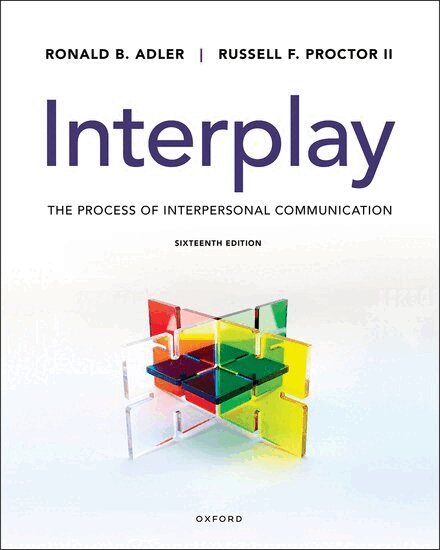
Interplay
The Process of Interpersonal Communication
AvRonald B. Adler,Russell F. Proctor
1 409 kr
Beställningsvara. Skickas inom 5-8 vardagar. Fri frakt över 249 kr.
Beskrivning
Produktinformation
- Utgivningsdatum:2024-02-02
- Mått:211 x 246 x 35 mm
- Vikt:839 g
- Format:Häftad
- Språk:Engelska
- Antal sidor:512
- Upplaga:16
- Förlag:OUP USA
- ISBN:9780197666128
Utforska kategorier
Mer om författaren
Ronald B. Adler is Professor Emeritus of Communication at Santa Barbara City College.Russell F. Proctor II is Professor Emeritus of Communication at Northern Kentucky University.
Recensioner i media
This is a well-written text with an exhaustive list of concepts that are covered. The writing is outstanding and the examples presented are relevant and relatable. The sidebar topics and the video and image examples are great.
Innehållsförteckning
- Preface PART 1. FOUNDATIONS OF INTERPERSONAL COMMUNICATION Chapter 1. Interpersonal Process 1.1 Why We Communicate Physical Needs Identity Needs Social Needs Practical Needs 1.2 The Communication Process Early Models of Communication Insights from the Transactional Communication Model Communication Principles Communication Misconceptions 1.3 What Makes Communication Interpersonal? Defining Interpersonal Communication Interpersonal and Impersonal Communication: A Matter of Balance 1.4 Communication Competence Principles of Communication Competence Characteristics of Competent Communication CHECK YOUR UNDERSTANDING KEY TERMS ACTIVITIES FEATURESWATCH AND DISCUSS: <"Going It Alone> " DARK SIDE OF COMMUNICATION: The Epidemic of Loneliness AT WORK: Office vs. Home: Communication Considerations WATCH AND DISCUSS: <"Super Bowl 2015: Always Ad> " FOCUS ON RESEARCH: A Better Understanding of Misunderstanding FOCUS ON RESEARCH: Building Relationships Before Doing Business WATCH AND DISCUSS: <"Struggles of Having a Friend with No Filter> " ASSESSING YOUR COMMUNICATION: How Interpersonal Are Your Relationships? Chapter 2. Mediated Interpersonal Communication 2.1 Mediated Communication: Pros and Cons Alienating or Connecting? Superficial or Meaningful? Unhealthy or Healthy? The Bottom Line 2.2 Mediated Interpersonal Versus Masspersonal Communication Hallmarks or Mediated Interpersonal Communication Hallmarks of Masspersonal Communication 2.3 Competence in Mediated Communication Consider the Channel(s) Be Careful What You Post Consider the Communicators and Environment CHECK YOUR UNDERSTANDING KEY TERMS ACTIVITIES FEATURESWATCH AND DISCUSS: <"I Forgot My Phone> " FOCUS ON RESEARCH: Maintaining Long-Distance Romances through Texting DARK SIDE OF COMMUNICATION: The Effects of Smartphone Use among Teens FOCUS ON RESEARCH: Social Media Detox AT WORK: Communicating Professionally via Video WATCH AND DISCUSS: <"Women in Sports 'Face' Harassment> " ASSESING YOUR COMMUNICATION: Are You Spending Too Much Time Online? Chapter 3. Culture and Interpersonal Communication 3.1 Culture and Communication Culture and Co-Culture Intercultural Communication Interpersonal and Intercultural Dimensions of Communication Intercultural Differences as Generalizations 3.2 Cultural Values and Norms High Versus Low Context Individualism Versus Collectivism Power Distance Uncertainty Avoidance Achievement Versus Nurturing 3.3 Co-Cultures and Communication Race and Ethnicity Gender Identity and Sexual Orientation Age and Generation (Dis)abilities Socioeconomic Status 3.4 Codes and Culture Verbal Codes Nonverbal Codes Microaggressions 3.5 Developing Intercultural Communication Competence Motivation and Attitude Tolerance for Ambiguity Open-Mindedness Knowledge and Skill Patience and Perseverance CHECK YOUR UNDERSTANDING KEY TERMS ACTIVITIES FEATURESFOCUS ON RESEARCH: Co-Cultural Strategies for Latinx Students DARK SIDE OF COMMUNICATION: Why Cultural Appropriation is Inappropriate AT WORK: Organizations Are Cultures WATCH AND DISCUSS: <"P&G: The Look> " WATCH AND DISCUSS: <"Momondo: The DNA Journey> " FOCUS ON RESEARCH: Using Your Voice to Confront Racism Assessing Your Communication: What Is Your Intercultural Communication Competence? Chapter 4. Interpersonal Communication and the Self 4.1 Communication and the Self-Concept How the Self-Concept Develops Characteristics of the Self-Concept The Self-Fulfilling Prophecy and Communication 4.2 Presenting the Self Public Self and Private Self Characteristics of Impression Management Face-to-Face Impression Management Impression Management in Mediated Communication Impression Management and Honesty 4.3 Disclosing the Self The Nature of Self-Disclosure Models of Self-Disclosure Benefits and Risks of Self-Disclosure Guidelines for Self-Disclosure Alternatives to Self-Disclosure CHECK YOUR UNDERSTANDING KEY TERMS ACTIVITIES FEATURESWATCH AND DISCUSS: <"Reverse Selfie: Have #TheSelfieTalk> " AT WORK: Impression Management in the Workplace FOCUS ON RESEARCH: Managing Impressions of Motherhood DARK SIDE OF COMMUNICATION: Talking Frankly About STDs FOCUS ON RESEARCH: Tattoos: Reveal or Conceal? ASSESSING YOUR COMMUNICATION: Online and Offline Self-Disclosure Chapter 5. Perceiving Others 5.1 The Perception Process Selection Organization Interpretation Negotiation 5.2 Influences on Perception Access to Information Physiological Influences Social Influences Cultural Influences 5.3 Common Tendencies in Perception We Make Snap Judgments We Cling to First Impressions We Judge Ourselves More Charitably Than We Judge Others We Are Influenced by Our Expectations We Are Influenced by the Obvious We Assume Others Are Like Us 5.4 Synchronizing Our Perceptions Perception Checking Building Empathy CHECK YOUR UNDERSTANDING KEY TERMS ACTIVITIES FEATURESWATCH AND DISCUSS: <"All That We Share> " AT WORK: Sexual Harassment and Perception 115DARK SIDE OF COMMUNICATION: Implicit Bias and Its Effects FOCUS ON RESEARCH: You, Not I, Have a Social Media Problem FOCUS ON RESEARCH: Want to Understand Someone's Perspective? Ask. WATCH AND DISCUSS: <"The Importance of Empathy> " ASSESSING YOUR COMMUNICATION: Your Empathy Quotient PART 2. CREATING AND RESPONDING TO MESSAGES Chapter 6. Language 6.1 The Nature of Language Language Is Symbolic Language Is Rule-Governed Language Is Subjective Language and Worldview 6.2 The Impact of Language Naming and Identity Affiliation Power and Politeness Sexism and Racism Precision and Vagueness 6.3 The Language of Responsibility Accountable Language > "I,> " <"You,> " and <"We> " Language The Language of Choice 6.4 Gender and Language Extent of Gender Differences Non-Gender Influences on Language Use CHECK YOUR UNDERSTANDING KEY TERMS ACTIVITIES FEATURESWATCH AND DISCUSS: <"Girl vs. Woman: Why Language Matters> " AT WORK: Swearing on the Job DARK SIDE OF COMMUNICATION: Sorry, Not Sorry WATCH AND DISCUSS: <"Vague Facebook Posts-Congressional Hearings> " FOCUS ON RESEARCH: <"You> " Language and Interpersonal Support FOCUS ON RESEARCH: Communication in Transition ASSESSING YOUR COMMUNICATION: Sexist Language Chapter 7. Nonverbal Communication 7.1 Nonverbal Communication Defined 7.2 Characteristics of Nonverbal Communication Nonverbal Communication Is Always Occurring Nonverbal Communication Is Primarily Relational Nonverbal Communication Is Ambiguous Nonverbal Communication Occurs Even in Mediated Messages Nonverbal Communication Is Influenced by Culture and Gender 7.3 Functions of Nonverbal Communication Creating and Maintaining Relationships Regulating Interaction Influencing Others Influencing Ourselves Concealing/Deceiving Managing Impressions 7.4 Types of Nonverbal Communication Body Movement Touch Voice Distance Territoriality Time Physical Attractiveness Clothing CHECK YOUR UNDERSTANDING KEY TERMS ACTIVITIES FEATURESFOCUS ON RESEARCH: The Power of Periods. In Texting. ASSESSING YOUR COMMUNICATION: Nonverbal Immediacy Behaviors FOCUS ON RESEARCH: Verbal Planning Helps Nonverbal Delivery AT WORK: Let Your Voice Be Heard WATCH AND DISCUSS: <"Who Sounds Gay?> " WATCH AND DISCUSS: <"Invading Personal Space in Public> " DARK SIDE OF COMMUNICATION: The Inequality of <"Lookism> " Chapter 8. Listening: Receiving and Responding 8.1 The Nature of Listening The Importance of Listening Listening Defined Listening Styles 8.2 The Challenge of Listening Recognizing Barriers to Listening Avoiding Poor Listening Habits 8.3 Components of Listening Hearing Attending Remembering Understanding Remembering Responding 8.4 Types of Listening Responses Silent Listening Questioning Paraphrasing Empathizing Supporting Analyzing Evaluating Advising Which Response Type to Use? CHECK YOUR UNDERSTANDING KEY TERMS ACTIVITIES FEATURESAT WORK: Listening Is Good Business DARK SIDE OF COMMUNICATION: The Myth of Multitasking WATCH AND DISCUSS: <"The Listener: The Stories of Craigslist Confessional> " WATCH AND DISCUSS: <"Brené Brown on Empathy> " FOCUS ON RESEARCH: Responding Supportively to Those in Need FOCUS ON RESEARCH: Chatbots Soften Advice with Empathy ASSESSING YOUR COMMUNICATION: Your Listening Styles Chapter 9. Emotions 9.1 What Are Emotions? Physiological Changes Nonverbal Behavior Cognitive Interpretations Verbal Expression 9.2 Influences on Emotional Expression Culture Gender Social Conventions and Roles Mediated Communication Emotional Contagion 9.3 Expressing Emotions Effectively Recognize Your Feelings Choose the Best Language Share Multiple Feelings Recognize the Difference Between Feeling and Acting Accept Responsibility for Your Feelings Choose the Best Time and Place to Express Your Feelings 9.4 Managing Emotions Facilitative and Debilitative Emotions Thoughts Cause Feelings Irrational Thinking and Debilitative Emotions Minimizing Debilitative Emotions Maximizing Facilitative Emotions CHECK YOUR UNDERSTANDING KEY TERMS ACTIVITIES FEATURESWATCH AND DISCUSS: <"How to Turn Anxiety into Excitement> " AT WORK: Emotional Labor on the Job WATCH AND DISCUSS: <"Emotional Contagion> " FOCUS ON RESEARCH: Use Your Words FOCUS ON RESEARCH: Regulating Your Emotions Interpersonally DARK SIDE OF COMMUNICATION: Toxic Positivity: Too Much of a Good Thing ASSESSING YOUR COMMUNICATION: Your Emotional Intelligence PART 3. DIMENSIONS OF INTERPERSONAL RELATIONSHIPS Chapter 10. Dynamics of Interpersonal Relationships 10.1 Why We Form Relationships Appearance Similarity Complementarity Rewards Competency Proximity Disclosure 10.2 Models of Relational Dynamics Stages of Relational Development Dialectical Tensions 10.3 Communicating about Relationships Content and Relational Messages Maintaining and Supporting Relationships Repairing Damaged Relationships CHECK YOUR UNDERSTANDING KEY TERMS ACTIVITIES FEATURESDARK SIDE OF COMMUNICATION: The Anguish of Abusive Relationships FOCUS ON RESEARCH: The Value of Online Profiles for First Dates WATCH AND DISCUSS: <"Couples Swap Phones> " FOCUS ON RESEARCH: Metacommunication in Online Discussions AT WORK: Relational Repair on the Job WATCH AND DISCUSS: <"The Power of Forgiveness> " ASSESSING YOUR COMMUNICATION: Relational Maintenance Chapter 11. Communication in Close Relationships: Friends, Family, and Romantic Partners 11.1 Communication in Friendships Types of Friendships Communication in Successful Friendships 11.2 Communication in the Family Creating the Family through Communication Patterns of Family Communication Effective Communication in Families 11.3 Communication in Romantic Relationships Characteristics of Romantic Relationships Effective Communication in Romantic Relationships CHECK YOUR UNDERSTANDING KEY TERMS ACTIVITIES FEATURESFOCUS ON RESEARCH: Making and Developing Friendships WATCH AND DISCUSS: <"Can Men and Women Be Just Friends?> " AT WORK: Social Media Relationships with Coworkers FOCUS ON RESEARCH: Affectionate Communication: It's (Even) Better to Give than ReceiveWATCH AND DISCUSS: <"Love Languages> " DARK SIDE OF COMMUNICATION: Pornography and Relational Quality ASSESSING YOUR COMMUNICATION: Your Family's Communication Pattern Chapter 12. Managing Conflict 12.1 What Is Conflict? Expressed Struggle Interdependence Perceived Incompatible Goals Perceived Scarce Resources Inevitability 12.2 Conflict Styles Avoidance (Lose-Lose) Accommodation (Lose-Win) Competition (Win-Lose) Compromise Collaboration (Win-Win) Which Style to Use? 12.3 Conflict in Relational Systems Complementary and Symmetrical Conflict Serial Arguments Toxic Conflict: The <"Four Horsemen> " Conflict Rituals 12.4 Conflict Management in Practice CHECK YOUR UNDERSTANDING KEY TERMS ACTIVITIES FEATURESFOCUS ON RESEARCH: The Dangers of Mind-Reading Expectations DARK SIDE OF COMMUNICATION: Ghosting: The Ultimate Silent Treatment WATCH AND DISCUSS: <"Signs You're the Passive Aggressive Friend> " WATCH AND DISCUSS: <"Four Horsemen of the Apocalypse> " FOCUS ON RESEARCH: Taking Conflict Personally AT WORK: Managing Conflict via Email ASSESSING YOUR COMMUNICATION: Your Method of Conflict Management Chapter 13. Communication Climate 13.1 What Is a Communication Climate? 13.2 How Communication Climates Develop Levels of Message Confirmation Causes and Effects of Defensiveness 13.3 Creating Supportive Climates Evaluation versus Description Control versus Problem Orientation Strategy versus Spontaneity Neutrality versus Empathy Superiority versus Equality Certainty versus Provisionalism 13.4 Conversation: From Monologue to Dialogue Casual Conversation Civil Dialogue CHECK YOUR UNDERSTANDING KEY TERMS ACTIVITIES FEATURESDARK SIDE OF COMMUNICATION: Cyberbullying: Inflicting Pain Online ASSESSING YOUR COMMUNICATION: Confirming and Disconfirming Communication FOCUS ON RESEARCH: Phubbing: Losing Out to Your Partner's Phone FOCUS ON RESEARCH: A Blurt Can Hurt WATCH AND DISCUSS: <"Let's Try Emotional Correctness> " AT WORK: Telling STAR Stories in Job Interviews WATCH AND DISCUSS: <"What Do You Do When Someone Just Doesn't Like You?> " Glossary References Credits Author Index Subject Index
Mer från samma författare
Understanding Human Communication
Ronald B. Adler, George Rodman, Athena du Pré, Barbara Cook Overton
Häftad, 2023
1 505 kr
Understanding Human Communication
Barbara Cook Overton, Athena du Pre, George Rodman, Ronald B. Adler
648 kr
Essential Communication
Ronald B. Adler, George Rodman, Athena du Pré, Barbara Cook Overton
Häftad, 2025
1 060 kr
Essential Communication
Barbara Cook Overton, Athena du Pre, George Rodman, Ronald B. Adler
828 kr
Communicating at Work, with Connect Plus Communication Access Card
Ronald B. Adler, Jeanne Marquardt Elmhorst
Häftad
3 122 kr
Du kanske också är intresserad av
Essential Communication
Ronald B. Adler, George Rodman, Athena du Pré, Barbara Cook Overton
Häftad, 2025
1 060 kr
Understanding Human Communication
Barbara Cook Overton, Athena du Pre, George Rodman, Ronald B. Adler
648 kr
Essential Communication
Barbara Cook Overton, Athena du Pre, George Rodman, Ronald B. Adler
828 kr
Understanding Human Communication
Ronald B. Adler, George Rodman, Athena du Pré, Barbara Cook Overton
Häftad, 2023
1 505 kr
Communicating at Work, with Connect Plus Communication Access Card
Ronald B. Adler, Jeanne Marquardt Elmhorst
Häftad
3 122 kr
- -19%
- Nyhet