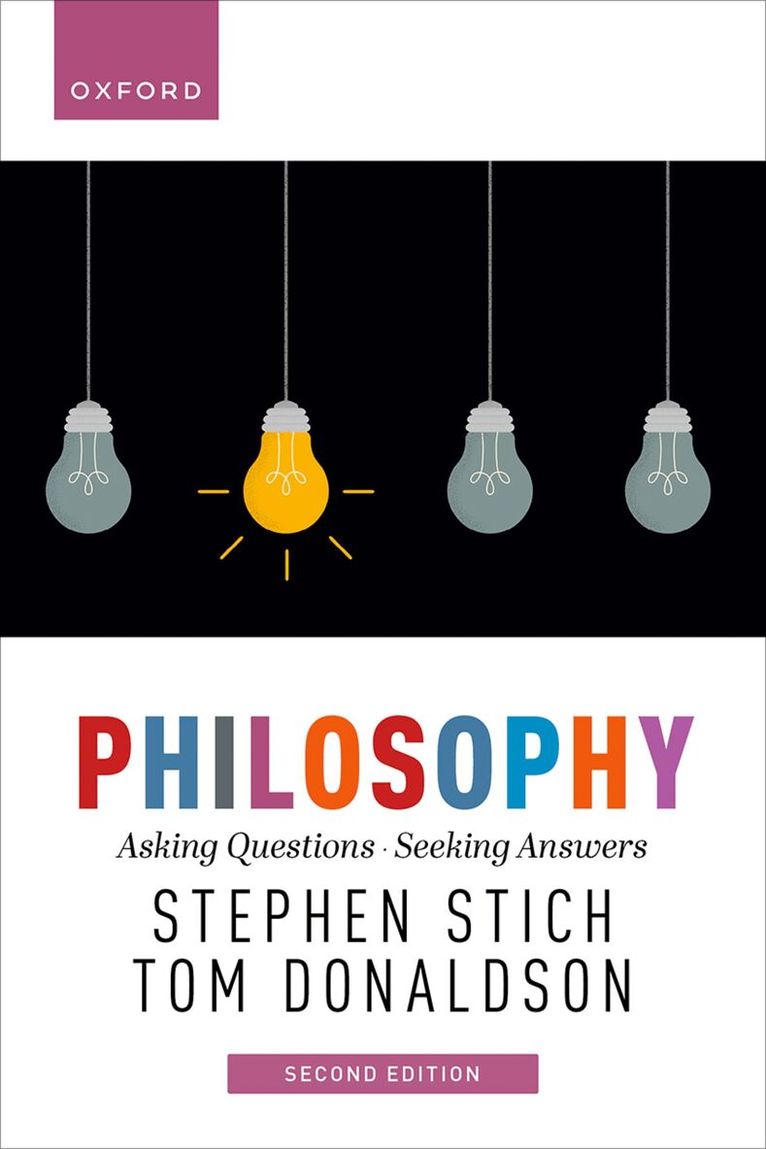
Philosophy, 2e
Asking Questions, Seeking Answers
AvStephen Stich,Thomas Donaldson
754 kr
Beställningsvara. Skickas inom 5-8 vardagar. Fri frakt över 249 kr.
Beskrivning
Produktinformation
- Utgivningsdatum:2024-10-17
- Mått:132 x 201 x 25 mm
- Vikt:499 g
- Format:Häftad
- Språk:Engelska
- Antal sidor:456
- Upplaga:2
- Förlag:OUP USA
- ISBN:9780197768013
Utforska kategorier
Mer om författaren
Stephen Stich is Professor of Philosophy at Rutgers University and an Honorary Professor at the University of Sheffield. He is known for his contributions to philosophy of mind. He is the author of Mindreading (OUP, 2003), Deconstructing the Mind (OUP, 1996), The Fragmentation of Reason (MIT Press, 1990), From Folk Psychology to Cognitive Science (MIT Press, 1983), and many others. Thomas Donaldson is Assistant Professor of Philosophy at Simon Fraser University. He holds a PhD in Philosophy from Rutgers University and wrote his dissertation on American Pragmatism. While receiving his MMathPhil (1st class) in Mathematics and Philosophy at Oxford University, he was awarded the Henry Wilde Prize, Elizabeth Anscombe Prize, and the Gibbs Prize. His areas of expertise are Philosophy of Logic and Language, Metaphysics, and American Pragmatism.
Recensioner i media
This is a superb book - far and away the best general introduction to analytic philosophy on the market today. The selection of topics is perfect for a first course in philosophy, the depth of coverage is just right, and the writing is lively and crystal clear. Stich and Donaldson have really hit it out of the park." - Philip Robbins, Associate Professor of Philosophy, University of Missouri
Innehållsförteckning
- Preface CHAPTER 1. What Is Philosophy?1.1 Philosophy Is Everywhere1.2 What Is a Philosophical Question?1.3 The Philosophical Method1.4 Philosophy and Science1.5 Why Bother?Discussion QuestionNotes CHAPTER 2. What Are Arguments, and How Should We Evaluate Them?Introduction2.1 Premises and Conclusions2.2 Evaluating Arguments2.3 Deductive Validity2.4 Induction and Abduction2.5 Multistep Arguments2.6 Evaluating Multistep Arguments2.7 Some Arguments to Evaluate2.8 Answers to ProblemsWhat to Look at NextGlossaryNotes CHAPTER 3. Does God Exist?Introduction3.1 The First Cause Argument3.2 Some Questions about the First Cause Argument3.3 Leibniz's Cosmological Argument3.4 The Design Argument3.5 Criticisms of the Design Argument3.6 Anselm's Ontological Argument3.7 What, If Anything, Is Wrong with Anselm's Ontological Argument?3.8 A Pragmatic Case for Theism?ConclusionGlossaryComprehension QuestionsDiscussion QuestionsWhat to Look at NextNotes CHAPTER 4. Why Does God Leave Us to Suffer?Introduction4.1 Three Logical Puzzles for Theists4.2 Introducing the Problem of Evil4.3 Three Inadequate Responses4.4 Rethinking the Nature of God4.5 Theodicy4.6 Skeptical TheismConclusionGlossaryComprehension QuestionsDiscussion QuestionsWhat to Look at NextNotes CHAPTER 5. Can We Be Completely Certain of Anything?Introduction5.1 Descartes's Project5.2 Certainty Is Hard to Find5.3 Achieving Certainty5.4 Clear and Distinct Perception5.5 Descartes's Theism, and His Solution to the Evil Demon Problem5.6 The Cartesian Circle5.7 Descartes's LegacyConclusionGlossaryComprehension QuestionsDiscussion QuestionsWhat to Look at NextNotes CHAPTER 6. Can We Trust Our Senses?6.1 Rationalism and Empiricism6.2 Indirect Realism6.3 Primary and Secondary Qualities6.4 Do Material Objects Really Exist?6.5 Berkeley's Idealism6.6 Direct RealismConclusionGlossaryComprehension QuestionsDiscussion QuestionsWhat to Look at NextNotes CHAPTER 7. Will the Sun Rise Tomorrow?Introduction7.1 Making Predictions7.2 Hume's Problem7.3 Karl Popper7.4 Peter Strawson7.5 Epistemically Basic Beliefs7.6 Beyond Enumerative InductionGlossaryComprehension QuestionsDiscussion QuestionsWhat to Look at NextNotes CHAPTER 8. What Is Knowledge?Introduction8.1 Three Kinds of Knowledge8.2 Analyzing Propositional Knowledge: The Easy Part-Belief and Truth8.3 Analyzing Propositional Knowledge: The Hard Part-Justification8.4 Foundationalism8.5 Coherentism8.6 Internalism and Externalism8.7 Fallibilism and Skepticism8.8 Gettier Cases-A Challenge to the Justified True Belief Account of KnowledgeGlossaryComprehension QuestionsDiscussion QuestionsWhat to Look at NextNotes CHAPTER 9. Do We Have Free Will?9.1 What Is Determinism?9.2 Incompatibilism9.3 Compatibilism9.4 LibertarianismGlossaryComprehension QuestionsDiscussion QuestionsWhat to Look at NextNotes CHAPTER 10. RaceIntroduction10.1 Racialism 10.2 Non-Racialist Meanings of 'Race'SummaryGlossaryComprehension QuestionsDiscussion QuestionsWhat to Look at NextNotes CHAPTER 11. How Is Your Mind Related to Your Body?Introduction11.1 Cartesian Dualism11.2 Philosophical Behaviorism11.3 The Mind-Brain Identity Theory11.4 Functionalism11.5 Physicalism, Zombies and a Revival of DualismGlossaryComprehension QuestionsDiscussion QuestionsWhat to Look at NextNotes CHAPTER 12. Will You Be the Same Person in Ten Years? Could You Survive Death?12.1 The Philosophical Issue and Its Practical Importance12.2 The Soul Theory12.3 Problems for Soul Theory12.4 Memory Theories12.5 Personal Identity and the BrainGlossaryComprehension QuestionsDiscussion QuestionsWhat to Look at NextNotes CHAPTER 13. Are There Objective Truths about Right and Wrong?Introduction13.1 Objective Truth13.2 The Divine Command Theory13.3 Cultural Relativism13.4 Subjectivism and Expressivism13.5 The Qualified Attitude TheoryConclusionGlossaryComprehension QuestionsDiscussion QuestionsWhat to Look at NextNotes CHAPTER 14. What Really Matters?Introduction14.1 Hedonism14.2 Sartre14.3 Susan Wolf on MeaningfulnessConclusionGlossaryComprehension QuestionsDiscussion QuestionsWhat to Look at NextNotes CHAPTER 15. What Should We Do? (Part I)15.1 Act Consequentialism and Act Utilitarianism15.2 Objections to Act Utilitarianism15.3 Rule Consequentialism and Rule Utilitarianism15.4 Kant's Universalization Test15.5 Kant's Humanity Formula15.6 Comparing Kantianism and ConsequentialismGlossaryComprehension QuestionsDiscussion QuestionsWhat to Look at NextNotes CHAPTER 16. What Should We Do? (Part II)Introduction16.1 Is It Morally Wrong to Go to the Opera While People Are Starving?16.2 Vegetarianism16.3 Is Abortion Morally Wrong?GlossaryComprehension QuestionsDiscussion QuestionsWhat to Look at NextNotes CHAPTER 17. Why Democracy?17.1 What is Democracy?17.2 The Basic Argument Against Democracy17.3 A Modest Defence of Democracy 17.4 Are Democratic Countries Well Run?17.5 Non-Instrumental Defenses of Democracy ConclusionGlossaryComprehension QuestionsDiscussion QuestionsWhat to Look at Next Appendix: A General Knowledge QuizAppendix A: Reading and Writing TipsSeven Tips on Reading PhilosophyEighteen Tips for Writing Philosophy PapersAppendix B: The Truth about Philosophy MajorsCareersSalariesMeaningResourcesNotes GlossaryCreditsIndex
Mer från samma författare
Epistemology for the Rest of the World
Stephen Stich, Masaharu Mizumoto, Elin McCready
Inbunden, 2018
1 062 kr
Epistemology for the Rest of the World
Elin McCready, Masaharu Mizumoto, Stephen Stich
1 082 kr
Epistemology for the Rest of the World
Elin McCready, Masaharu Mizumoto, Stephen Stich
1 082 kr
Innate Mind: Volume 2: Culture and Cognition
Peter Carruthers, Stephen Laurence, Stephen Stich
Häftad, 2007
900 kr
Du kanske också är intresserad av
Eastern Band of Cherokees of North Carolina
Henry Beebee Carrington, Thomas Donaldson, United States Census Office
Häftad, 2022
290 kr
Eastern Band of Cherokees of North Carolina
Henry Beebee Carrington, Thomas Donaldson
Inbunden, 2022
403 kr