• Fri frakt över 249 kr
  • •
  • Snabba leveranser
  • •
  • Billiga böcker
Kundservice

Du är på sajten för privatpersoner.

Företag, bibliotek eller offentlig verksamhet?

Du handlar på classic.bokus.com, där alla dina funktioner finns intakta.
Till classic.bokus.com
Bokus logotyp. Gå till startsidan.
  • Erbjudanden
  • Student
  • Topplistor
  • Barn & ungdom
  • Bokus Play
  • E-böcker
  • Ljudböcker
  • Pocketböcker
  • Spel och pussel

Pocketfynda! Hundratals böcker för 49 kr/st →

Sidfot

Mina sidor

    Hjälp

    • Kundservice
    • Vanliga frågor och svar
    • Frakt och leverans
    • Retur vid ångerrätt
    • Reklamera vara
    • Betalning
    • Köpvillkor
    • Allmänna villkor
    • Information om webbplatsens tillgänglighet

    Om Bokus

    • Om oss
    • Pressrum
    • För studenter
    • För företag
    • För bibliotek och offentlig verksamhet
    • För leverantörer
    • Hållbarhet

    Populärt

    • Aktuella erbjudanden
    • Presentkort
    • Studentlitteratur
    • Nya böcker
    • Topplistor
    • Signerade böcker
    • Engelska böcker

    Inspiration

    • Boktips
    • BookTok
    • Barnbokskaraktärer
    • Populära författare
    Logotyp för Bokus
    Följ oss på Facebook (extern länk)Följ oss på Instagram (extern länk)Följ oss på YouTube (extern länk)Följ oss på TikTok (extern länk)
    bokus @ CookiesAnpassa cookiesIntegritetspolicyKöpvillkor
    Till Citymail hemsida (extern länk)Till Budbee hemsida (extern länk)Till Postnord hemsida (extern länk)Till Schenker hemsida (extern länk)Till Early Bird hemsida (extern länk)Till Walleys hemsida (extern länk)
    1. Ekonomi och Ledarskap
    2. Nationalekonomi
    3. Ekonomisk historia

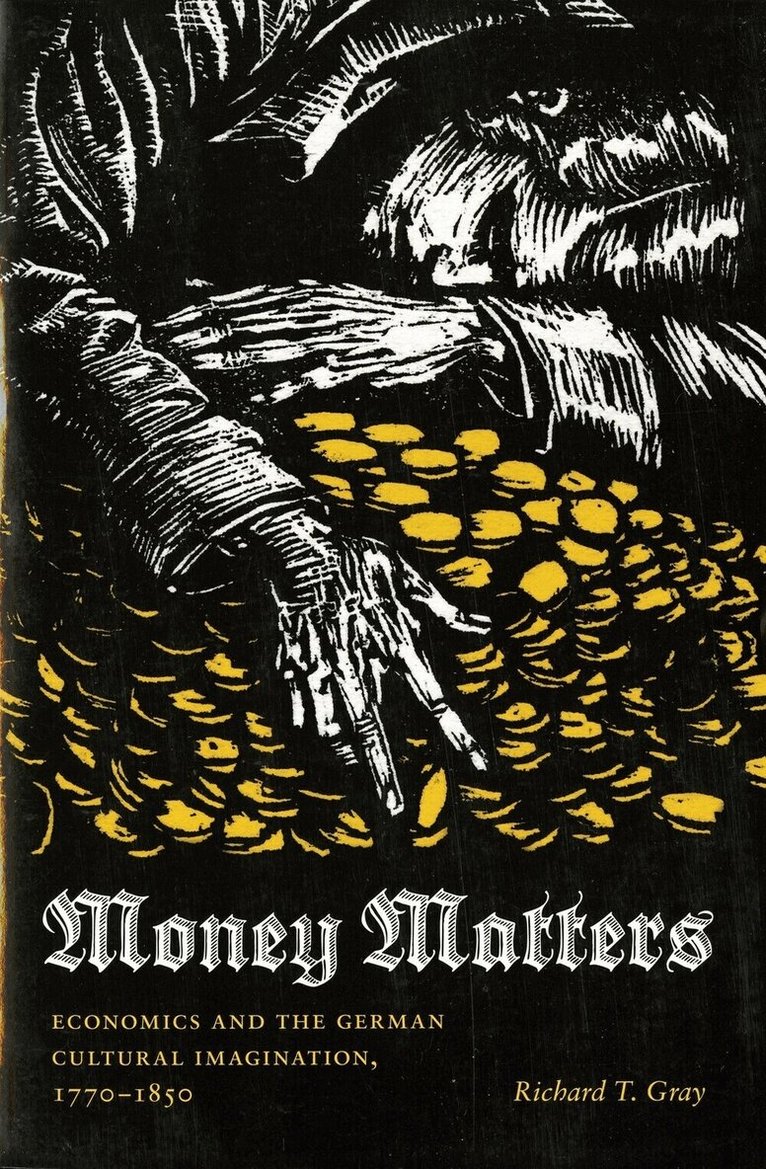
    Money Matters

    Economics and the German Cultural Imagination, 1770-1850

    AvRichard T. Gray

    Häftad, Engelska, 2008

    Del i serien Money Matters

    443 kr

    Skickas . Fri frakt över 249 kr.

    Fler format och utgåvor

    E-bok

    580 kr

    Inbunden

    1 951 kr

    Beskrivning

    In Money Matters, Richard Gray investigates the discourses of aesthetics and philosophy alongside economic thought, arguing that their domains are not mutually exclusive. The transition in Germany from an agrarian or proto-industrial economy to a capitalist industrial economy, which was paralleled by a shift from the exchange of money in coin to the use of paper currencies, occurred simultaneously with an efflorescence of German-language literature and philosophy. Based on close readings of canonical literary and philosophical texts, Gray explores how this confluence led to a rich cross-fertilization between economic and literary thought in Germany during this period.Money Matters documents the surprising degree to which literature and philosophy participated in the creation of modern economic paradigms, as well as the extent to which economics influenced literature and philosophy. The cultural artifacts of the period demonstrate the existence of an “economic unconsciousness”: persistent notions of value and exchange that inflect the aesthetic and thematic dimensions of literary and philosophical texts. This book offers a thought-provoking and original analysis of literature and ideas in the critical transition period from Kant and Goethe, through the German Romantics, to Marx.

    Produktinformation

    • Utgivningsdatum:2008-11-12
    • Mått:152 x 229 x 32 mm
    • Vikt:680 g
    • Format:Häftad
    • Språk:Engelska
    • Serie:Money Matters
    • Antal sidor:464
    • Förlag:University of Washington Press
    • ISBN:9780295988375

    Utforska kategorier

    • Ekonomisk historia inom Ekonomi och Ledarskap
    • Filosofiska discipliner inom Filosofi och religion
    • Litteraturvetenskap inom Skönlitteratur

    Mer om författaren

    Richard T. Gray is Byron W. and Alice L. Lockwood Professor in the Humanities at the University of Washington. He is the author of About Face: German Physiognomic Thought from Lavater to Auschwitz.

    Recensioner i media

    "Gray's book Money Matters is the work of a voracious and yet rigorously disciplined intellect, and points to the way to a sustained engagement of the humanities with three centuries of political economy. Unfortunately, books like Gray's . . . are all too rare. In an age where finance capital continues to make good use of liberal arts graduates . . . the liberal arts must continue to speak directly to the historic of economics, and attest to a cultural memory that can counterbalance the rush of amnesia between the screens of global monetary systems. In short, more people should read and think and write this way—and therefore, more people should read what Richard Gray offers in this volume."

    Innehållsförteckning

    • IntroductionPart One: Economics and Intellectual CultureChapter 1 / Buying into Signs: Money and Semiosis in Eighteenth-Century German Language TheoryChapter 2 / Hypersign, Hypermoney, Hypermarket: Adam Muller's Theory of Money and Romantic SemioticsChapter 3 / Economic Romanticism: Monetary Nationalism in Johann Gottlieb Fichte and Adam MullerChapter 4 / Economics and the Imagination: Cultural Values and the Debate over Physiocracy in Germany, 1770-1789Part Two: Literary EconomiesChapter 5 / Counting on God: Economic Providentialism in Johann Heinrich Jung-Stilling's LebensgeschichteChapter 6 / Deep Pockets: The Economics and Poetics of Excess in Adelbert von Chamisso's Peter ShlemihlChapter 7 / Red Herrings and Blue Smocks: Commercialism, Ecological Destruction, and Anti-Semitism in Annette von Droste-Hulshoff's Die JudenbucheChapter 8 / The (Mis)Fortune of Commerce: Economic Transformation in Adalbert Stifter's BergkristallConclusion / Limitless Faith in the Limitless: Money, Modernity, and the Economics/Aesthetics of Mediation of Goethe's Faust IINotesBibliographyIndex