• Fri frakt över 249 kr
  • •
  • Snabba leveranser
  • •
  • Billiga böcker
Kundservice

Du är på sajten för privatpersoner.

Företag, bibliotek eller offentlig verksamhet?

Du handlar på classic.bokus.com, där alla dina funktioner finns intakta.
Till classic.bokus.com
Bokus logotyp. Gå till startsidan.
  • Erbjudanden
  • Nyheter
  • Student
  • Topplistor
  • Barn & ungdom
  • Bokus Play
  • E-böcker
  • Pocketböcker
  • Spel & pussel

10% rabatt på allt med kod NYSTART10 →

Sidfot

Mina sidor

    Hjälp

    • Kundservice
    • Vanliga frågor och svar
    • Frakt och leverans
    • Retur vid ångerrätt
    • Reklamera vara
    • Betalning
    • Köpvillkor
    • Allmänna villkor
    • Information om webbplatsens tillgänglighet

    Om Bokus

    • Om oss
    • Pressrum
    • För studenter
    • För företag
    • För bibliotek och offentlig verksamhet
    • För leverantörer
    • Hållbarhet

    Populärt

    • Aktuella erbjudanden
    • Presentkort
    • Studentlitteratur
    • Nya böcker
    • Topplistor
    • Signerade böcker
    • Engelska böcker

    Inspiration

    • Boktips
    • BookTok
    • Populära bokserier
    • Barnbokskaraktärer
    • Populära författare
    Logotyp för Bokus
    Följ oss på Facebook (extern länk)Följ oss på Instagram (extern länk)Följ oss på YouTube (extern länk)Följ oss på TikTok (extern länk)
    bokus @ CookiesAnpassa cookiesIntegritetspolicyKöpvillkor
    Till Citymail hemsida (extern länk)Till Budbee hemsida (extern länk)Till Postnord hemsida (extern länk)Till Schenker hemsida (extern länk)Till Early Bird hemsida (extern länk)Till Walleys hemsida (extern länk)
    1. Naturvetenskap och teknik
    2. Teknik och industri
    3. Agronomi och lantbruk

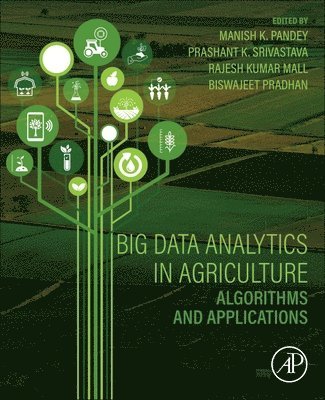
    Big Data Analytics in Agriculture

    Algorithms and Applications

    AvManish K. Pandey,Prashant K. Srivastava

    Häftad, Engelska, 2027

    1 933 kr

    Kommande

    Beskrivning

    Big Data Analytics in Agriculture focuses on the quantitative and qualitative assessment of agricultural systems using state-of-the-art technologies to deliver practical improvements in agricultural production.

    Addressing the challenge of translating data into real-world applications, the book provides a comprehensive mapping of the entire data lifecycle-from data generation, storage, and curation to processing and implementation. It guides readers through the steps required to produce high-quality, reliable information that supports effective decision-making. Following a logical progression, the volume demonstrates how diverse data streams converge into decision-support systems and how they can be transformed into actionable outcomes, aligned with intelligent, efficient, technologically advanced, economically viable, and politically and culturally sustainable practices.

    This book further explores the integration of information and communication technologies (ICT) and the Internet of Things (IoT) for managing rural assets and enhancing economic and environmental performance in spatially and temporally variable agricultural environments. Topics covered include big data analytics, data management and processing, and a range of algorithms and applications relevant to agriculture. Subtopics encompass artificial intelligence- and machine-learning-enabled smart and precision irrigation, disease and pest management, microclimatic forecasting, preventive fertigation and chemigation, data-driven smart farming through the Internet of Everything (IoE), and supply-chain analytics for improved farm-level operations.


    • Introduces readers to the evolution from conventional analytical approaches to large-scale analytical paradigms through a stepwise, sectioned framework that supports progressive skill development
    • Examines practical considerations surrounding storage architectures, multisource datasets, scalability constraints, and cost trade-offs in agricultural computing environments
    • Details algorithm-centric workflows, including feature construction, model calibration, and comparative performance evaluation across diverse agricultural contexts
    • Showcases a wide range of sector-specific implementations, covering crop monitoring, irrigation planning, weed control, nutrient stress identification, climate assessment, pest detection, and agri-food supply-chain operations in both advanced and resource-limited settings

    Produktinformation

    • Utgivningsdatum:2027-02-01
    • Mått:191 x 235 x undefined mm
    • Format:Häftad
    • Språk:Engelska
    • Antal sidor:350
    • Förlag:Elsevier Science
    • ISBN:9780323999328

    Utforska kategorier

    • Agronomi och lantbruk inom Naturvetenskap och teknik
    • Lantbruk, fiske och skogsbruk inom Ekonomi och Ledarskap
    • Databaser inom Data och IT

    Mer om författaren

    Dr. Manish K Pandey, a Research Associate Professor at MURC, Marwadi University, Rajkot, Gujarat, India, is passionate about blending geomorphology with the latest advances in artificial intelligence, remote sensing, and geographic information systems. He completed his undergraduate and postgraduate studies in Geography with specialisation in remote sensing and GIS at the University of Allahabad and earned his Ph.D. from Banaras Hindu University in fluvial geomorphology with support from prestigious CSIR research grants. With more than a decade of research experience, Dr. Pandey investigates earth surface processes, such as flooding, landslides, and groundwater dynamics, using cutting-edge AI techniques. Skilled in cartography and GIS software like ArcGIS and QGIS, and MATLAB- and Python-based GeoAI, he has also broadened his expertise into glaciology through training with the Geological Survey of India and ISRO. Above all, Dr. Pandey is dedicated to advancing GeoAI as a powerful tool for modeling and understanding the natural world.Prashant K. Srivastava is working at IESD, Banaras Hindu University, as a faculty and was affiliated with Hydrological Sciences, NASA Goddard Space Flight Center, as research scientist on SMAP satellite soil mois ture retrieval algorithm development, instrumentation, and simulation for various applications. He received his PhD degree from the Department of Civil Engineering, University of Bristol, Bristol, United Kingdom. Prashant was the recipient of several awards such as NASA Fellowship, USA; University of Maryland Fellowship, USA; Commonwealth Fellowship, UK; Early Career Research Award (ECRA, DST, India), CSIR, as well as UGC JRF-NET (2005, 2006). He is leading a number of projects funded from reputed agencies in India as well as world. He was also a collaborator with NASA JPL on SMAP soil mois ture calibration and validation as well as Scatsat-1, NISAR, AVIRIS-NG missions of India. Prashant made more than 200+ publications in peer-reviewed journals and published 14 books with reputed publishing house such as Springer, Taylor and Francis, AGU-Wiley, and Elsevier, and several book chapters with good cita tion index. He presented his work in several conferences and workshops and is acting as a convener for the last few years in EGU, Hydroinformatics (HIC), and other conferences. He is also acting as Regional Editor Asia-Geocarto International (T & F), Associate Editor-Journal of Hydrology (Elsevier), GIScience and Remote Sensing (T & F), Remote Sensing Applications: Society and Environment (Elsevier), Sustainable Environment (T & F), Water Resources Management (Springer), Frontiers Remote Sensing, Associate Editor- Remote Sensing-MDPI, Associate Editor- Environment, Development and Sustainability (Springer), Environmental Processes (Springer), Bull of Env and Sci Res. Professor R. K. Mall is Dean and Head of the Institute of Environment & Sustainable Development, Banaras Hindu University. Prof Mall received his Ph.D. in Geophysics from Banaras Hindu University. With about thirty years of professional experience, he has gained extensive knowledge in the field of research and academia, administration, and managerial capacity in the fields of simulation modelling, climate change / disaster risk management and related issues, sustainable development and poverty alleviation, agro-advisory services for farmers. Prof. Mall has been the principal investigator of various projects with a combined total grant exceeding £150 million. As a major milestone Prof. Mall has established the “DST-Mahamana Centre of Excellence in Climate Change Research” at BHU under Prime Minister’s National Action Plan on Climate Change in 2017. As of now, Prof. Mall has visited more than 25 countries for various international conferences, seminars, training and international collaborations and received several awards and recognitions worldwide. He has conferred several awards such as Senior & Regular Associateship of ICTP-Italy, TWAS-CAS fellow (2006), Visiting Scientist/Professor at ANU-Australia, GMU-USA, Purdue-USA & ICTP-Italy etc. Prof. Mall has published over 100 research papers, 17 books, and various book chapters, and supervised over 8 Ph.D. students. He has developed robust models based on social, economic, and environmental vulnerability of India and the South Asia region, found to be immensely applicable for regional and sub regional planning (UNDRR, SAARC-Disaster Management Centre, UNDP, World Bank, IMD, CGWB etc.). He also serves as consultant and policy adviser for various State Government, Central Government Departments as well as UN and other international agencies. He has also represented several Government of India delegations in the Asian Ministerial Conference on Disaster Risk Reduction (AMCDRR) and Global Platform on Disaster Risk Reduction (GPDRR) in Indonesia, Switzerland, Thailand, Japan, and India. Professor Pradhan is a globally recognized expert in geospatial analytics and artificial intelligence applications in Earth and environmental sciences. Currently a Distinguished Professor at the University of Technology Sydney (UTS), Australia, he also leads the Centre for Advanced Modelling and Geospatial Information Systems (CAMGIS). With a PhD in GIS-based modeling, Prof. Pradhan has over two decades of experience in spatial data science, remote sensing, natural hazard modeling, and environmental monitoring. He has been listed among the world's top 2% scientists by Stanford University and received numerous international awards, including from IEEE and Elsevier. A Fellow of the Royal Geographical Society (FRGS), he also serves on editorial boards of several top-tier journals. His research integrates geospatial AI and deep learning for disaster risk reduction, land use planning, and sustainability.

    Innehållsförteckning

    • Section I: Introduction to Big Data Analytics in Agriculture1. Introduction to Traditional Data Analytics2. Introduction to Big Data and Big Data AnalyticsSection II: Big Data Management and Processing3. Agricultural Big Data — Storage, Loading, and Application Development4. Data Analysis Techniques for Agricultural-based Multi corpus: Scalability and Cost Perspective5. Approaches for Big Data Processing: Applications and ChallengesSection III: Big Data Analytics Algorithms6. From Theory to Practice: The Application of Big Data and Machine Learning in Real-World Scenarios7. Feature engineering and Model fitting for Efficient Big Data AnalyticsSection IV: Big Data Applications8. Data-Driven Approaches and AI Applications in Managing Variability for Sustainable Crop Production9. Big Data-Driven Smart Farming: A Visualization Perspective of tracking Agricultural Productivity10. Smart and Precise Irrigation: A Way Forward11. Application of Mobile Collaborative Robot using Deep Learning in Precision Weed Control of Large Farms – A Brief Review12. Machine Learning Enabled Nutrient Stress Detection and Real time Prediction13. Performance Evaluation of Machine Learning Algorithms for Leaf Disease Detection14. AI-Driven Smart Agriculture System for Multi-Crop Disease Detection: A Study on Potato, Tomato and Bell Pepper15. Soil moisture estimation through machine learning and polarimetric Synthetic Aperture Radar data over high altitude agroforestry landscapes16. Review on the increasing role of Artificial Intelligence / Machine Learning in climate prediction17. Impact Assessment of Climate Change Through Agricultural Big Data with Emphasis on Smart Agriculture18. Rice Pest Detection using YOLO Machine Learning19. Practical applications of Supply Chain Analytics in Agriculture20. Harnessing Big Data for Agricultural Transformation in Developing Economies: Origins, Applications, and Impacts on FarmersSection V: Challenges and prospects21. Challenges and Future Pathways for Big Data Analytics in Agriculture from an Algorithmic and Applications Perspective