• Fri frakt över 249 kr
  • •
  • Snabba leveranser
  • •
  • Billiga böcker
Kundservice

Du är på sajten för privatpersoner.

Företag, bibliotek eller offentlig verksamhet?

Du handlar på classic.bokus.com, där alla dina funktioner finns intakta.
Till classic.bokus.com
Bokus logotyp. Gå till startsidan.
  • Erbjudanden
  • Student
  • Topplistor
  • Barn & ungdom
  • Bokus Play
  • E-böcker
  • Ljudböcker
  • Pocketböcker
  • Spel och pussel

Pocketfynda! Hundratals böcker för 49 kr/st →

Sidfot

Mina sidor

    Hjälp

    • Kundservice
    • Vanliga frågor och svar
    • Frakt och leverans
    • Retur vid ångerrätt
    • Reklamera vara
    • Betalning
    • Köpvillkor
    • Allmänna villkor
    • Information om webbplatsens tillgänglighet

    Om Bokus

    • Om oss
    • Pressrum
    • För studenter
    • För företag
    • För bibliotek och offentlig verksamhet
    • För leverantörer
    • Hållbarhet

    Populärt

    • Aktuella erbjudanden
    • Presentkort
    • Studentlitteratur
    • Nya böcker
    • Topplistor
    • Signerade böcker
    • Engelska böcker

    Inspiration

    • Boktips
    • BookTok
    • Barnbokskaraktärer
    • Populära författare
    Logotyp för Bokus
    Följ oss på Facebook (extern länk)Följ oss på Instagram (extern länk)Följ oss på YouTube (extern länk)Följ oss på TikTok (extern länk)
    bokus @ CookiesAnpassa cookiesIntegritetspolicyKöpvillkor
    Till Citymail hemsida (extern länk)Till Budbee hemsida (extern länk)Till Postnord hemsida (extern länk)Till Schenker hemsida (extern länk)Till Early Bird hemsida (extern länk)Till Walleys hemsida (extern länk)
    1. Data och IT
    2. Nätverk och kommunikation

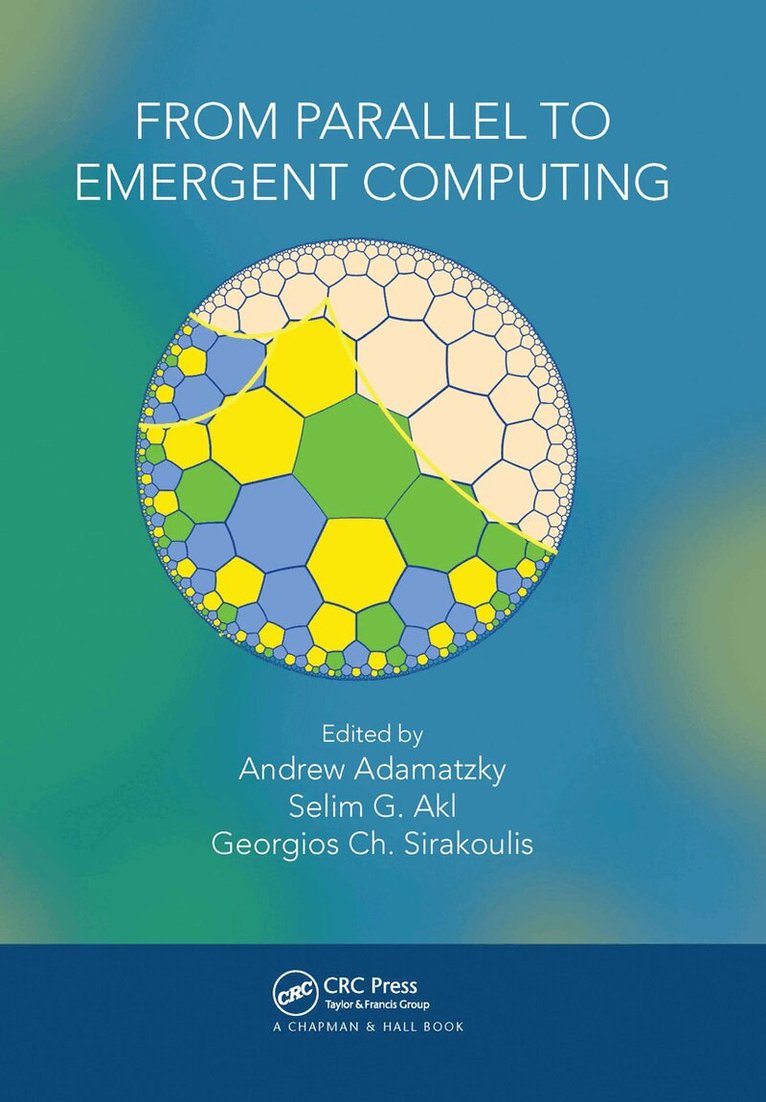
    From Parallel to Emergent Computing

    AvAndrew Adamatzky,Selim Akl

    Häftad, Engelska, 2020

    727 kr

    Beställningsvara. Skickas inom 10-15 vardagar. Fri frakt över 249 kr.

    Beskrivning

    Modern computing relies on future and emergent technologies which have been conceived via interaction between computer science, engineering, chemistry, physics and biology. This highly interdisciplinary book presents advances in the fields of parallel, distributed and emergent information processing and computation. The book represents major breakthroughs in parallel quantum protocols, elastic cloud servers, structural properties of interconnection networks, internet of things, morphogenetic collective systems, swarm intelligence and cellular automata, unconventionality in parallel computation, algorithmic information dynamics, localized DNA computation, graph-based cryptography, slime mold inspired nano-electronics and cytoskeleton computers. Features Truly interdisciplinary, spanning computer science, electronics, mathematics and biology Covers widely popular topics of future and emergent computing technologies, cloud computing, parallel computing, DNA computation, security and network analysis, cryptography, and theoretical computer science Provides unique chapters written by top experts in theoretical and applied computer science, information processing and engineering From Parallel to Emergent Computing provides a visionary statement on how computing will advance in the next 25 years and what new fields of science will be involved in computing engineering. This book is a valuable resource for computer scientists working today, and in years to come.

    Produktinformation

    • Utgivningsdatum:2020-09-30
    • Mått:178 x 254 x 38 mm
    • Vikt:453 g
    • Format:Häftad
    • Språk:Engelska
    • Antal sidor:608
    • Förlag:Taylor & Francis Ltd
    • ISBN:9780367656607

    Utforska kategorier

    • Nätverk och kommunikation inom Data och IT
    • Hårdvara inom Data och IT
    • Programmeringsböcker inom Data och IT

    Mer om författaren

    Andrew Adamatzky is Professor of Unconventional Computing and Director of theUnconventional Computing Laboratory, Department of Computer Science, Universityof the West of England, Bristol, United Kingdom. He does research in molecular computing,reaction-diffusion computing, collision-based computing, cellular automata,slime mould computing, massive parallel computation, applied mathematics, complexity,nature-inspired optimisation, collective intelligence and robotics, bionics,computational psychology, non-linear science, novel hardware, and future and emergentcomputation. He authored seven books, including Reaction-Diffusion Computers(Elsevier, 2005), Dynamics of Crowd-Minds (World Scientific, 2005), and PhysarumMachines (World Scientific, 2010), and edited 22 books in computing, including CollisionBased Computing (Springer, 2002), Game of Life Cellular Automata (Springer, 2010),and Memristor Networks (Springer, 2014); he also produced a series of influentialartworks published in the atlas Silence of Slime Mould (Luniver Press, 2014). He isfounding editor-in-chief of the Journal of Cellular Automata (2005–) and the Journalof Unconventional Computing (2005–) and editor-in-chief of the Journal of Parallel,Emergent, Distributed Systems (2014–) and Parallel Processing Letters (2018–).Selim G. Akl (Ph.D., McGill University, 1978) is a Professor at Queen’s Universityin the Queen’s School of Computing, where he leads the Parallel and UnconventionalComputation Group. His research interests are primarily in the area of algorithmdesign and analysis, in particular for problems in parallel computing and unconventionalcomputing. Dr. Akl is the author of Parallel Sorting Algorithms (Academic Press,1985), The Design and Analysis of Parallel Algorithms (Prentice Hall, 1989), andParallel Computation: Models and Methods (Prentice Hall, 1997). He is co-author ofParallel Computational Geometry (Prentice Hall, 1993), Adaptive Cryptographic AccessControl (Springer, 2010), and Applications of Quantum Cryptography (Lambert, 2016).Georgios Ch. Sirakoulis is a Professor in Department of Electrical and ComputerEngineering at Democritus University of Thrace, Greece. His current research emphasisis on complex electronic systems, future and emergent electronic devices, circuits,models and architectures (memristors, quantum cellular automata, etc.), novel computingdevices and circuits, cellular automata, unconventional computing, high-performancecomputing, cyber-physical and embedded systems, bioinspired computation andbioengineering, FPGAs, modelling, and simulation. He co-authored two books, namelyMemristor-Based Nanoelectronic Computing Circuits and Architectures (Springer,2016) and Artificial Intelligence and Applications (Krikos Publishing, 2010) and coeditedthree books.

    Innehållsförteckning

    • Preface, Editor BiosEditorial Boards of the International Journal of Parallel, Emergent and Distributed SystemsPart 1 Networks and Parallel ComputingChapter 1 On the Importance of Parallelism for the Security of Quantum ProtocolsMarius Nagy and Naya NagyChapter 2 Analytical Modeling and Optimization of an Elastic Cloud Server SystemKeqin LiChapter 3 Towards an Opportunistic Software-Defined Networking SolutionLefteris Mamatas, Alexandra Papadopoulou, and Vassilis TsaoussidisChapter 4 Structural Properties and Fault Resiliency of Interconnection NetworksEddie Cheng, Rong-Xia Hao, Ke Qiu, and Zhizhang ShenPart 2 Distributed SystemsChapter 5 Dynamic State Transitions of Individuals Enhance Macroscopic Behavioral Diversity of Morphogenetic Collective SystemsHiroki SayamaChapter 6 Toward Modeling Regeneration via Adaptable Echo State NetworksJennifer Hammelman, Hava Siegelmann, Santosh Manicka, and Michael LevinChapter 7 From Darwinian Evolution to Swarm Computation and GamesourcingIvan Zelinka, Donald Davendra, Lenka Skanderová, Tomáš Vantuch, Lumír Kojecký, and Michal BukáčekChapter 8 A Scalable and Modular Software Architecture for Finite Elements on Hierarchical Hybrid GridsNils Kohl, Dominik Thönnes, Daniel Drzisga, Dominik Bartuschat, and Ulrich RüdeChapter 9 Minimal Discretised Agent-Based Modelling of the Dynamics of Change in Reactive SystemsTiago G. Correale and Pedro P.B. de OliveiraChapter 10 Toward a Crab-Driven Cellular AutomatonYuta Nishiyama, Masao Migita, Kenta Kaito, and Hisashi MurakamiChapter 11 Evolving Benchmark Functions for Optimization Algorithms Yang Lou, Shiu Yin Yuen, and Guanrong ChenChapter 12 Do Ant Colonies Obey the Talmud? Andrew SchumannChapter 13 Biomorphs with MemoryRamón Alonso-SanzChapter 14 Constructing Iterated Exponentials in Tilings of the Euclidean and of the Hyperbolic PlaneMaurice MargensternChapter 15 Swarm Intelligence for Area Surveillance Using Autonomous RobotsTilemachos Bontzorlos, Georgios Ch. Sirakoulis, and Franciszek SeredynskiPart 3 Emergent ComputingChapter 16 Unconventional Wisdom: Superlinear Speedup and Inherently Parallel ComputationsSelim G. AklChapter 17 Algorithmic Information Dynamics of Emergent, Persistent, and Colliding Particles in the Game of LifeHector Zenil, Narsis A. Kiani, and Jesper TegnérChapter 18 On Mathematics of Universal Computation with Generic Dynamical SystemsVasileios Athanasiou and Zoran KonkoliChapter 19 Localized DNA ComputationHieu Bui and John ReifChapter 20 The Graph Is the Message: Design and Analysis of an Unconventional Cryptographic FunctionSelim G. AklChapter 21 Computing via Self-optimising ContinuumAlexander SafonovChapter 22 Exploring Tehran with Excitable MediumAndrew I. Adamatzky and Mohammad Mahdi DehshibiChapter 23 Feasibility of Slime-Mold-Inspired Nano-Electronic DevicesTakahide OyaChapter 24 A Laminar Cortical Model for 3D Boundary and Surface Representations of Complex Natural ScenesYongqiang Cao and Stephen GrossbergChapter 25 Emergence of Locomotion Gaits Through Sensory Feedback in a Quadruped RobotPaolo Arena, Andrea Bonanzinga, and Luca PatanèChapter 26 Towards Cytoskeleton Computers. A ProposalAndrew I. Adamatzky, Jack Tuszynski, Jörg Pieper, Dan V. Nicolau, Rosaria Rinaldi, Georgios Ch. Sirakoulis, Victor Erokhin, Jörg Schnauß, and David M. SmithIndex