• Fri frakt över 249 kr
  • •
  • Snabba leveranser
  • •
  • Billiga böcker
Kundservice

Du är på sajten för privatpersoner.

Företag, bibliotek eller offentlig verksamhet?

Du handlar på classic.bokus.com, där alla dina funktioner finns intakta.
Till classic.bokus.com
Bokus logotyp. Gå till startsidan.
  • Erbjudanden
  • Student
  • Topplistor
  • Barn & ungdom
  • Bokus Play
  • E-böcker
  • Ljudböcker
  • Pocketböcker
  • Spel och pussel

Pocketfynda! Hundratals böcker för 49 kr/st →

Sidfot

Mina sidor

    Hjälp

    • Kundservice
    • Vanliga frågor och svar
    • Frakt och leverans
    • Retur vid ångerrätt
    • Reklamera vara
    • Betalning
    • Köpvillkor
    • Allmänna villkor
    • Information om webbplatsens tillgänglighet

    Om Bokus

    • Om oss
    • Pressrum
    • För studenter
    • För företag
    • För bibliotek och offentlig verksamhet
    • För leverantörer
    • Hållbarhet

    Populärt

    • Aktuella erbjudanden
    • Presentkort
    • Studentlitteratur
    • Nya böcker
    • Topplistor
    • Signerade böcker
    • Engelska böcker

    Inspiration

    • Boktips
    • BookTok
    • Barnbokskaraktärer
    • Populära författare
    Logotyp för Bokus
    Följ oss på Facebook (extern länk)Följ oss på Instagram (extern länk)Följ oss på YouTube (extern länk)Följ oss på TikTok (extern länk)
    bokus @ CookiesAnpassa cookiesIntegritetspolicyKöpvillkor
    Till Citymail hemsida (extern länk)Till Budbee hemsida (extern länk)Till Postnord hemsida (extern länk)Till Schenker hemsida (extern länk)Till Early Bird hemsida (extern länk)Till Walleys hemsida (extern länk)
    1. Ekonomi och Ledarskap
    2. Nationalekonomi
    3. Mikroekonomi

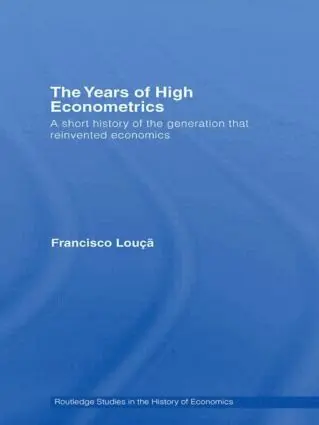
    Years of High Econometrics

    A Short History of the Generation that Reinvented Economics

    AvFrancisco Louçã

    Häftad, Engelska, 2012

    Del i serien Routledge Studies in the History of Economics

    873 kr

    Beställningsvara. Skickas inom 10-15 vardagar. Fri frakt över 249 kr.

    Fler format och utgåvor

    Inbunden

    2 634 kr

    E-bok

    1 040 kr

    E-bok

    1 040 kr

    Beskrivning

    A fascinating and comprehensive history, this book explores the most important transformation in twentieth century economics: the creation of econometrics.Containing fresh archival material that has not been published before and taking Ragnar Frisch as the narrator, Francisco Louca discusses both the keys events - the establishment of the Econometric Society, the Cowles Commission and the journal Econometrica – and the major players - economists like Wesley Mitchell, mathematicians like John von Neumann and statisticians like Karl Pearson - in history that shaped the development of econometrics. He discusses the evolution of their thought, detailing the debates, the quarrels and the interrogations that crystallized their work and even offers a conclusion of sorts, suggesting that some of the more influential thinkers abandoned econometrics or became critical of its development. International in scope and appeal, The Years of High Econometrics is an excellent accompaniment for students taking courses on probability, econometric methods and the history of economic thought.

    Produktinformation

    • Utgivningsdatum:2012-03-22
    • Mått:156 x 234 x 22 mm
    • Vikt:740 g
    • Format:Häftad
    • Språk:Engelska
    • Serie:Routledge Studies in the History of Economics
    • Antal sidor:400
    • Förlag:Taylor & Francis Ltd
    • ISBN:9780415514576

    Utforska kategorier

    • Mikroekonomi inom Ekonomi och Ledarskap
    • Ekonomisk historia inom Ekonomi och Ledarskap
    • Naturvetenskapens filosofi inom Naturvetenskap och teknik

    Mer om författaren

    Francisco Louçã is Associate Professor of Economics at ISEG (Lisbon), where he teaches macroeconomics and the history of economics. He is part of a research team on complexity in economics, and published several books and a number of papers, namely in economic journals (Cambridge Journal of Economics, Economic Journal, History of Political Economy, etc.) but also in journals of theoretical physics (Physica A, etc.).He got the prize of the History of Economics Association for the best paper published in 1999.He was elected member of Parliament in 1999, and reelected in 2002 and 2005 (for the Left Block), serving currently at the Budget Commission. Louçã was involved in a major reform of the fiscal laws in Portugal (2000) as well as in other legislation on economic and social matters.Francisco Louçã is Associate Professor of Economics at ISEG (Lisbon), where he teaches macroeconomics and the history of economics. He is part of a research team on complexity in economics, and published several books and a number of papers, namely in economic journals (Cambridge Journal of Economics, Economic Journal, History of Political Economy, etc.) but also in journals of theoretical physics (Physica A, etc.).He got the prize of the History of Economics Association for the best paper published in 1999.He was elected member of Parliament in 1999, and reelected in 2002 and 2005 (for the Left Block), serving currently at the Budget Commission. Louçã was involved in a major reform of the fiscal laws in Portugal (2000) as well as in other legislation on economic and social matters.

    Recensioner i media

    'A fascinating book.' Kevin D. Hoover, Duke University, USA in the Journal of the History of Economic Thought

    Innehållsförteckning

    • Introduction Part 1: Foundation 1. 'Not Afraid of the Impossible': Ragnar Frisch, 1895-1973 2. The Emergence of Social Physics: The Econometric People are Assembled 3. The Years of High Theory Part 2: Construction 4. What Counts is What Can be Counted 5. Particles or Humans: Paradoxes of Mechanics Part 3: Debates 6. Challenging Keynes: The Econometric Movement Builds its Trenches 7. Intriguing Pendula: Delights and Dangers of Econometric Conversation 8. Quod Errat Demonstrandum: The Concept of Probability Puzzling the Econometricians Part 4: Theory and Practice at the Edge 9. Chaos or Randomness 10. Is Capitalism Doomed?: A Nobel Discussion 11. Prometheus Tired of War 12. Conclusion: A Brave New World