• Fri frakt över 249 kr
  • •
  • Snabba leveranser
  • •
  • Billiga böcker
Kundservice

Du är på sajten för privatpersoner.

Företag, bibliotek eller offentlig verksamhet?

Du handlar på classic.bokus.com, där alla dina funktioner finns intakta.
Till classic.bokus.com
Bokus logotyp. Gå till startsidan.
  • Erbjudanden
  • Nyheter
  • Student
  • Topplistor
  • Barn & ungdom
  • Bokus Play
  • E-böcker
  • Pocketböcker
  • Spel & pussel

10% rabatt på allt med kod: NYSTART10 →

Sidfot

Mina sidor

    Hjälp

    • Kundservice
    • Vanliga frågor och svar
    • Frakt och leverans
    • Retur vid ångerrätt
    • Reklamera vara
    • Betalning
    • Köpvillkor
    • Allmänna villkor
    • Information om webbplatsens tillgänglighet

    Om Bokus

    • Om oss
    • Pressrum
    • För studenter
    • För företag
    • För bibliotek och offentlig verksamhet
    • För leverantörer
    • Hållbarhet

    Populärt

    • Aktuella erbjudanden
    • Presentkort
    • Studentlitteratur
    • Nya böcker
    • Topplistor
    • Signerade böcker
    • Engelska böcker

    Inspiration

    • Boktips
    • BookTok
    • Populära bokserier
    • Barnbokskaraktärer
    • Populära författare
    Logotyp för Bokus
    Följ oss på Facebook (extern länk)Följ oss på Instagram (extern länk)Följ oss på YouTube (extern länk)Följ oss på TikTok (extern länk)
    bokus @ CookiesAnpassa cookiesIntegritetspolicyKöpvillkor
    Till Citymail hemsida (extern länk)Till Budbee hemsida (extern länk)Till Postnord hemsida (extern länk)Till Schenker hemsida (extern länk)Till Early Bird hemsida (extern länk)Till Walleys hemsida (extern länk)
    1. Ekonomi och Ledarskap
    2. Nationalekonomi
    3. Ekonomisk historia

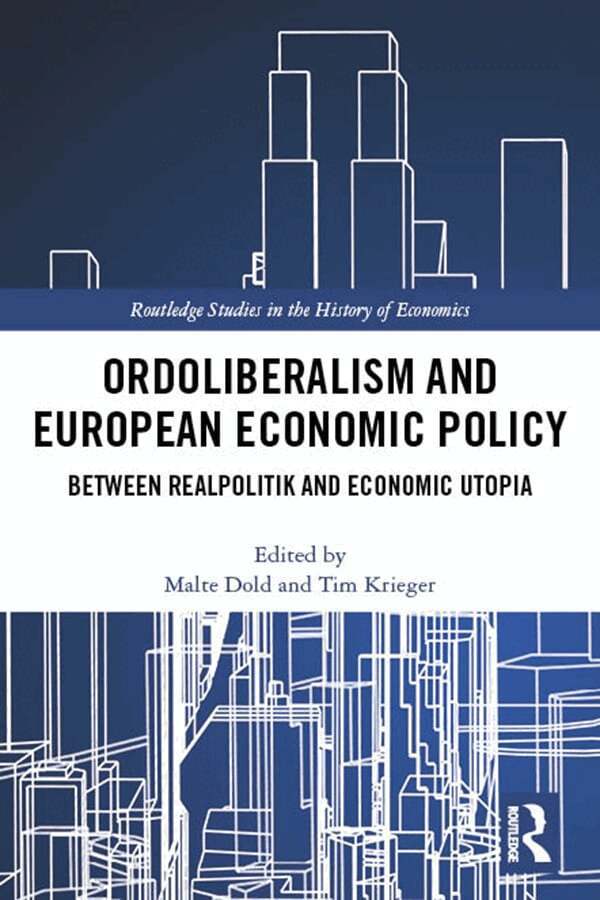
    Ordoliberalism and European Economic Policy

    Between Realpolitik and Economic Utopia

    AvMalte Dold,Tim Krieger

    Inbunden, Engelska, 2019

    Del i serien Routledge Studies in the History of Economics

    2 421 kr

    Beställningsvara. Skickas inom 10-15 vardagar. Fri frakt över 249 kr.

    Beskrivning

    This volume takes a broad perspective on the recent debate on the role of German ordoliberalism in shaping European economic policy before and after the eurozone crisis. It shows how ordoliberal scholars explain the institutional origins of the eurozone crisis, and presents creative policy proposals for the future of the European economy. Ordoliberal discourse both attempts to offer political solutions to socioeconomic challenges, and to find an ideal market order that fosters individual freedom and social cohesion. This tension between realpolitik and economic utopia reflects the wider debate on how far economic theory shapes, and is shaped by, historical contingencies and institutions. The volume will be of interest to policymakers as well as research scholars, and graduate students from various disciplines ranging from economics to political science, history, and philosophy.

    Produktinformation

    • Utgivningsdatum:2019-09-26
    • Mått:156 x 234 x 16 mm
    • Vikt:640 g
    • Format:Inbunden
    • Språk:Engelska
    • Serie:Routledge Studies in the History of Economics
    • Antal sidor:296
    • Förlag:Taylor & Francis Ltd
    • ISBN:9780367193812

    Utforska kategorier

    • Ekonomisk historia inom Ekonomi och Ledarskap
    • Ekonomisk politik inom Ekonomi och Ledarskap
    • Statsvetenskap och politisk teori inom Samhälle och politik

    Mer om författaren

    Malte Dold is an assistant professor in the Economics Department at Pomona College in California. Previously, he spent two years as a postdoctoral fellow at New York University. He holds a master’s degree in philosophy and economics from the University of Bayreuth, and received his PhD in economics from the University of Freiburg. His research lies at the intersection of behavioral economics, welfare economics, and political economy. In particular, his research looks at normative and methodological issues in behavioral economics and the historical interdependencies between Austrian and ordoliberal economic thought.Tim Krieger is the Wilfried Guth Professor of Constitutional Political Economy and Competition Policy at University of Freiburg. He holds a master’s degree in economics from the University of Kiel, and received his PhD in economics from the University of Munich. He worked as an assistant and interim professor at the universities of Mainz, Marburg, and Paderborn. His research focuses on economic, social, and education policies in aging and globalizing societies with a special focus national and supranational institutions. In addition, he specializes in the economics of conflict, terrorism, and crime.

    Innehållsförteckning

    • Part I: IntroductionForeword Wolfgang Schäuble1. Introduction Malte Dold and Tim KriegerPart II: The Historical and Contemporaneous Roots of Ordoliberalism2. Ordoliberalism’s Embeddedness in the Neoliberalisms of the 1930s and 1940s Stefan Kolev3. Ordoliberalism and Democracy - How the Interwar Period Changed the Agenda of German Liberalism Gerhard Wegner4. Ordoliberalism, Social Catholicism, and West Germany’s Social Market Economy, 1949-1976 Volker Berghahn5. The Protestant Roots of Ordoliberalism and the Re-emergence of the North-South Conflict Josef Hien6. Ordoliberalism and the Cross-National Disciplinary Revolution in Liberalism Kenneth Dyson7. Ordoliberalism from the Perspective of a U.S.-trained Macroeconomist Rüdiger Bachmann8. The Interdependency of Law and Economics in Ordoliberal Theory and EU Law Heike SchweitzerPart III: Ordoliberal Explanations of the Eurozone Crisis9. The Commitment Problem and the Euro Crisis Johannes Becker and Clemens Fuest10. Is Ordoliberalism Institutionally Useful for the EU? Wolf Schäfer11. Ordo, Macro and the Euro: Germany in the Dock Oliver Landmann12. The Deutsche Mark and the Euro: Prerequisites for a Stable Currency Otmar Issing13. Ten Commandments to Overcome the Eurozone’s Many Crises Norbert BertholdPart IV: Advancements of the Ordoliberal Framework after the Crisis14. The Eurocrisis and Ordoliberalism: Towards a More Perfect Market of Jurisdictions in the Eurozone? Thomas Biebricher15. Ordoliberalism and the Future of European Integration Michael Wohlgemuth16. The Normative Legacy of Walter Eucken and Beyond: EU Cohesion Policy as a Fundament of a European Social Market Economy Julian Dörr, Nils Goldschmidt and Alexander Lenger17. The Enigma of German Ordoliberalism: Is There a Future for a European Social Market Economy? Brigitte Young18. New Ordoliberalism and the Euro-Dividend Bernhard Neumärker19. The Future of German Ordoliberalism Lars P. Feld and Ekkehard A. Köhler20. Ordoliberalism and Beyond: Economic Liberalism for the 21st Century Tim Krieger and Malte Dold