• Fri frakt över 249 kr
  • •
  • Snabba leveranser
  • •
  • Billiga böcker
Kundservice

Du är på sajten för privatpersoner.

Företag, bibliotek eller offentlig verksamhet?

Du handlar på classic.bokus.com, där alla dina funktioner finns intakta.
Till classic.bokus.com
Bokus logotyp. Gå till startsidan.
  • Erbjudanden
  • Student
  • Topplistor
  • Barn & ungdom
  • Bokus Play
  • E-böcker
  • Ljudböcker
  • Pocketböcker
  • Spel och pussel

Pocketfynda! Hundratals böcker för 49 kr/st →

Sidfot

Mina sidor

    Hjälp

    • Kundservice
    • Vanliga frågor och svar
    • Frakt och leverans
    • Retur vid ångerrätt
    • Reklamera vara
    • Betalning
    • Köpvillkor
    • Allmänna villkor
    • Information om webbplatsens tillgänglighet

    Om Bokus

    • Om oss
    • Pressrum
    • För studenter
    • För företag
    • För bibliotek och offentlig verksamhet
    • För leverantörer
    • Hållbarhet

    Populärt

    • Aktuella erbjudanden
    • Presentkort
    • Studentlitteratur
    • Nya böcker
    • Topplistor
    • Signerade böcker
    • Engelska böcker

    Inspiration

    • Boktips
    • BookTok
    • Barnbokskaraktärer
    • Populära författare
    Logotyp för Bokus
    Följ oss på Facebook (extern länk)Följ oss på Instagram (extern länk)Följ oss på YouTube (extern länk)Följ oss på TikTok (extern länk)
    bokus @ CookiesAnpassa cookiesIntegritetspolicyKöpvillkor
    Till Citymail hemsida (extern länk)Till Budbee hemsida (extern länk)Till Postnord hemsida (extern länk)Till Schenker hemsida (extern länk)Till Early Bird hemsida (extern länk)Till Walleys hemsida (extern länk)
    1. Ekonomi och Ledarskap
    2. Nationalekonomi

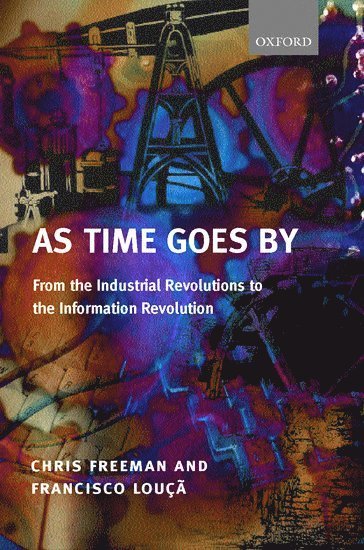
    As Time Goes By

    From the Industrial Revolutions to the Information Revolution

    AvChris Freeman,Francisco Louçã

    Inbunden, Engelska, 2001

    3 964 kr

    Beställningsvara. Skickas inom 5-8 vardagar. Fri frakt över 249 kr.

    Fler format och utgåvor

    Häftad

    1 269 kr

    Beskrivning

    How can we best understand the impact of revolutionary technologies on the business cycle, the economy, and society? Why is economics meaningless without history and without an understanding of institutional and technical change? Does the 'new economy' mean the 'end of history'?an we best understand the impact of revolutionary technologies on business organization and the business cycle?These are some of the questions addressed in this authoritative analysis of modern economic growth from the Industrial Revolution to the 'New Economy' of today. Chris Freeman has been one of the foremost researchers on innovation for a long time and his colleague Francisco Louçã is an outstanding historian of economic theory and an analyst of econometric models and methods. Together they chart the history of five technological revolutions: water-powered mechanization, steam-powered mechanization, electrification, motorization, and computerization. They demonstrate the necessity to take account of politics, culture, organizational change, and entrepreneurship, as well as science and technology in the analysis of economic growth. This is an well-informed, highly topical, and persuasive study of interest across all the social sciences.

    Produktinformation

    • Utgivningsdatum:2001-02-15
    • Mått:163 x 242 x 28 mm
    • Vikt:764 g
    • Format:Inbunden
    • Språk:Engelska
    • Antal sidor:424
    • Förlag:OUP OXFORD
    • ISBN:9780199241071

    Utforska kategorier

    • Nationalekonomi inom Ekonomi och Ledarskap
    • Ekonomisk historia inom Ekonomi och Ledarskap
    • Naturvetenskap:allmänt inom Naturvetenskap och teknik

    Mer om författaren

    Chris Freeman is Emeritus Professor at SPRU, University of Sussex. After studying at the London School of Economics, he later took up the position of Research Fellow at the National Institute of Economic and Social Research, London (1959-66) before becoming Director of the Science Policy Research Unit at the University of Susex (1966-81). His most recent position was Visiting Professor at the University of Limburg in Maastricht (1986-96). He is the author of numerous books including 'The Economics of Industrial Innovation' (with L. Soete, Pinter, 1997); 'Work for All or Mass Unemployment: Computerised Technical Change into the 21st Century' (with L. Soete, Pinter, 1994); and 'Technology and Economic Performance: Lessons from Japan' (Pinter, 1987).Francisco Louçã is Professor of Economics in the Faculty of Economics and Management at the ISEG, Lisbon. He obtained his Ph.D. in Economics at the University of Lisbon under the supervision of Chris Freeman, subsequently publishing his thesis in both English and Portuguese ('Turbulence in Economics', Edward Elgar 1997). In 1999 he was elected Member of Parliament in Portugal, and serves in the Economic and Budgetary Commission.

    Recensioner i media

    This is a very good and important book that is must reading for anyone interested in evolutionary economics and/or the relationship between history and economics. In addition, you get a very well documented and argued interpretation of long run capitalist development from the industrial revolution to the present that will be a standard reference ... a first rate contribution to the discussion of how evolutionary economics should (may) develop.

    Innehållsförteckning

    • PART I: HISTORY AND ECONOMICS; PART II: SUCCESSIVE INDUSTRIAL REVOLUTIONS