• Fri frakt över 249 kr
  • •
  • Snabba leveranser
  • •
  • Billiga böcker
Kundservice

Du är på sajten för privatpersoner.

Företag, bibliotek eller offentlig verksamhet?

Du handlar på classic.bokus.com, där alla dina funktioner finns intakta.
Till classic.bokus.com
Bokus logotyp. Gå till startsidan.
  • Erbjudanden
  • Student
  • Topplistor
  • Barn & ungdom
  • Bokus Play
  • E-böcker
  • Ljudböcker
  • Pocketböcker
  • Spel och pussel

Pocketfynda! Hundratals böcker för 49 kr/st →

Sidfot

Mina sidor

    Hjälp

    • Kundservice
    • Vanliga frågor och svar
    • Frakt och leverans
    • Retur vid ångerrätt
    • Reklamera vara
    • Betalning
    • Köpvillkor
    • Allmänna villkor
    • Information om webbplatsens tillgänglighet

    Om Bokus

    • Om oss
    • Pressrum
    • För studenter
    • För företag
    • För bibliotek och offentlig verksamhet
    • För leverantörer
    • Hållbarhet

    Populärt

    • Aktuella erbjudanden
    • Presentkort
    • Studentlitteratur
    • Nya böcker
    • Topplistor
    • Signerade böcker
    • Engelska böcker

    Inspiration

    • Boktips
    • BookTok
    • Barnbokskaraktärer
    • Populära författare
    Logotyp för Bokus
    Följ oss på Facebook (extern länk)Följ oss på Instagram (extern länk)Följ oss på YouTube (extern länk)Följ oss på TikTok (extern länk)
    bokus @ CookiesAnpassa cookiesIntegritetspolicyKöpvillkor
    Till Citymail hemsida (extern länk)Till Budbee hemsida (extern länk)Till Postnord hemsida (extern länk)Till Schenker hemsida (extern länk)Till Early Bird hemsida (extern länk)Till Walleys hemsida (extern länk)
    1. Kultur
    2. Arkitektur

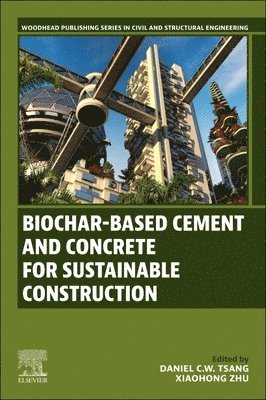
    Biochar-Based Cement and Concrete for Sustainable Construction

    AvDaniel C.W. Tsang,Xiaohong Zhu

    Häftad, Engelska, 2025

    Del i serien Woodhead Publishing Series in Civil and Structural Engineering

    2 253 kr

    Beställningsvara. Skickas inom 10-15 vardagar. Fri frakt över 249 kr.

    Beskrivning

    In response to the urgent need for achieving carbon neutrality in the construction industry, with Biochar-Based Cement and Concrete for Sustainable Construction, an international group of experts has set out to provide a timely, comprehensive overview of biochar-enhanced cementitious materials. Although the method is relatively new, extensive research has been conducted in recent years to systematically gather information proving biochar as an ideal medium for carbon sequestration when used as an engineered additive in cementitious materials, but also to strengthen concrete in many key dimensions via enhancements to hydration and integration into the hardened matrix.
    The volume stands out as an invaluable resource that offers up-to-date guidance on eco-efficient construction materials’ manufacturing and practical application examples backed by considerations regarding their environmental soundness. At the same time, it stimulates research into future developments with relevance to interdisciplinary audiences both in academia and industry.


    • Focuses on biochar for construction, spotlighting its utilization as a promising investment to contribute to sustainable development
    • Covers macro and micro properties of biochar to demonstrate that not only can it serve as a filler but also as a functionalized additive
    • Illustrates state-of-the-art application achievements of biochar-based cementitious materials and concrete

    Produktinformation

    • Utgivningsdatum:2025-11-07
    • Mått:152 x 229 x 21 mm
    • Vikt:1 000 g
    • Format:Häftad
    • Språk:Engelska
    • Serie:Woodhead Publishing Series in Civil and Structural Engineering
    • Antal sidor:400
    • Förlag:Elsevier Science
    • ISBN:9780443220371

    Utforska kategorier

    • Arkitektur inom Kultur
    • Byggnadsteknik inom Naturvetenskap och teknik
    • Byggnadsindustri och tung industri inom Ekonomi och Ledarskap

    Mer om författaren

    Daniel C.W. Tsang is a Professor in the Department of Civil and Environmental Engineering at the Hong Kong University of Science and Technology and Pao Yue-Kong Chair Professor at the State Key Laboratory of Clean Energy Utilization of Zhejiang University in China. He was a Professor and MSc Programme Leader at the Hong Kong Polytechnic University, a Visiting Professor at the University of Queensland in Australia and Chulalongkorn University in Thailand, a Visiting Scholar at Stanford University in the US, an IMETE Scholar at Ghent University in Belgium, and a postdoctoral fellow at Imperial College London in the UK. With over 20 years of R&D experience, he has published more than 600 articles in top-tier journals and has been recognized among Stanford University’s Top 2% Scientists and Clarivate’s Highly Cited Researchers in the fields of Engineering and Environment & Ecology. His team is dedicated to developing green technologies for long-term decarbonization and promoting resource circularity and sustainable development. He serves as the Editor-in-Chief of npj Materials Sustainability (Springer Nature), Chairman of the Hong Kong Waste Management Association (2023-2025), and Chairman of the Waste Management Subcommittee of the Advisory Council on the Environment (2023 & 2024) of the Hong Kong SAR Government. Xiaohong Zhu is a Professor of Civil Engineering Materials at Beijing University of Technology. Over the years, he has conducted research at Chongqing University, Queen’s University Belfast, the University of Leeds, the Hong Kong Polytechnic University, and the University of California, Berkeley, specializing in low-carbon cement and concrete technology, as well as aged concrete. Dr. Zhu has collaborated with Prof. Ian G. Richardson at the University of Leeds on the analysis of historically significant aged cement samples, including Joseph Aspdin’s patent Portland cement (Wakefield, UK) and William Aspdin’s cement (Sheerness, UK). Additionally, he has worked with Prof. Paulo J. M. Monteiro at UC Berkeley on studies of Roman concrete and concrete from the Hagia Sophia Grand Mosque (Istanbul, Turkey).

    Innehållsförteckning

    • Part I: Using biochar to achieve carbon-neutral construction with traditional building materials1. Application of biochar in cementitious materials: Life cycle assessment and costing2. Biochar-augmented carbon-negative concrete3. Biochar-improved cement composites for carbon sequestration4. Low-carbon 3D-printed concrete by using biochar as a carbon sequestrator5. Finite element modelling of biochar composites6. Effects of various biochars on the physical, mechanical, and microstructural characteristics of cement pastes and mortars: A review7. Carbon capture ability of biochar-based cement compositesPart II: Functionalised biochar as the value-added additive in cementitious materials8. Biochar-carried bacteria for self-healing concrete9. Chloride diffusion of biochar–cement composites10. Thermal insulation of biochar-cement composites11. Biochar-based shrinkage reducer in conventional and new cement12. Biochar as the rheological modifier in three-dimensional printed concretePart III: Biochar used in new cement or special concrete products13. Durability concerns of biochar in low-carbon concrete14. Biochar-modified alkali-activated slag15. Biochar-amended alkali-activated slag for the stabilization of coral sand in coastal areas16. Biochar-based concrete composites in permeable block applications17. Biochar as a carbon sequestration material combined with sewage sludge incineration ash for lightweight concrete production18. Modelling of biochar-based concrete for structural components19. Opportunities and future perspectives for biochar-enhanced construction