• Fri frakt över 249 kr
  • •
  • Snabba leveranser
  • •
  • Billiga böcker
Kundservice

Du är på sajten för privatpersoner.

Företag, bibliotek eller offentlig verksamhet?

Du handlar på classic.bokus.com, där alla dina funktioner finns intakta.
Till classic.bokus.com
Bokus logotyp. Gå till startsidan.
  • Erbjudanden
  • Student
  • Topplistor
  • Barn & ungdom
  • Bokus Play
  • E-böcker
  • Ljudböcker
  • Pocketböcker
  • Spel och pussel

Pocketfynda! Hundratals böcker för 49 kr/st →

Sidfot

Mina sidor

    Hjälp

    • Kundservice
    • Vanliga frågor och svar
    • Frakt och leverans
    • Retur vid ångerrätt
    • Reklamera vara
    • Betalning
    • Köpvillkor
    • Allmänna villkor
    • Information om webbplatsens tillgänglighet

    Om Bokus

    • Om oss
    • Pressrum
    • För studenter
    • För företag
    • För bibliotek och offentlig verksamhet
    • För leverantörer
    • Hållbarhet

    Populärt

    • Aktuella erbjudanden
    • Presentkort
    • Studentlitteratur
    • Nya böcker
    • Topplistor
    • Signerade böcker
    • Engelska böcker

    Inspiration

    • Boktips
    • BookTok
    • Barnbokskaraktärer
    • Populära författare
    Logotyp för Bokus
    Följ oss på Facebook (extern länk)Följ oss på Instagram (extern länk)Följ oss på YouTube (extern länk)Följ oss på TikTok (extern länk)
    bokus @ CookiesAnpassa cookiesIntegritetspolicyKöpvillkor
    Till Citymail hemsida (extern länk)Till Budbee hemsida (extern länk)Till Postnord hemsida (extern länk)Till Schenker hemsida (extern länk)Till Early Bird hemsida (extern länk)Till Walleys hemsida (extern länk)
    1. Naturvetenskap och teknik
    2. Matematik och naturvetenskap
    3. Matematik
    4. Optimering

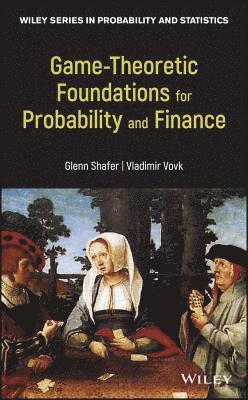
    Game-Theoretic Foundations for Probability and Finance

    AvGlenn Shafer,Vladimir Vovk

    Inbunden, Engelska, 2019

    Del 455 i serien Wiley Series in Probability and Statistics

    1 245 kr

    Beställningsvara. Skickas inom 5-8 vardagar. Fri frakt över 249 kr.

    Beskrivning

    Game-theoretic probability and finance come of ageGlenn Shafer and Vladimir Vovk’s Probability and Finance, published in 2001, showed that perfect-information games can be used to define mathematical probability. Based on fifteen years of further research, Game-Theoretic Foundations for Probability and Finance presents a mature view of the foundational role game theory can play. Its account of probability theory opens the way to new methods of prediction and testing and makes many statistical methods more transparent and widely usable. Its contributions to finance theory include purely game-theoretic accounts of Ito’s stochastic calculus, the capital asset pricing model, the equity premium, and portfolio theory.Game-Theoretic Foundations for Probability and Finance is a book of research. It is also a teaching resource. Each chapter is supplemented with carefully designed exercises and notes relating the new theory to its historical context.Praise from early readers“Ever since Kolmogorov's Grundbegriffe, the standard mathematical treatment of probability theory has been measure-theoretic. In this ground-breaking work, Shafer and Vovk give a game-theoretic foundation instead. While being just as rigorous, the game-theoretic approach allows for vast and useful generalizations of classical measure-theoretic results, while also giving rise to new, radical ideas for prediction, statistics and mathematical finance without stochastic assumptions. The authors set out their theory in great detail, resulting in what is definitely one of the most important books on the foundations of probability to have appeared in the last few decades.” – Peter Grünwald, CWI and University of Leiden“Shafer and Vovk have thoroughly re-written their 2001 book on the game-theoretic foundations for probability and for finance. They have included an account of the tremendous growth that has occurred since, in the game-theoretic and pathwise approaches to stochastic analysis and in their applications to continuous-time finance. This new book will undoubtedly spur a better understanding of the foundations of these very important fields, and we should all be grateful to its authors.” – Ioannis Karatzas, Columbia University

    Produktinformation

    • Utgivningsdatum:2019-06-07
    • Mått:160 x 229 x 28 mm
    • Vikt:885 g
    • Format:Inbunden
    • Språk:Engelska
    • Serie:Wiley Series in Probability and Statistics
    • Antal sidor:480
    • Förlag:John Wiley & Sons Inc
    • ISBN:9780470903056

    Utforska kategorier

    • Optimering inom Naturvetenskap och teknik
    • Matematisk statistik inom Naturvetenskap och teknik

    Mer om författaren

    Glenn Shafer is University Professor at Rutgers University. Vladimir Vovk is Professor in the Department of Computer Science at Royal Holloway, University of London. Shafer and Vovk are the authors of Probability and Finance: It's Only a Game, published by Wiley and co-authors of Algorithmic Learning in a Random World. Shafer's other previous books include A Mathematical Theory of Evidence and The Art of Causal Conjecture.

    Innehållsförteckning

    • Preface xiAcknowledgments xvPart I Examples in Discrete Time 11 Borel’s Law of Large Numbers 51.1 A Protocol for Testing Forecasts 61.2 A Game-Theoretic Generalization of Borel’s Theorem 81.3 Binary Outcomes 161.4 Slackenings and Supermartingales 181.5 Calibration 191.6 The Computation of Strategies 211.7 Exercises 211.8 Context 242 Bernoulli’s and De Moivre’s Theorems 312.1 Game-Theoretic Expected Value and Probability 332.2 Bernoulli’s Theorem for Bounded Forecasting 372.3 A Central Limit Theorem 392.4 Global Upper Expected Values for Bounded Forecasting 452.5 Exercises 462.6 Context 493 Some Basic Supermartingales 553.1 Kolmogorov’s Martingale 563.2 Doléans’s Supermartingale 563.3 Hoeffding’s Supermartingale 583.4 Bernstein’s Supermartingale 633.5 Exercises 663.6 Context 674 Kolmogorov’s Law of Large Numbers 694.1 Stating Kolmogorov’s Law 704.2 Supermartingale Convergence Theorem 734.3 How Skeptic Forces Convergence 804.4 How Reality Forces Divergence 814.5 Forcing Games 824.6 Exercises 864.7 Context 895 The Law of the Iterated Logarithm 935.1 Validity of the Iterated-Logarithm Bound 945.2 Sharpness of the Iterated-Logarithm Bound 995.3 Additional Recent Game-Theoretic Results 1005.4 Connections with Large Deviation Inequalities 1045.5 Exercises 1045.6 Context 106Part II Abstract Theory in Discrete Time 1096 Betting on a Single Outcome 1116.1 Upper and Lower Expectations 1136.2 Upper and Lower Probabilities 1156.3 Upper Expectations with Smaller Domains 1186.4 Offers 1216.5 Dropping the Continuity Axiom 1256.6 Exercises 1276.7 Context 1317 Abstract Testing Protocols 1357.1 Terminology and Notation 1367.2 Supermartingales 1367.3 Global Upper Expected Values 1427.4 Lindeberg’s Central Limit Theorem for Martingales 1457.5 General Abstract Testing Protocols 1467.6 Making the Results of Part I Abstract 1517.7 Exercises 1537.8 Context 1558 Zero-One Laws 1578.1 Lévy’s Zero-One Law 1588.2 Global Upper Expectation 1608.3 Global Upper and Lower Probabilities 1628.4 Global Expected Values and Probabilities 1638.5 Other Zero-One Laws 1658.6 Exercises 1698.7 Context 1709 Relation to Measure-Theoretic Probability 1759.1 Ville’s Theorem 1769.2 Measure-Theoretic Representation of Upper Expectations 1809.3 Embedding Game-Theoretic Martingales in Probability Spaces 1899.4 Exercises 1919.5 Context 192Part III Applications in Discrete Time 19510 Using Testing Protocols in Science and Technology 19710.1 Signals in Open Protocols 19810.2 Cournot’s Principle 20110.3 Daltonism 20210.4 Least Squares 20710.5 Parametric Statistics with Signals 21210.6 Quantum Mechanics 21510.7 Jeffreys’s Law 21710.8 Exercises 22510.9 Context 22611 Calibrating Lookbacks and p-Values 22911.1 Lookback Calibrators 23011.2 Lookback Protocols 23511.3 Lookback Compromises 24111.4 Lookbacks in Financial Markets 24211.5 Calibrating p-Values 24511.6 Exercises 24811.7 Context 25012 Defensive Forecasting 25312.1 Defeating Strategies for Skeptic 25512.2 Calibrated Forecasts 25912.3 Proving the Calibration Theorems 26412.4 Using Calibrated Forecasts for Decision Making 27012.5 Proving the Decision Theorems 27412.6 From Theory to Algorithm 28612.7 Discontinuous Strategies for Skeptic 29112.8 Exercises 29512.9 Context 299Part IV Game-Theoretic Finance 30513 Emergence of Randomness in Idealized Financial Markets 30913.1 Capital Processes and Instant Enforcement 31013.2 Emergence of Brownian Randomness 31213.3 Emergence of Brownian Expectation 32013.4 Applications of Dubins–Schwarz 32513.5 Getting Rich Quick with the Axiom of Choice 33113.6 Exercises 33313.7 Context 33414 A Game-Theoretic Itô Calculus 33914.1 Martingale Spaces 34014.2 Conservatism of Continuous Martingales 34814.3 Itô Integration 35014.4 Covariation and Quadratic Variation 35514.5 Itô’s Formula 35714.6 Doléans Exponential and Logarithm 35814.7 Game-Theoretic Expectation and Probability 36014.8 Game-Theoretic Dubins–Schwarz Theorem 36114.9 Coherence 36214.10 Exercises 36314.11 Context 36515 Numeraires in Market Spaces 37115.1 Market Spaces 37215.2 Martingale Theory in Market Spaces 37515.3 Girsanov’s Theorem 37615.4 Exercises 38215.5 Context 38216 Equity Premium and CAPM 38516.1 Three Fundamental Continuous I-Martingales 38716.2 Equity Premium 38916.3 Capital Asset Pricing Model 39116.4 Theoretical Performance Deficit 39516.5 Sharpe Ratio 39616.6 Exercises 39716.7 Context 39817 Game-Theoretic Portfolio Theory 40317.1 Stroock–Varadhan Martingales 40517.2 Boosting Stroock–Varadhan Martingales 40717.3 Outperforming the Market with Dubins–Schwarz 41317.4 Jeffreys’s Law in Finance 41417.5 Exercises 41517.6 Context 416Terminology and Notation 419List of Symbols 425References 429Index 455