3 298 kr
Beställningsvara. Skickas inom 7-10 vardagar. Fri frakt över 249 kr.
Beskrivning
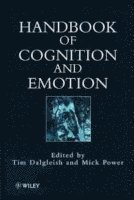
Edited by leading figures in the field, this handbook gives an overview of the current status of cognition and emotion research by giving the historical background to the debate and the philosophical arguments before moving on to outline the general aspects of the various research traditions. This handbook reflects the latest work being carried out by the key people in the field.
Produktinformation
- Utgivningsdatum:1999-02-25
- Mått:175 x 246 x 52 mm
- Vikt:1 588 g
- Format:Inbunden
- Språk:Engelska
- Antal sidor:880
- Förlag:John Wiley & Sons Inc
- ISBN:9780471978367
Utforska kategorier
Mer om författaren
Tim Dalgleish is the editor of Handbook of Cognition and Emotion, published by Wiley.Mick Power is the editor of Handbook of Cognition and Emotion, published by Wiley.
Recensioner i media
"This book is an important reference for use by researchers in cognition and emotion and will be of value to anyone who has interests that overlap this area...it would clearly be a key addition to any serious psychology or psychiatry library..", British Journal of Psychiatry
Innehållsförteckning
- About the Editors ixList of Contributors xiForeword—Keith Oatley xviiPreface xixPart I General AspectsChapter 1 The cognition–emotion debate: a bit of historyRichard S. Lazarus 3Chapter 2 The philosophy of cognition and emotionWilliam Lyons 21Chapter 3 Basic emotionsPaul Ekman 45Chapter 4 Research methods in cognition and emotionW. Gerrod Parrott and Paula Hertel 61Chapter 5 Cognition, emotion, conscious experience and the brainJeffrey A. Gray 83Chapter 6 Neuropsychological perspectives on affective styles and their cognitive consequencesRichard J. Davidson 103Chapter 7 The role of the self in cognition and emotionMichael Lewis 125Part II Cognitive ProcessesChapter 8 Selective attention and anxiety: a cognitive–motivational perspectiveKarin Mogg and Brendan P. Bradley 145Chapter 9 The cognitive science of attention and emotionGerald Matthews and Adrian Wells 171Chapter 10 Mood and memoryHenry C. Ellis and Brent A. Moore 193Chapter 11 Organization of emotional memoriesSven-Åke Christianson and Elisabeth Engelberg 211Chapter 12 Autobiographical memoryHelen Healy and J. Mark G. Williams 229Chapter 13 Inhibition processes in cognition and emotion: a special caseTim Dalgleish, Andrew Mathews and Jacqueline Wood 243Chapter 14 Prospective cognitionsAndrew K. MacLeod 267Chapter 15 Unintended thoughts and imagesFrank Tallis 281Chapter 16 Facial expressionsPaul Ekman 301Chapter 17 Distinguishing unconscious from conscious emotional processes: methodological considerations and theoretical implicationsArne Öhman 321Chapter 18 Self-regulation, affect and psychosis: the role of social cognition in paranoia and maniaRichard P. Bentall and Peter Kinderman 353Chapter 19 The early emergence of emotional understanding and appraisal: implications for theories of developmentNancy L. Stein. and Linda J. Levine 383Part III EmotionsChapter 20 AngerLeonard Berkowitz 411Chapter 21 Disgust: the body and soul emotionPaul Rozin, Jonathan Haidt and Clark R. McCauley 429Chapter 22 Anxiety and anxiety disordersColin MacLeod 447Chapter 23 Panic and phobiasRichard J. McNally 479Chapter 24 Sadness and its disordersMick J. Power 497Chapter 25 Positive affectAlice M. Isen 521Chapter 26 The self-conscious emotions: shame, guilt, embarrassment and prideJune Price Tangney 541Chapter 27 Jealousy and envyMartin P. East and Fraser N. Watts 569Part IV Theories in Cognition and EmotionChapter 28 Network theories and beyondJoseph P. Forgas 591Chapter 29 Attributional theories of emotionIan H Gotlib and Lynn Y. Abramson 613Chapter 30 Appraisal theoryKlaus R. Scherer 637Chapter 31 Multi level theories of cognition–emotion relationsJohn D. Teasdale 665Chapter 32 Self-organization of cognition–emotion interactionsMarc D. Lewis and Isabela Granic 683Part V Applied Issues Chapter 33 Cognition and emotion research and the practice of cognitive behavioural therapyZindel V. Segal, Mark A. Lau and Paul D. Rokke 705Chapter 34 Psychodynamic theory and technique in relation to research on cognition and emotion: mutual implicationsDrew Westen 727Chapter 35 Mechanisms of change in exposure therapy for anxiety disordersSusan Mineka and Cannon Thomas 747Chapter 36 Creativity in the domain of emotionJames R. Averill 765Chapter 37 Forensic applications of theories of cognition and emotionDebra A Bekerian and Susan J. Goodrich 783Chapter 38 Cognition and emotion: future directionsTim Dalgleish and Mick J. Power 799Author index 807Subject index 831