• Fri frakt över 249 kr
  • •
  • Snabba leveranser
  • •
  • Billiga böcker
Kundservice

Du är på sajten för privatpersoner.

Företag, bibliotek eller offentlig verksamhet?

Du handlar på classic.bokus.com, där alla dina funktioner finns intakta.
Till classic.bokus.com
Bokus logotyp. Gå till startsidan.
  • Erbjudanden
  • Nyheter
  • Student
  • Topplistor
  • Barn & ungdom
  • Bokus Play
  • E-böcker
  • Pocketböcker
  • Spel & pussel

10% rabatt på allt med kod: NYSTART10 →

Sidfot

Mina sidor

    Hjälp

    • Kundservice
    • Vanliga frågor och svar
    • Frakt och leverans
    • Retur vid ångerrätt
    • Reklamera vara
    • Betalning
    • Köpvillkor
    • Allmänna villkor
    • Information om webbplatsens tillgänglighet

    Om Bokus

    • Om oss
    • Pressrum
    • För studenter
    • För företag
    • För bibliotek och offentlig verksamhet
    • För leverantörer
    • Hållbarhet

    Populärt

    • Aktuella erbjudanden
    • Presentkort
    • Studentlitteratur
    • Nya böcker
    • Topplistor
    • Signerade böcker
    • Engelska böcker

    Inspiration

    • Boktips
    • BookTok
    • Populära bokserier
    • Barnbokskaraktärer
    • Populära författare
    Logotyp för Bokus
    Följ oss på Facebook (extern länk)Följ oss på Instagram (extern länk)Följ oss på YouTube (extern länk)Följ oss på TikTok (extern länk)
    bokus @ CookiesAnpassa cookiesIntegritetspolicyKöpvillkor
    Till Citymail hemsida (extern länk)Till Budbee hemsida (extern länk)Till Postnord hemsida (extern länk)Till Schenker hemsida (extern länk)Till Early Bird hemsida (extern länk)Till Walleys hemsida (extern länk)
    1. Filosofi och religion
    2. Filosofi
    3. Filosofiska discipliner

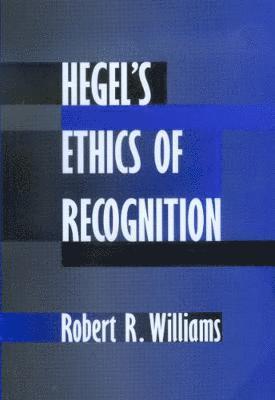
    Hegel's Ethics of Recognition

    AvRobert R. Williams

    Häftad, Engelska, 2000

    Del i serien University of California Press

    324 kr

    Beställningsvara. Skickas inom 5-8 vardagar. Fri frakt över 249 kr.

    Beskrivning

    In this significant contribution to Hegel scholarship, Robert Williams develops the most comprehensive account to date of Hegel's concept of recognition (Anerkennung). Fichte introduced the concept of recognition as a presupposition of both Rousseau's social contract and Kant's ethics. Williams shows that Hegel appropriated the concept of recognition as the general pattern of his concept of ethical life, breaking with natural law theory yet incorporating the Aristotelian view that rights and virtues are possible only within a certain kind of community. He explores Hegel's intersubjective concept of spirit (Geist) as the product of affirmative mutual recognition and his conception of recognition as the right to have rights. Examining Hegel's Jena manuscripts, his Philosophy of Right, the Phenomenology of Spirit, and other works, Williams shows how the concept of recognition shapes and illumines Hegel's understandings of crime and punishment, morality, the family, the state, sovereignty, international relations, and war.A concluding chapter on the reception and reworking of the concept of recognition by contemporary thinkers including Derrida, Levinas, and Deleuze demonstrates Hegel's continuing centrality to the philosophical concerns of our age.

    Produktinformation

    • Utgivningsdatum:2000-10-02
    • Mått:152 x 229 x 28 mm
    • Vikt:680 g
    • Format:Häftad
    • Språk:Engelska
    • Serie:University of California Press
    • Antal sidor:450
    • Förlag:University of California Press
    • ISBN:9780520224926

    Utforska kategorier

    • Filosofiska discipliner inom Filosofi och religion

    Mer om författaren

    Robert R. Williams, Professor of Philosophy at Hiram College and Vice-President of the Hegel Society of America, is author of Recognition: Hegel and Fichte on the Other (1992).

    Innehållsförteckning

    • Preface Abbreviations 1 Recognition and EthicsIntroduction The Concealment of Recognition in Hegelian Ethical Studies Distortions of Recognition in the French Reception of Hegel Recognition as Counterdiscourse of Modernity: Habermas Michael Theunissen: Hegel's Repression of Intersubjectivity Ludwig Siep's.Studies of Hegel's Practical Philosophy Recognition and the Actuality of the Rational Plan and Overview Part One Preliminaries: Recognition, Right, and Ethics 2 Recognition in Fichte and Schelling Fichte Schelling 3 Recognition in the Phenomenology of Spirit The Intersubjective Doubling of Self-Consciousness The Double Sign.i fications in the Concept of Recognition Mastery and Slavery as a Determinate Shape of Recognition The Servile Consciousness 4 Recognition in the Encyclopedia Philosophy of Spirit Introduction and Overview Reciprocal Recognition Crossing the Threshold of Ethical Life Four Dimensions of Recognition Universal Self-Consciousness as Affirmative Self-Recognition in Other The Social Constitution and Mediation of Reason 5 Recognition and Right in the Jena Manuscripts Recognition in the 1805 Jena Philosophy of Spirit Recognition as the Origin and Relation of RightBeing-Recognized, Right and Wrong The Intersubjective Concept of the Will Part Two Recognition in the Philosophy of Right 6 Systematic: Issues in the Philosophy of Right Recognition in the Argument of the Philosophy of Right Hegel's Method of Abstraction The Concept of the Will From 'In-Itself' to 'For-Itself': The Development of the Will 7 Persons, Property, and Contract Abstract Right and Person The Intersubjectivity of Ownership Embodiment, or Taking Possession of Oneself The Intersubjectivity of Contract 8 Crime and Punishment Wrong and Fraud Wrong, Semblance, and the Logic of Essence Transgression as Coercion The Impossible Possibility of Coercion Banquo's Ghost The Mature Theory: Punishment as the Second Coercion Recognition and the Second Coercion The Nullity of Transgression Is Punishment Necessary? 9 Morality The Moral Subject and the Difference The Intersubjectivity of Moral Action Purpose and Intention, Responsibility and Welfare Hegel's Critique of the Moral Point of View The Decline and Fall of Conscience Transition to Ethical Life 1O Ethical Life and the family Ethical Substance, Rights, and Duties Love Transforming the Dialectics of Recognition Marriage as an Ethical Relationship Marriage as a Contract to Transcend Contract Embodied Intersubjectivity and Gender Roles 11 Civil Society, Poverty, and the Corporations Civil Society as the Sphere of Disintegration and Difference Need and Labor, Town and Country Antinomies in Civil Society Poverty: Freedom and Recognition in Peril Hegel's Portrait of Poverty Recognition, Honor, and the Corporation 12 Recognition and the Social Contract Theory of the State Overview of the State as a Unity of Reciprocal Recognitions Patriotism Social Contract Theory Hegel and Rousseau Hegel's Criticism of Fichte 13 The State as a Social Organism Fichte on Social Contract and Organism Hegel on Organism The Encyclopedia Treatment of Mechanism and Organism Mechanism and Chemism in the Science of Logic Organism in the Aesthetics Objective Idealism and Organism in the State Recognition and the Spirit of the Laws The Organic Correlation between Rights and Duties Religious and Cultural Pluralism 14 Sovereignty, International Relations, and War Sovereignty War Issues of Recognition in International Relations The Deficiency of the International 'We' 15 Recent Views of Recognition and the Question of Ethics Kojeve Sartre and Hegel Feminist Critique of Hegel Hegel, Nietzsche, and Deleuze Derrida and the 'Ethics of Deconstruction'Levinas: Reciprocity and Totality in QuestionBibliography Index