• Fri frakt över 249 kr
  • •
  • Snabba leveranser
  • •
  • Billiga böcker
Kundservice

Du är på sajten för privatpersoner.

Företag, bibliotek eller offentlig verksamhet?

Du handlar på classic.bokus.com, där alla dina funktioner finns intakta.
Till classic.bokus.com
Bokus logotyp. Gå till startsidan.
  • Erbjudanden
  • Student
  • Topplistor
  • Barn & ungdom
  • Bokus Play
  • E-böcker
  • Ljudböcker
  • Pocketböcker
  • Spel & pussel

Upp till 25% på utvalda nyheter →

Sidfot

Mina sidor

    Hjälp

    • Kundservice
    • Vanliga frågor och svar
    • Frakt och leverans
    • Retur vid ångerrätt
    • Reklamera vara
    • Betalning
    • Köpvillkor
    • Allmänna villkor
    • Information om webbplatsens tillgänglighet

    Om Bokus

    • Om oss
    • Pressrum
    • För studenter
    • För företag
    • För bibliotek och offentlig verksamhet
    • För leverantörer
    • Hållbarhet

    Populärt

    • Aktuella erbjudanden
    • Presentkort
    • Studentlitteratur
    • Nya böcker
    • Topplistor
    • Signerade böcker
    • Engelska böcker

    Inspiration

    • Boktips
    • BookTok
    • Populära bokserier
    • Barnbokskaraktärer
    • Populära författare
    Logotyp för Bokus
    Följ oss på Facebook (extern länk)Följ oss på Instagram (extern länk)Följ oss på YouTube (extern länk)Följ oss på TikTok (extern länk)
    bokus @ CookiesAnpassa cookiesIntegritetspolicyKöpvillkor
    Till Citymail hemsida (extern länk)Till Budbee hemsida (extern länk)Till Postnord hemsida (extern länk)Till Schenker hemsida (extern länk)Till Early Bird hemsida (extern länk)Till Walleys hemsida (extern länk)
    1. Data och IT
    2. Databaser

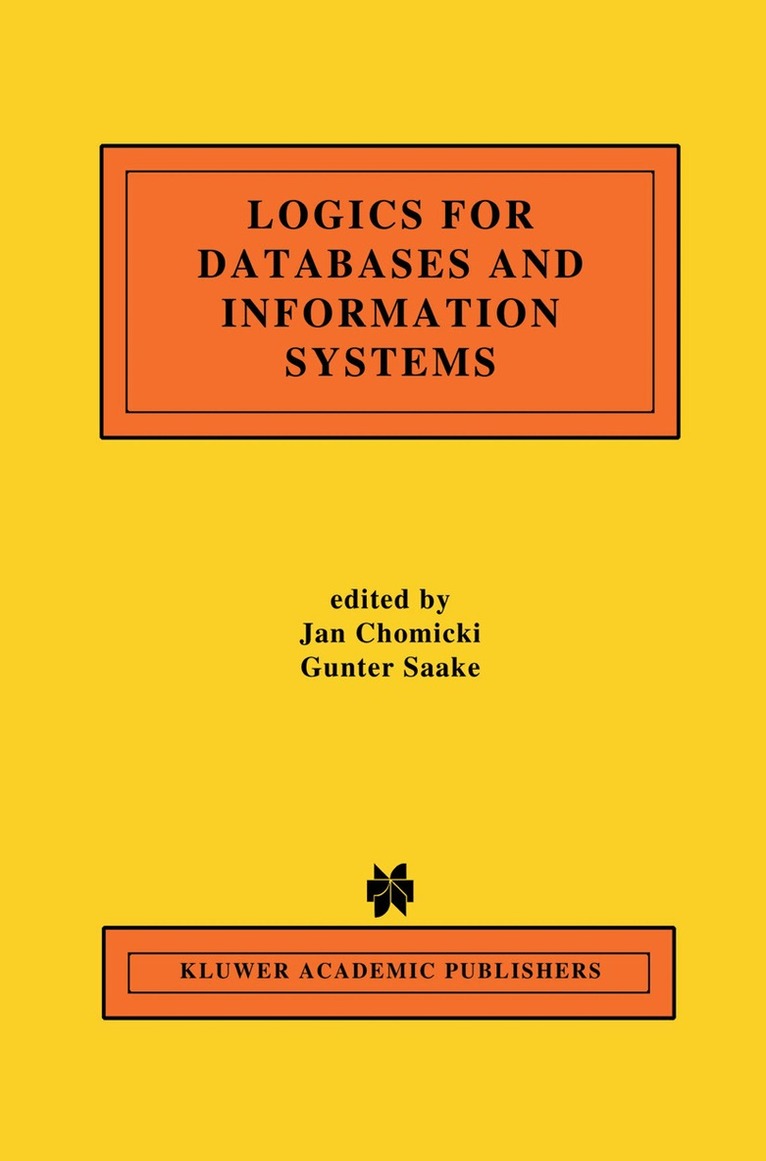
    Logics for Databases and Information Systems

    AvJan Chomicki,Gunter Saake

    Inbunden, Engelska, 1998

    Del i serien Springer International Series in Engineering and Computer Science

    2 231 kr

    Beställningsvara. Skickas inom 10-15 vardagar. Fri frakt över 249 kr.

    Beskrivning

    Time is ubiquitous in information systems. Almost every enterprise faces the problem of its data becoming out of date. However, such data is often valu­ able, so it should be archived and some means to access it should be provided. Also, some data may be inherently historical, e.g., medical, cadastral, or ju­ dicial records. Temporal databases provide a uniform and systematic way of dealing with historical data. Many languages have been proposed for tem­ poral databases, among others temporal logic. Temporal logic combines ab­ stract, formal semantics with the amenability to efficient implementation. This chapter shows how temporal logic can be used in temporal database applica­ tions. Rather than presenting new results, we report on recent developments and survey the field in a systematic way using a unified formal framework [GHR94; Ch094]. The handbook [GHR94] is a comprehensive reference on mathematical foundations of temporal logic. In this chapter we study how temporal logic is used as a query and integrity constraint language. Consequently, model-theoretic notions, particularly for­ mula satisfaction, are of primary interest. Axiomatic systems and proof meth­ ods for temporal logic [GHR94] have found so far relatively few applications in the context of information systems. Moreover, one needs to bear in mind that for the standard linearly-ordered time domains temporal logic is not re­ cursively axiomatizable [GHR94]' so recursive axiomatizations are by necessity incomplete.

    Produktinformation

    • Utgivningsdatum:1998-03-31
    • Mått:155 x 235 x 29 mm
    • Vikt:834 g
    • Format:Inbunden
    • Språk:Engelska
    • Serie:Springer International Series in Engineering and Computer Science
    • Antal sidor:430
    • Upplaga:1998
    • Förlag:Kluwer Academic Publishers
    • ISBN:9780792381297

    Utforska kategorier

    • Databaser inom Data och IT
    • Programmeringsböcker inom Data och IT

    Innehållsförteckning

    • 1 Introduction to Logics for Databases and Information Systems.- References.- 2 A Logic Primer.- 2.1 Introduction.- 2.2 First-Order Logic (FOL).- 2.3 Modal Logics.- 2.4 Logic Programming.- 2.5 Conclusion.- References.- 3 Temporal Logic in Information Systems.- 3.1 Introduction.- 3.2 Temporal Databases.- 3.3 Temporal Queries.- 3.4 Temporal Integrity Constraints.- 3.5 Multidimensional Time.- 3.6 Beyond First-order Temporal Logic.- 3.7 Conclusions.- References.- 4 The Role of Deontic Logic in the Specification of Information Systems.- 4.1 Introduction: Soft Constraints and Deontic Logic.- 4.2 Standard Deontic Logic (SDL).- 4.3 The Paradoxes of Deontic Logic.- 4.4 A Diagnosis of the Problems.- 4.5 A Solution to the ‘Ought-to-Be’ Version of the Chisholm Paradox: S5O(n).- 4.6 Ought-to-Do: The Dynamic Perspective.- 4.7 An Integrated Logic of Ought-to-Be and Ought-to-Do Constraints.- 4.8 Applications.- References.- 5 A Logic for Programming Database Transactions.- 5.1 Introduction.- 5.2 Overview and Introductory Examples.- 5.3 Syntax.- 5.4 Elementary Operations.- 5.5 Model Theory.- 5.6 Proof Theory.- 5.7 Related Work.- References.- 6 Logics for Specifying Concurrent Information Systems.- 6.1 Introduction.- 6.2 Overview.- 6.3 Local Logic L.- 6.4 Distributed Logics.- 6.5 Reduction.- 6.6 Extended Example.- 6.7 Related Work.- 6.8 Concluding Remarks.- References.- 7 Evolving Logical Specification in Information Systems.- 7.1 Introduction.- 7.2 Motivation and Language.- 7.3 Syntax and Semantics of the Logic.- 7.4 Translation of Language into Logic.- 7.5 Using the Logical Framework.- 7.6 Concluding Remarks.- References.- 8 Description Logics for Conceptual Data Modeling.- 8.1 Introduction.- 8.2 Description Logics.- 8.3 Semantic Data Models.- 8.4 Object-Oriented Data Models.- 8.5Support for Data Modeling.- 8.6 Conclusions.- References.- 9 Integrity Constraints: Semantics and Applications.- 9.1 Introduction.- 9.2 Background.- 9.3 Semantics of Integrity Constraints.- 9.4 Reasoning with Integrity Constraints.- 9.5 Applications of Integrity Constraints.- 9.6 Conclusion and Future Directions.- References.- 10 Logical Approaches to Incomplete Information: A Survey.- 10.1 Introduction.- 10.2 Sources of Indefiniteness.- 10.3 A Semantic Framework for Incomplete Databases.- 10.4 Algebraic Models of Nulls.- 10.5 Logical Databases.- 10.6 Complexity of Queries.- 10.7 Negative Information.- 10.8 Integrity Constraints.- 10.9 Updates of Incomplete Databases.- 10.10 Other Issues.- 10.11 Incomplete Information in Current Technology.- References.- 11 Declarative Frameworks for Inheritance.- 11.1 Introduction.- 11.2 Motivation for Inheritance.- 11.3 Main Issues and Problems.- 11.4 Logic-based Approaches to Inheritance.- 11.5 Research Directions.- References.- 12 On Logical Foundations of Active Databases.- 12.1 Introduction.- 12.2 Basics of Active Rules.- 12.3 Research on Foundations of Active Rules.- 12.4 A Deductive State-Oriented Core Language.- 12.5 A Framework for Active Rules.- 12.6 Conclusion.- References.