• Fri frakt över 249 kr
  • •
  • Snabba leveranser
  • •
  • Billiga böcker
Kundservice

Du är på sajten för privatpersoner.

Företag, bibliotek eller offentlig verksamhet?

Du handlar på classic.bokus.com, där alla dina funktioner finns intakta.
Till classic.bokus.com
Bokus logotyp. Gå till startsidan.
  • Erbjudanden
  • Student
  • Topplistor
  • Barn & ungdom
  • Bokus Play
  • E-böcker
  • Ljudböcker
  • Pocketböcker
  • Spel och pussel

Pocketfynda! Hundratals böcker för 49 kr/st →

Sidfot

Mina sidor

    Hjälp

    • Kundservice
    • Vanliga frågor och svar
    • Frakt och leverans
    • Retur vid ångerrätt
    • Reklamera vara
    • Betalning
    • Köpvillkor
    • Allmänna villkor
    • Information om webbplatsens tillgänglighet

    Om Bokus

    • Om oss
    • Pressrum
    • För studenter
    • För företag
    • För bibliotek och offentlig verksamhet
    • För leverantörer
    • Hållbarhet

    Populärt

    • Aktuella erbjudanden
    • Presentkort
    • Studentlitteratur
    • Nya böcker
    • Topplistor
    • Signerade böcker
    • Engelska böcker

    Inspiration

    • Boktips
    • BookTok
    • Barnbokskaraktärer
    • Populära författare
    Logotyp för Bokus
    Följ oss på Facebook (extern länk)Följ oss på Instagram (extern länk)Följ oss på YouTube (extern länk)Följ oss på TikTok (extern länk)
    bokus @ CookiesAnpassa cookiesIntegritetspolicyKöpvillkor
    Till Citymail hemsida (extern länk)Till Budbee hemsida (extern länk)Till Postnord hemsida (extern länk)Till Schenker hemsida (extern länk)Till Early Bird hemsida (extern länk)Till Walleys hemsida (extern länk)
    1. Naturvetenskap och teknik
    2. Teknik och industri
    3. Maskinteknik och material

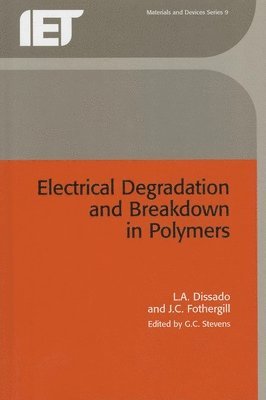
    Electrical Degradation and Breakdown in Polymers

    AvL.A. Dissado,J.C. Fothergill

    Inbunden, Engelska, 1992

    Del i serien Materials, Circuits and Devices

    2 961 kr

    Beställningsvara. Skickas inom 3-6 vardagar. Fri frakt över 249 kr.

    Beskrivning

    Breakdown is fascinating to the scientist and frustrating to the engineer! As well as advancing the scientific and engineering understanding of electrical degradation and breakdown in polymers, this book forms a comprehensive and international review of the state-of-the-art. Topics include: water and electrical treeing; charge transport; 'classical' and filamentary thermal, electromechanical, electronic and partial discharge breakdown models; the stochastic nature of breakdown and statistical characterisation techniques; and engineering considerations for breakdown testing and degradation assessment. The treatment presumes little prior knowledge but develops into an advanced understanding of new concepts such as the fractal-like nature of trees. Although the book is primarily aimed at scientists and engineers practising in the field, a broad introductory section has been included to cater for a wide audience including those new to the subject area. This comprises a description of the nature of the polymers, basic solid-state physics and an introduction to degradation and breakdown.

    Produktinformation

    • Utgivningsdatum:1992-05-31
    • Mått:156 x 234 x 40 mm
    • Vikt:1 140 g
    • Format:Inbunden
    • Språk:Engelska
    • Serie:Materials, Circuits and Devices
    • Antal sidor:620
    • Förlag:Institution of Engineering and Technology
    • ISBN:9780863411960

    Utforska kategorier

    • Maskinteknik och material inom Naturvetenskap och teknik
    • Tillverkningsteknik inom Naturvetenskap och teknik

    Mer om författaren

    Len Dissado studied chemistry at University College London, obtaining a First Class degree in 1963 and a PhD in 1966. He subsequently developed the theory of excitons and exciton-phonon interactions in molecular crystals at the Research School of Chemistry, ANU, Canberra, Australia. Since 1977, when he joined the Department of Physics at Chelsea College, University of London, his major interest has centred on the topic of dielectrics. When he became a consultant to Standard Telecommunications Laboratories (STL) in 1981, his interests expanded to cover the field of dielectric breakdown. He has published over 100 scientific papers on a wide range of topics and was awarded the degree of DSc in 1990 by the University of London.John Fothergill obtained his MSc in 1976 and PhD in 1979 from the School of Electronic Engineering Science, University College of North Wales, Bangor. He then worked for five years at Standard Telecommunication Laboratories on breakdown and degradation in high-voltage polymeric-insulated power cables. This work included advancing fundamental understanding in the field; developing new testing techniques for cables, statistical techniques for the interpretation of test results, and new techniques for jointing and handling cables. In 1984 he joined the Department of Engineering at Leicester University where he continues his research work.Gary Stevens studied physics at Queen Mary College, London and undertook postgraduate research in solid state physics. He joined the CEGB in 1975 and after a number of appointments in dielectrics and polymer research he led the Nonmetallic Materials Group at the Central Electricity Research Laboratory until 1989. He was then appointed Head of Electrical Sciences Group at National Power plc and he currently heads the Energy Utilisation Research Group. He is a member of the Institute of Physics and the Dielectrics Society, and has served on a number of BSI and CIGRE committees on solid electrical insulating materials. He has published widely in the area of polymer physics and materials science, dielectric material, conducting polymers and electrical breakdown.

    Innehållsförteckning

    • Part 1: Introduction to polymers and electrical breakdownChapter 1: Polymer structure and morphologyChapter 2: Polymers as wide band-gap insulatorsChapter 3: Overview of electrical degradation and breakdownPart 2: Treeing degradation in polymersChapter 4: Water treeing degradationChapter 5: Electrical tree degradationChapter 6: Tree-initiated breakdownChapter 7: Factors affecting treeingChapter 8: Routes to tree inhibitionPart 3: Deterministic mechanisms of breakdownsChapter 9: Charge injection and transport in insulating polymersChapter 10: Thermal breakdownChapter 11: Electromechanical breakdownChapter 12: Electronic breakdownChapter 13: Partial discharge and free volume breakdownPart 4: The stochastic nature of breakdownChapter 14: Statistical features of breakdownChapter 15: Stochastic models of breakdownPart 5: Engineering considerations for breakdown testing and degradation assessmentChapter 16: Breakdown testing and analysisChapter 17: Comparison of AC and DC breakdown behaviourChapter 18: Cable assessment proceduresChapter 19: Detecting electrical degradation non-destructivelyAppendix 1: Computer program for calculating Weibull parametersAppendix 2: Calculating the Threshold value of a 3-parameter Weibull Distribution using MATHCAD826 Appendix 3: Mathematical proof