- Nyhet
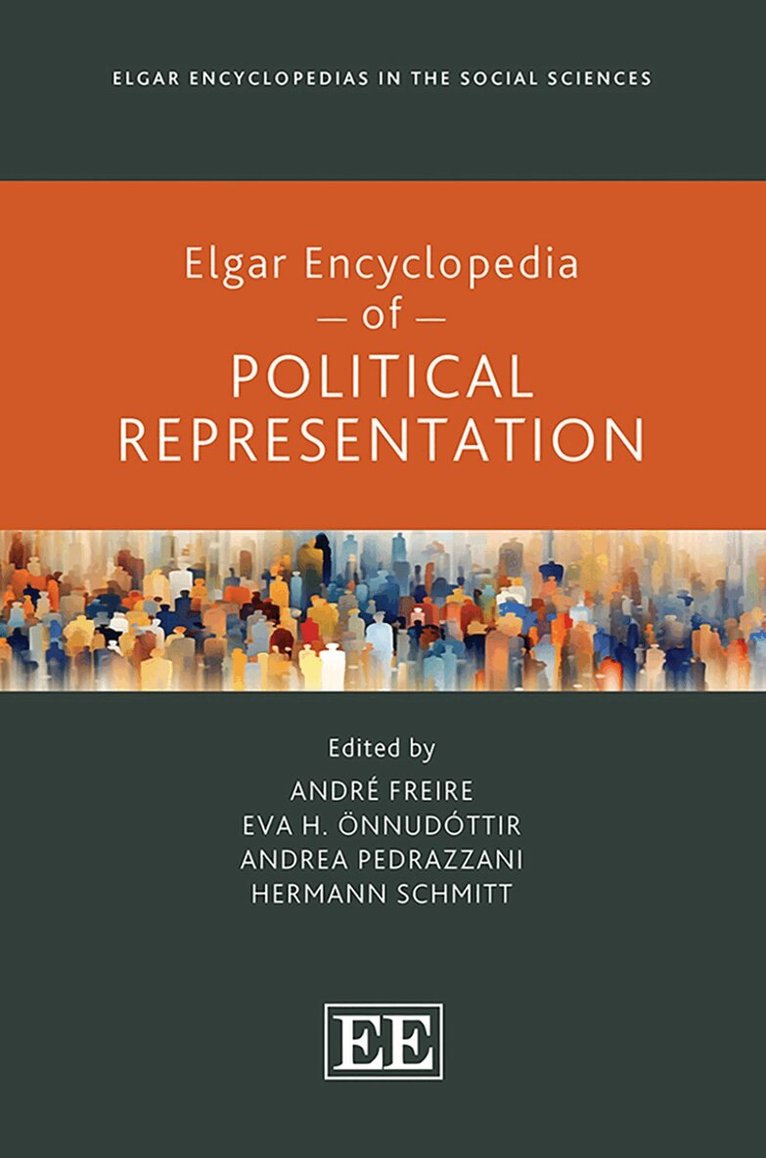
Elgar Encyclopedia of Political Representation
AvAndré Freire,Eva H. Önnudóttir
Del i serien Elgar Encyclopedias in the Social Sciences series
5 766 kr
Beställningsvara. Skickas inom 7-10 vardagar. Fri frakt över 249 kr.
Beskrivning
Produktinformation
- Utgivningsdatum:2026-03-24
- Mått:169 x 244 x undefined mm
- Format:Inbunden
- Språk:Engelska
- Serie:Elgar Encyclopedias in the Social Sciences series
- Förlag:Edward Elgar Publishing Ltd
- ISBN:9781035324811
Utforska kategorier
Mer om författaren
Edited by André Freire, former Professor of Political Science, University of Lisbon, Portugal, Eva H. Önnudóttir, Professor of Political Science, University of Iceland, Reykjavik, Iceland, Andrea Pedrazzani, Associate Professor of Political Sociology, University of Milan, Italy and Hermann Schmitt, Emeritus Professor of Electoral Politics, University of Manchester, UK
Recensioner i media
‘Bringing together a wide range of leading international scholars, this volume provides a comprehensive overview of classic and contemporary theories on political representation. These issues are at the heart of liberal democracy, including whose voices should count, how citizens and elites interact, and how institutions translate popular demands into public policies. The Encyclopedia provides an invaluable summary of the normative and empirical literature for students and scholars alike.’
Innehållsförteckning
- ContentsIntroduction: political representationin modern liberal and democraticregimes: from its origins to itscurrent strains and major challenges 1PART I HISTORICAL ANDPHILOSOPHICAL ROOTSOF MODERN POLITICALREPRESENTATION1 The American Revolution(1776) and modern liberalrepresentative government 14José Gomes André2 Carl Schmitt and the criticismof liberal parliamentaryrepresentation 20Alessandra Maia andBernardo Ferreira3 Democracy in ancient Athens:the idea of popular self-government 23Alberto Esu4 Edmund Burke and the idea oftrustee representation 32Alessandra Maia and Paulo d’Avila5 Emmanuel Joseph Sieyès andthe representation of the TiersÉtat 35Alessandra Maia and AndréMagnelli6 The English Revolution andmodern political representation 39Markku Peltonen7 The Federalist Papersand the delegate vision ofrepresentation 45Alessandra Maia8 The Federalist Papers and theidea of federalism 48Alessandra Maia and Mayra Silva9 The Federalist Papers and theidea of limitation of the powerof majorities 51Alessandra Maia and Mayra Silva10 The French Revolution(1789) and modern liberalrepresentative government 54José Gomes André11 The Italian republics and theoligarchical representativegovernment 61Newton Bignotto12 Jean-Jacques Rousseau and hiscritical vision of representation 67Alessandra Maia and AndréMagnelli13 John Locke and the idea ofgovernment by consent 70Alessandra Maia andVladimyr Jorge14 Liberal democratic regimes andpolitical representation 73Alexandros Kabbathas andWolfgang Merkel15 Medieval forms of politicalrepresentation 82Carol Symes16 Montesquieu and the separationof powers 89Alessandra Maia and AndréMagnelli17 Political representation indictatorships 93Filipa Raimundo18 The Roman republican systemand representative government 102Heather E. Duncan19 Thomas Hobbes and the idea ofrepresentation as authorization 110Alessandra Maia and AndréMagnelliPART II CLASSICAL ANDOUTSTANDING MODERNREPRESENTATION STUDIES20 The Concept of Representation(1967), by Hanna Pitkin 115Paolo Segatti21 Constituency Influence inCongress (1963), by WarrenMiller and Donald Stokes 121Hermann Schmitt22 Democracy and Its Critics(1989), by Robert A. Dahl 126Svend-Erik Skaaning andPalle Svensson23 Electoral Systems and PartySystems: A Study of Twenty-Seven Democracies, 1945–1990 (1994), by Arend Lijphart 133André Freire24 The End of RepresentativePolitics (2015), by SimonTormey 137Cristiano Gianolla25 Ideological Representation:Achieved and Astray.Elections, Institutions, andthe Breakdown of IdeologicalCongruence in ParliamentaryDemocracies (2019), by G.Bingham Powell 143Robin E. Best26 Latin American Party Systems(2010), by Herbert Kitschelt,Kirk A. Hawkins, Juan PabloLuna, Guillermo Rosas, andElizabeth J. Zechmeister 147Mélany Barragán27 Les Partis Politiques (1951),by Maurice Duverger vis-à-visThe Political Consequences ofElectoral Laws ([1967] 1971),by Douglas Rae 150André Freire28 Political Recruitment: Gender,Race and Class in the BritishParliament (1995), by PippaNorris and Joni Lovenduski 158Sophia Kanaouti andManina Kakepaki29 Political Representationand Legitimacy in theEuropean Union (1999), byHermann Schmitt and JacquesThomassen (editors) 163Eva H. Önnudóttir30 Political Representation inFrance (1986), by PhilipConverse and Roy Pierce 168Nonna Mayer31 Political Representation inSouthern Europe and LatinAmerica. Before and Afterthe Great Recession and theCommodity Crisis (2020),by André Freire, MélanyBarragán, Xavier Coller, MarcoLisi, and Emmanouil Tsatsanis(editors) 174Andrea Pedrazzani32 The Politics of Presence (1998),by Anne Phillips 180Maro Pantelidou Maloutas33 Post-Communist PartySystems: Competition,Representation, and Inter-Party Cooperation (1999),by Herbert Kitschelt, ZdenkaMansfeldova, RadoslawMarkowski, and Gábor Toka 185Gabriella Ilonszki34 The Principles ofRepresentative Government(1997), by Bernard Manin 191Alessandra Maia35 Representation from Above:Members of Parliament andRepresentative Democracyin Sweden (1996), by PeterEsaiasson and Sören Holmberg 196Eva H. Önnudóttir36 Representative Democracy:Principles and Genealogy(2006), by Nadia Urbinati 201Alessandra Maia37 Rethinking Representation(2003), by Jane Mansbridge 206Andrea Pedrazzani38 The Strain of Representation:How Parties Represent DiverseVoters in Western and EasternEurope (2012), by RobertRohrschneider and StephenWhitefield 212Pietro Michael Lepidi andMatthew LovelessPART III CONCEPTUALISATIONAND MEASUREMENTOF POLITICALREPRESENTATION INCONTEMPORARY POLITICALSCIENCE RESEARCH39 Collective representation beforeliberal representation 218Paolo Ricci40 Data sources for the studyof political representation inEurope and North America 222Paride Carrara and Luca Pinto41 Data sources for the study ofpolitical representation in LatinAmerica 231Mélany Barragán42 Descriptive representation:“standing for” approaches 239Sophia Kanaouti andManina Kakepaki43 Dramaturgical approaches topolitical representation 243Jean-Pascal Daloz44 Dynamic politicalrepresentation 249Gauthier Fally andChristopher Wlezien45 Elite recruitment 256Bruno Marino46 Elite theories 261Pedro T. Magalhães andPedro Tavares de Almeida47 Ethnic representation 266Francisco Javier Alarcón and Carmen Ortega48 Gender representation 270Ana Espírito-Santo49 Ideology and policy congruence 274Ana Maria Belchior andFilipe Pacheco da Silva50 Interest representation 278Manuel Meirinho Martins51 Legal representation 282José Luís Jacinto52 The mandate vs. independencecontroversy 286Stefano Camatarri53 Measurement issues instudies of congruence andresponsiveness 289Benjamin Ferland54 Measuring ideological andpolicy congruence 297Ana Maria Belchior andFilipe Pacheco da Silva55 Political elites 304Xavier Coller56 Political representation underaffective and ideologicalpolarization 309Pedro Riera and Luana Russo57 The principal-agent model ofpolitical representation 315Alessandra Maia and Paulo d’Avila58 Representation asaccountability: formalisticviews 318Pedro Moreira da Fonseca59 Representation asauthorization: formalistic views 322Manuel Meirinho Martins60 Representation as delegation:the imperative mandate 326Pedro Moreira da Fonseca61 The responsible party model 330Anika Gauja and KarinaKosiara-Pedersen62 Responsiveness 333Vera Beloshitzkaya and ZoeLefkofridi63 Social Disproportion Index 337Xavier Coller64 Social movements andrepresentation 341Guya Accornero and TiagoCarvalho65 Symbolic representation:“standing for” approaches 347Manuel Meirinho Martins66 Trustee representation: “actingfor” approaches 351Manuel Meirinho Martinsand João SantosPART IV ELECTORAL INSTITUTIONS,PARTIES, PARTY SYSTEMS,AND POLITICALREPRESENTATION67 Assembly size 356Pedro Riera and Luis Azores68 Candidate selection andpolitical representation 361Alona O. Dolinsky andGideon Rahat69 The cartel party and the‘agent of the state’ model ofrepresentation 367Ingrid van Biezen70 The catch-all party andthe entrepreneur model ofrepresentation 370Ingrid van Biezen71 Constituency service 373Fátima Recuero andCarmen Ortega72 Data sources for the study ofelectoral systems 377Carmen Ortega and JoséManuel Trujillo73 Data sources for the study ofparties and party systems 382Vincenzo Emanuele andBruno Marino74 The declining social rootingof political parties and itsconsequences for politicalrepresentation 388Davide Angelucci75 Direct and participatorydemocracies 396Leonardo Avritzer andPriscila Zanandrez76 District boundaries 401Sergio Pérez Castaños andCarmen Ortega77 District magnitude 405Carmen Ortega and GiselleGarcía-Hípola78 Effective and legal thresholds 409Alberto Penadés and Pedro Riera79 Electoral districts 414Carmen Ortega and GiselleGarcía-Hípola80 Electoral institutions andcollective vs. individualistic/personalised representation 417Juan Montabes, CarmenOrtega and José CarlosHernández-Gutiérrez81 Electoral institutions andideological and policycongruence 424Pola Lehmann82 Electoral lists 431Carmen Ortega, JuanMontabes and José CarlosHernández-Gutiérrez83 Electoral system families 434Jean-Benoit Pilet andFernando Feitosa84 Electoral systems, partysystems and politicalrepresentation in Africa 441Edalina Rodrigues Sanches85 Electoral systems, partysystems, and politicalrepresentation in Asia 452Diego Fossati86 Electoral systems, partysystems and politicalrepresentation in Central andEastern Europe 459Sergiu Gherghina87 Electoral systems, partysystems, and politicalrepresentation in Latin America 469Mélany Barragán and AldoMartínez Hernández88 Electoral systems, partysystems, and politicalrepresentation in NorthAmerica 477Valere Gaspard andBenjamin Ferland89 Electoral systems, partysystems and politicalrepresentation in WesternEurope 487Marco Lisi90 The elite party and the trusteemodel of representation 495Ingrid van Biezen91 Ethnic quotas 498Carmen Ortega andFrancisco Javier Alarcón92 Evolution of the right to vote 504Manuel Loff and Sergio Maia93 The focus of representation 510Federico Russo94 Gender quotas 513Pamela Pansardi95 Gerrymandering andredistricting 517Daniel Adrião and André Freire96 Governments as representativeinstitutions 521Patrícia Silva and MarinaCosta Lobo97 Indices of disproportionality 529Pedro Riera and Alberto Penadés98 Indices of party systemfragmentation 533Marco Lisi99 Indices of polarization 537Ruth Dassonneville andJuliette Leblanc100 Lot: election by sort 544Manuel Meirinho Martins101 Malapportionment 548Nicolás Izquierdo and Pedro Riera102 The mass party andthe delegate model ofrepresentation 552Ingrid van Biezen103 Mixed-member electoralsystems: mixed-memberproportional 555Jean-Benoit Pilet andFernando Feitosa104 Mixed-member electoralsystems: parallel systems 558Jean-Benoit Pilet andFernando Feitosa105 MPs’ roles 561Luca Verzichelli106 Multiple-tier electoral systems 565Jean-Benoit Pilet andFernando Feitosa107 Parliaments as representativeinstitutions 567Olivier Rozenberg108 Participatory budgeting 574Leonardo Avritzer andPriscila Zanandrez109 Party identification 579Richard Johnston110 Party manifestos and politicalrepresentation 583Daniela Braun andGiuseppe Carteny111 Party pledges and pledgefulfillment 587Ana Maria Belchior112 Personal vote 591Carmen Ortega and JoséCarlos Hernández-Gutiérrez113 Polarization 594Ruth Dassonneville andJuliette Leblanc114 Political communication andpolitical representation: socialmedia 599Tiago Brás and JoséSantana-Pereira115 Political communicationand political representation:traditional media 605Susana Rogeiro Nina andJosé Santana-Pereira116 Political parties asorganizations 611Emilie van Haute andThomas Legein117 Political parties: definitions 614Emilie van Haute118 Political parties in institutions 617Caroline Close119 Political parties: the party onthe ground 621Emilie van Haute120 Political representationin presidential and semi-presidential systems 624Rui Graça Feijó121 Primaries 633Indriði H. Indriðason andGunnar Helgi Kristinsson122 Referendums and politicalrepresentation 636Isabelle Stadelmann-Steffen123 Single-tier electoral systems 639Jean-Benoit Pilet andFernando Feitosa124 Social cleavages and politicalrepresentation 641Andreas C. Goldberg125 Structure of the vote:categorical vs. ordinal 648Carmen Ortega and CarlosJosé Aguilar García126 Term limits 652Noémie Jeanne FévratPART V CURRENT CHALLENGESFOR POLITICALREPRESENTATION:DOMESTIC LEVEL127 Citizens’ tolerance vis-à-visauthoritarian alternatives 657David Pimenta, LúcioHanenberg, Hugo FerrinhoLopes and Pedro C. Magalhães128 Consequences of in/effectiverepresentation for systemsupport 660Christopher Wratil and JensWäckerle129 Counter-democracy 667Alessandra Maia130 Defective democracies 673Wolfgang Merkel131 Disloyal oppositions (losers’consent) 682Claudio Balderacchi132 Fake news 685Pedro Marques Ribeiro andJosé Santana-Pereira133 Grand coalition politics at thedomestic level 688Thomas Bräuninger andMarc Debus134 The Great Recession 693Timothy Hellwig135 Inequalities and politicalrepresentation 696Renato Miguel Carmo andGuya Accornero136 Left-wing populism (the fadedpromises of) 703Luke March137 Non-majoritarian institutions atthe domestic level: the rise ofthe unelected 707Amal Sethi and BrianChristopher Jones138 Parties in the digital era 715Giulia Sandri139 Political-economic collusion 720Colin Crouch140 Populist parties 727Eirikur Bergmann141 Post-democracy 731Colin Crouch142 Regime support 738Hugo Ferrinho Lopes, LúcioHanenberg, David Pimentaand Pedro C. Magalhães143 Right-wing populism 742Eirikur BergmannPART VI CURRENT CHALLENGESFOR POLITICALREPRESENTATION:INTERNATIONAL LEVEL144 Beijing Consensus 747Francesco Gatti145 Competitive vs. consensualgovernment and politicalrepresentation 751Tom Louwerse and Rudy B.Andeweg146 The COVID-19 pandemic 758Kennet Lynggaard, MichaelKluth and Theofanis Exadaktylos147 Environmental risks: climatechange 762Federica Genovese148 The European Union and thedemocratic deficit 767José Pedro TeixeiraFernandes and Maria LuísaVerdelho Alves149 Globalization and the strains onpolitical representation 775Emmanouil Tsatsanis150 The ‘grand coalition’ in theEuropean Parliament – past,present and future 781Amie Kreppel151 Immigration and its challengesfor national political systems 785João Carvalho152 Multilevel systems ofgovernance 789Simona Piattoni153 Non-majoritarian institutions atthe international level: the riseof the unelected 795James Allan154 Washington Consensus 800Pao J. Engelbrecht155 Winners and losers ofglobalization 804Nicolò ContiIndex 807
Du kanske också är intresserad av
- Nyhet
Elgar Encyclopedia of African Politics
Anne M. Kjær, Moses Khisa, Xichavo Alecia Ndlovu
4 468 kr
- Nyhet
Encyclopedia of Technological Hazards and Disasters in the Social Sciences
Duane A. Gill, Liesel A. Ritchie, Nnenia M. Campbell
5 231 kr
Elgar Encyclopedia of City and Place Branding
Eduardo Oliveira, Efe Sevin, Emma Björner
4 144 kr
- Nyhet
Elgar Concise Encyclopedia of Research Methods in the Social Sciences
Theodoros Iosifides
3 657 kr