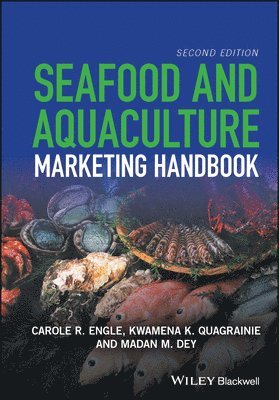
Seafood and Aquaculture Marketing Handbook
AvCarole R. Engle,Kwamena K. Quagrainie
Inbunden, Engelska, 2016
1 454 kr
Beställningsvara. Skickas inom 5-8 vardagar. Fri frakt över 249 kr.
Beskrivning
SEAFOOD AND AQUACULTURE MARKETING HANDBOOK Aquaculture, the farming of aquatic animals and plants, and other seafood business continue to grow rapidly around the world. However, many of these businesses fail due to the lack of sufficient attention to marketing. The Seafood and Aquaculture Marketing Handbook provides the reader with a comprehensive yet user-friendly presentation of key concepts and tools necessary for aquaculture and seafood businesses to evaluate and adapt to changing market conditions. Markets for aquaculture and seafood products are diverse, dynamic, and complex. The Seafood and Aquaculture Marketing Handbook presents fundamental principles of marketing with specific discussion of aquaculture and seafood market channels and supply chains from around the world, and builds towards a step-by-step approach to strategic market planning for successful aquaculture and seafood businesses. This book is an essential reference for all aquaculture seafood business as well as students of aquaculture. The volume contains a series of synopses of specific markets, an extensive annotated bibliography, and webliography for additional sources of information. Written by authors with vast experience in international marketing for aquaculture and seafood products, this volume is a valuable source of guidance for those seeking to identify profitable markets for their aquaculture and seafood products.
Produktinformation
- Utgivningsdatum:2016-09-16
- Mått:175 x 249 x 25 mm
- Vikt:862 g
- Format:Inbunden
- Språk:Engelska
- Antal sidor:416
- Upplaga:2
- Förlag:John Wiley and Sons Ltd
- ISBN:9781118845509
Utforska kategorier
Mer om författaren
CAROLE R. ENGLE, Engle-Stone Aquatic$ LLC, Strasburg, VA, USA KWAMENA K. QUAGRAINIE, Department of Agricultural Economics, Purdue University, USA MADAN M. DEY, Department of Agriculture, Texas State University, IN, USA
Innehållsförteckning
- About the authors xiii1 Seafood and aquaculture markets 1Global trends in seafood and aquaculture markets 1Where are most aquaculture crops produced? 4What are the major species cultured worldwide? 5What are the major finfish species caught and supplied to world markets? 7What countries are the major markets for seafood and aquaculture? 8Trade in seafood and aquaculture 9Are aquaculture products different from agriculture products? 9Characteristics of aquaculture products 9Market competition between wild‐caught and farmed finfish 12Consumption trends in seafood and aquaculture markets, expenditures, effects of income, and at‐home versus away‐from‐home purchases 13Aquaculture market synopsis: tilapia 14Summary 18Study and discussion questions 19References 192 Demand and supply: basic economic premises 22What is economics? 22Demand 23Population 27Income 27Consumer tastes and preferences 28Consumer behavior 28Supply 29Costs of production 31Technology 31Price determination 32Elasticity 32Demand elasticity 34Cross‐price elasticity 36Price elasticity and total revenue 37Elasticity of supply 38Market structures and implications for competition and pricing 38Special demand and supply conditions 39Aquaculture market synopsis: salmon 40Summary 44Study and discussion questions 45References 453 Seafood and aquaculture marketing concepts 47What is marketing? 47Marketing plan 48Market products 48Supply chain and value chain 48Processors 49Market or distribution channels 50Transportation 52Wholesaling 53Brokers 54Retailing 54Food grocers 55Livehaulers 56Restaurants 56Direct sales 56Profit margins 57Economies of scale in marketing 58Supply chain management 58Pricing systems 59Price determination 59Marketing margins, marketing bill, and farm‐retail price spreads 60Pricing at different market levels 62Price behavior, trends, and fluctuations 63Geographic markets 64Product storage 65Market power 65Advertising and promotion 66Product grades, quality, and marketing implications 67International trade 69Aquaculture market synopsis: shrimp and prawns 70Summary 76Study and discussion questions 76References 774 Market trends 80The role of imports in U.S. seafood markets 80U.S. seafood consumption 82Food consumption away from home 84Convenience in food preparation and consumption 85Demand for healthy and wholesome foods 86Sustainability and seafood 87Certification of sustainability 89The Marine Stewardship Council (MSC) 89The Global Aquaculture Alliance (GAA) Best Aquaculture Practices (BAP) 90The Aquaculture Stewardship Council (ASC) 90GLOBAL Good Agricultural Practice (GLOBALG.A.P.) 91Traceability and labeling of seafood products 91Country‐Of‐Origin Labeling (COOL) 92Ecolabeling of seafood products 93Seafood and the “local food“ movement in the U.S. 95Organic seafood 96Wholesale‐retailer integration in the food system 97Electronic Data Interchange (EDI) 98The Efficient Consumer Response (ECR) 98The Efficient Food Service Response (EFR) 99E‐commerce 100Aquaculture market synopsis: Pangasius spp. (swai, basa, and tra) 102Summary 104Study and discussion questions 106References 1065 Seafood market channels 109Market channels for primary seafood products 109Seafood distribution in developing economies 109Seafood distribution in developed economies 110Seafood distribution in the U.S. 112Price discovery for primary commodities 113Contracting and vertical integration in U.S. seafood business 113Other transaction types in U.S. seafood business 115Participation in food market channels 116Distributors 116Wholesalers 116Channel ownership and control for secondary products 123Consolidation and channel control 124Channel coordination and leadership for secondary products 126Channel agreements 128Tying agreements 128Exclusive dealing 128Value chain analysis 129Channel conflict 129Aquaculture market synopsis: trout 130Summary 132Study and discussion questions 133References 1346 Seafood and aquaculture product processing 136Processing 136Structure of the seafood and aquaculture product processing industry 142Concentration 144Vertical integration 146Product characteristics 146Entry into the industry 148Plant location 149Law of market areas 150Capacity utilization 151Innovation and branding 151Challenges in aquaculture product processing 153Aquaculture market synopsis: U.S. channel catfish 154Summary 158Study and discussion questions 159References 1597 The international market for seafood and aquaculture products 162The basis for trade 162Dimensions of the international market 163Trade policy tools 167Trade policy in seafood and aquaculture 169The General Agreement on Tariffs and Trade (GATT) 169The World Trade Organization (WTO) 170U.S. Antidumping 172Byrd Amendment, Continued Dumping and Subsidy Offset Act of 2000 172Salmon trade conflicts 173United States and Norway 173United States and Chile 173European Union and Norway 174Blue crab conflict 174U.S. crawfish and China 175U.S. catfish and Vietnamese basa 176Mussel conflicts 177Shrimp conflicts 177The Convention on International Trade in Endangered Species (CITES) 177Aquaculture market synopsis: ornamental fish 178Summary 181Study and discussion questions 181Appendix 7A: The U.S. Antidumping Law 182The U.S. Department of Commerce 182The U.S. International Trade Commission (ITC) 183References 1848 Marketing by aquaculture growers 187Fish species and markets 187Production systems and intensification 188Sizes of producers 191Supply response and biological lags 192Commodities, markets, and niche markets for differentiated products 193Farmers’ marketing alternatives 194Sales to processors 194Sales to livehaulers 194Selling directly to end consumers 195Marketing by fisher/farmer groups 198Marketing cooperatives 201Local cooperatives 201Centralized cooperatives 201Federated cooperatives 202Mixed cooperatives 202Marketing cooperatives as marketing agents 203Marketing cooperatives as processing groups 203Farmers’ bargaining groups 203Marketing orders 205Futures markets for aquaculture products? 206Generic advertising of seafood and aquaculture products 207Advertising of seafood – the National Fisheries Institute (NFI) 208Salmon advertising – the Salmon Marketing Institute (SMI) 208Catfish advertising – the Catfish Institute (TCI) 209Tilapia advertising – the Tilapia Marketing Institute (TMI) 209Trout advertising – the United States Trout Farmers Association (USTFA) 210Aquaculture market synopsis: oysters 210Summary 213Study and discussion questions 214Appendix 8A: The Capper-Volstead Act 214References 2169 Marketing strategies and planning for successful aquaculture businesses 219Current market situation analysis 219Market research 219Competition 222Consumer attitudes/preferences 223Analysis of business strengths and weaknesses 224Developing the marketing strategy 226Developing a retail outlet 227Market segmentation 228Products and product lines 229Commodity markets 235Niche markets 235Value‐added products 236Business organization and contracting 237Sales 238The marketing plan 238Aquaculture market synopsis: mussels 243Summary 247Study and discussion questions 248Appendix 9A: A sample market plan (hypothetical) 248Executive summary 248Vision 248Overall market situation analysis 249References 25110 Marketing research methodologies 254Types of research and design 255Exploratory research 255Qualitative research 256Quantitative research 257Data collection 257Secondary data 257Primary data 258Sampling 263Questionnaire design 265Response rate 266Research on attitudes and preferences 266Theories of choice behavior 267Product research 268Product ideas 268Product testing 269Market share research 270Advertising research 270Sales control research 272Value chain research 273Data analysis 275Statistical summaries 275Relationships between variables or responses 278Discrete choice analysis 280Conjoint analysis 282Traditional demand analysis 284Aquaculture market synopsis: baitfish 285Summary 288Study and discussion questions 289References 29111 Seafood demand analysis 293Demand theory 293Theoretical properties of demand 294Approaches to modeling fish and seafood demand 295Commodity grouping and separability 298Other issues pertaining to estimating demand for seafood 299Data 301Scanner data 302Elasticities and flexibilities of seafood demand 303Estimates of elasticities and flexibilities of seafood demand 304Recent estimates of elasticities/flexibilities of seafood demand in developed countries 304Recent estimates of elasticities/flexibilities of seafood demand in developing countries 318Aquaculture market synopsis: crawfish 319Summary 323Study and discussion questions 324References 32412 Policies and regulations governing seafood and aquaculture marketing 330Regulatory frameworks for seafood and aquaculture 330Food safety 331Industry‐initiated programs 333Regulation of food safety 335Organic standards 338Green labeling and standards 339Marketing and transportation of live aquatic animals 340Aquatic animal health and biosecurity 341Aquaculture market synopsis: mariculture of grouper, snapper, tuna, and cobia 342Summary 343Study and discussion questions 344References 344Glossary 347Annotated bibliography of aquaculture marketing information sources 365Annotated webliography of sources of data and information for aquaculture marketing 373Index 390
Hoppa över listan


Mer från samma författare
Seafood and Aquaculture Marketing Handbook
Madan M. Dey, Kwamena K. Quagrainie, Carole R. Engle
E-bok
20161 645 kr
Seafood and Aquaculture Marketing Handbook
Madan M. Dey, Kwamena K. Quagrainie, Carole R. Engle
E-bok
20161 645 kr
Hoppa över listan


Du kanske också är intresserad av
Seafood and Aquaculture Marketing Handbook
Madan M. Dey, Kwamena K. Quagrainie, Carole R. Engle
E-bok
20161 645 kr
Seafood and Aquaculture Marketing Handbook
Madan M. Dey, Kwamena K. Quagrainie, Carole R. Engle
E-bok
20161 645 kr
- Nyhet
Aquaponics
Amy M. Shambach, Rebecca M. Ward, J. Stuart Carlson, Kwamena K. Quagrainie, Tomas O. Höök
Häftad, 2026
438 kr