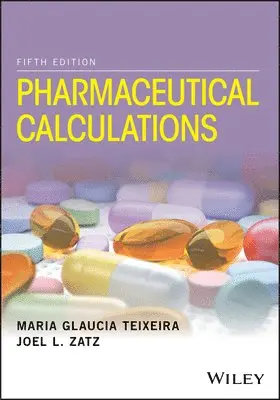
Pharmaceutical Calculations
AvMaria Glaucia Teixeira,Joel L. Zatz
972 kr
Beställningsvara. Skickas inom 5-8 vardagar. Fri frakt över 249 kr.
Beskrivning
Produktinformation
- Utgivningsdatum:2017-04-07
- Mått:178 x 254 x 31 mm
- Vikt:816 g
- Format:Häftad
- Språk:Engelska
- Antal sidor:560
- Upplaga:5
- Förlag:John Wiley & Sons Inc
- ISBN:9781118978511
Utforska kategorier
Mer om författaren
Maria Glaucia Teixeira, PhD, is Associate Professor Emeritus in the School of Pharmacy at the University of Wyoming, where she retired after 23 years on the faculty, following 10 years as Professor at the Federal University of Ceará in Fortaleza, Brazil. She has received numerous recognitions for her teaching, including the Top Prof and Excellence in Teaching awards while at University of Wyoming. She received her PhD in Pharmacology at Paul Sabatier University, Toulouse, France. Joel L. Zatz, PhD, is Professor Emeritus at Rutgers, The State University of New Jersey.
Innehållsförteckning
- Preface xiiiChapter 1 Review of Basic Mathematical Principles11.1. Significant Figures 21.2. Rounding Off 41.3. Fractions 51.4. Exponents and Powers 81.5. Estimation 101.6. Units 121.7. Ratio 151.8. Proportion 151.9. Dimensional Analysis 18Practice Problems 21Chapter 2 Systems of Measurement 312.1. Metrology 312.2. The Metric System 322.3. The English Systems 332.3.1. The Avoirdupois System 332.3.2. The Apothecary or Troy System 332.4. Measurement of Weight 332.4.1. Metric Weight 332.4.2. English Weight 352.4.2.1. Avoirdupois Weight 352.4.2.2. Apothecary Weight 362.4.3. Practical Weight Equivalents 362.5. Measurement of Volume 382.5.1. Metric Volume 382.5.2. English Volume 392.5.3. Practical Volume Equivalents 392.6. Measurement of Length 412.7. Intersystem Relationships 432.8. Household Equivalents and Metric Estimation 44Practice Problems 49Chapter 3 Prescriptions and Medication Orders 543.1. Prescribing Authority 553.2. Components 573.3. Practices to Prevent Medication Errors 583.4. Common Abbreviations 603.5. Outpatient Prescription Drug Orders 693.5.1. Prescriptions for Manufactured Drug Products 693.5.2. Prescriptions for Compounded Drug Products 693.5.2.1. Types of Compounded Orders 703.5.2.2.1. Formulation Based on Total Quantity 703.5.2.3.2. Formulation Based on Single Dosage Unit 713.6. Inpatient Medication Orders 723.7. Interpretation 773.8. Calculations to Check “DEA” Numbers 773.9. Reducing and Enlarging Formulas 803.10. Parts Formulas 87Practice Problems 90Chapter 4 Weighing and Measuring in Pharmacy Practice 1034.1. Measurement Errors 1034.2. Indication of Error 1044.2.1. Absolute Error: Indication of Error Based on Maximum Deviation and Significant Figures 1044.2.2. Relative Error: Indication of Error Based on Percentage of Estimated Value 1074.3. Tolerance in Prescription Compounding and Pharmaceutical Manufacturing 1084.4. Weighing and Measuring 1094.4.1. Electronic Balances 1094.4.2. Prescription Balances: Class A, Torsion 1104.4.2.1. Sensitivity Requirement (SR) 1104.4.2.2. Minimum Weighable Quantity (MWQ) or Least Weighable Quantity (LWQ) 1104.4.2.3. Percent Error 1114.4.3. Volumetric Devices for Pharmaceutical Measurements 1144.4.3.1. The Meniscus and Effect of Viscosity 1144.4.3.2. Graduates 1144.4.3.3. Pipets (Pipettes) 1154.4.3.4. Syringes 1154.4.3.5. Droppers 1164.5. Aliquot Method and Triturations 1194.5.1. Solid–Solid Aliquot Method 1194.5.2. Solid–Solid Triturations 1224.5.3. Liquid–Liquid Aliquots and Triturations 1314.5.4. Solid–Liquid Aliquots 1364.5.5. Serial Dilutions 1404.6. Density 1424.7. Specific Gravity 144Practice Problems 145Chapter 5 Dosage Calculations 1605.1. Calculations Involving Dose, Size, Number of Doses, Amount Dispensed, and Quanity of a Specific Ingredient in a Dose 1615.2. Dosage Measured By Drops 1695.3. Dosage Based on Body Weight 1715.4. Dosage Based on Body Surface Area (BSA) 1745.5. Pediatric and Geriatric Dose Calculations 1815.6. Chemotherapy Dose Calculations 184Practice Problems 187Chapter 6 Drug Concentration Expressions 2036.1. Concentration 2046.2. Percentage Strength Expressions 2046.2.1. Percent Volume-in-Volume 2046.2.2. Percent Weight-in-Weight 2056.2.3. Percent Weight-in-Volume 2066.2.4. Default Rules for Percentage Expressions 2086.2.5. Prescriptions and Formulations with Ingredients Listed as Percentage 2106.2.6. Using Specific Gravity to Calculate the Exact Amount of Solvent in a Solution 2156.2.7. Converting % w/w into %w/v Using Specific Gravity 2176.3. Stock Solutions, Concentrates, and Triturations 2186.4. Saturated Solutions 2226.5. Ratio Strength Expressions 2246.5.1. Ratio Volume-in-Volume 2246.5.2. Ratio Weight-in-Volume 2256.5.3. Ratio Weight-in-Weight 2266.6. Other Pharmaceutical Expressions of Drug Concentration 2306.6.1. Milligrams Per Milliliter (mg/mL) 2306.6.2. Milligrams Percent (mg%) and Miligrams Per Deciliter (mg/dL) 2316.6.3. Parts Per Million (ppm) and Parts Per Billion (ppb) 2326.6.4. Millimols, Milliequivalents, and Milliosmols Per Unit of Volume 234Practice Problems 235Chapter 7 Dilution and Concentration 2577.1. Problem-Solving Methodologies 2587.1.1. Concentration Principle 2587.1.2. Mass Balance Equation 2607.1.2.1. Dilution of Powders or Solid Mixtures 2617.1.2.2. Mixing Different Strengths 2657.1.2.3. Modifying the Drug Concentration of a Prepared Product: Increasing Drug Concentration 2677.1.3. The CQ Equation: Concentration X Quantity 2687.1.3.1. Expanded CQ Equation 2727.1.4. Algebraic Calculations Using the Concentration Equation and the CQ Equation 2757.1.5. Alligation Alternate 2837.1.5.1. Use of Alligation When Combining More Than Two Products 2877.2. So, Which Method Should I Use? 2917.2.1. Stock Solutions Diluted by the Patient 293Practice Problems 296Chapter 8 Isotonicity 3108.1. Principles 3108.2. Sodium Chloride Equivalent Values 3128.3. Isotonicity by the Sodium Chloride Equivalent Method 3158.3.1. Sodium Chloride Equivalent: Method 1 3158.3.2. Sodium Chloride Equivalent: Method 2 3188.4. Other Tonicity Agents 3198.5. Isotonicity When One Ingredient is Already Isotonic 3218.6. Isotonic Buffered Solutions 3238.6.1. Using the White–Vincent Method to Adjust Tonicity 3238.7. Other Methods 3268.8. Determination of the Tonicity of a Solution (Hypotonic, Isotonic, or Hypertonic) 329Practice Problems 330Chapter 9 Dosage Calculations of Electrolytes 3409.1. Molarity and Molality 3419.1.1. Mols and Millimols 3419.1.2. mmol/mL, mmol/L 3449.2. Electrolyte Dissociation, Valence, Equivalent, and Equivalent Weight 3449.3. Milliequivalents, mEq/mL, mEq/L 3479.3.1. Problem-Solving Methods for Milliequivalents 3489.4. Osmolarity (Osmolar Strength) 3549.4.1. Milliosmoles and mOsm/L 355Practice Problems 366Chapter 10 Calculations for Injectable Medications And Sterile Fluids 37810.1. Reconstitution of Dry Powders 37810.1.1. Reconstituting with Volumes Other Than Those on Manufacturer’s Label 38010.1.2. Considering Powder Volume 38310.1.3. Powders as Compounding Sources of Drugs 38510.2. Calculations Related to Units/ml (Insulin, Heparin) and Other Units of Potency 38610.2.1. Calculations of Insulin Single Dose and Combinations 38710.2.2. Calculations of Heparin Doses 39110.3. Intravenous Admixtures 39210.4. Extemporaneous IV Fluids 39510.5. Flow Rates in Intravenous Sets 397Practice Problems 399Chapter 11 Enteral and Parenteral Nutrition 41311.1. Screening and Assessment of Nutritional Needs 41411.1.1. Body Mass Index (BMI), Waist Circumference, and Associated Disease Risks 41411.1.2. Assessment of Malnutrition 41611.2. Enteral Nutrition 41611.3. Parenteral Nutrition (PN): 2-in-1 and 3-in-1 Formulations 41811.4. Calculation of Nutritional Requirements 42011.4.1. Caloric Requirement Equations 42011.4.2. Fluid Requirement 42511.4.3. Protein Requirement (Nitrogen) 42511.4.4. Carbohydrate and Fat Requirements 42811.4.5. Micronutrient Requirements (Electrolytes, Vitamins, and Trace Elements) 42811.5. Calculations for Compounding Parenteral Nutrition 42911.5.1. Calculation of Electrolytes 43011.5.2. Calculation of Carbohydrate and Fat 43311.5.3. Calculation of Protein 43511.5.4. Calculation of Other Additives 43811.6. Calculations Related to the Design of a PN 444Practice Problems 446Chapter 12 Miscellaneous Practical Calculations in Contemporary Compounding 45812.1. Compounding with Manufactured Dosage Forms 45912.1.1. Nonsterile Products 46012.1.2. Sterile Products 46312.2. Suppository Calculations 46512.2.1. Calibration of Molds 46512.3. Determination of Amount of Base/powder Occupied by the Drug(s): Solid Dosage Forms 46612.3.1. Density Factor Method 46712.3.2. Quantity/Volume of Base Occupied by Drug (or Density Ratio Method) 47412.3.3. Dosage Replacement Factor Method 47512.4. Lozenges and Lollipops 47912.4.1. Lozenge/Lollipop Mold Calibration 47912.5. Selecting a Capsule Size 48012.5.1. The Rule of Sixes 48012.5.2. The Rule of Seven 48212.5.3. Volume Occupied by Active Ingredient in a Capsule 48412.6. Primary Emulsion Calculations (4:2:1 Ratio) 48512.7. A Little Touch of Veterinary Compounding 487Practice Problems 489Appendices 499Appendix 1 Systems of Measurement 500Appendix 2 Chemical Elements and Atomic Weights 502Appendix 3 Calibration of Medicinal Dropper 503Appendix 4 Solutions Used to Compound PN 504Appendix 5 Conversions: Temperature, Time, Proof Strength 507Appendix 6 HLB System 511Appendix 7 Drug as a Base Versus Salt or Ester 514Appendix 8 pH, Buffers, and Buffer Capacity 517Appendix 9 Normal Concentration 525Appendix 10 Biologics for Immunization 527Literature Consulted 529Index 531
Du kanske också är intresserad av
New Jersey's Great Gardens: A Four-Season Guide to 125 Public Gardens, Parks, and Aboretums
Arline Zatz, Joel L. Zatz
Häftad, 1999
285 kr
- Signerad!
- Signerad!
- -30%
- Signerad!
- -19%
- 4 för 3
Brevbäraren i Lizzanello
Francesca Giannone
Pocket, 2026
99 kr
- -22%