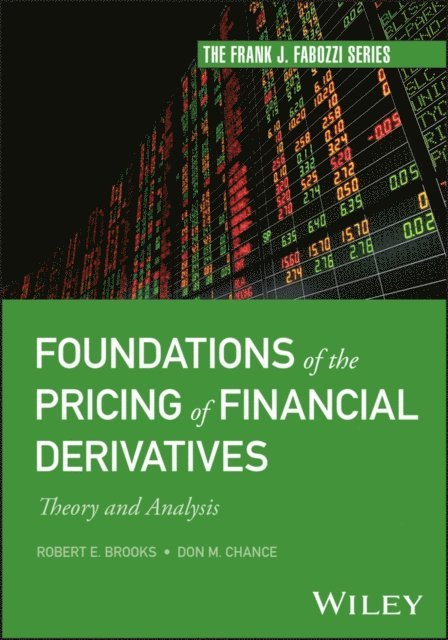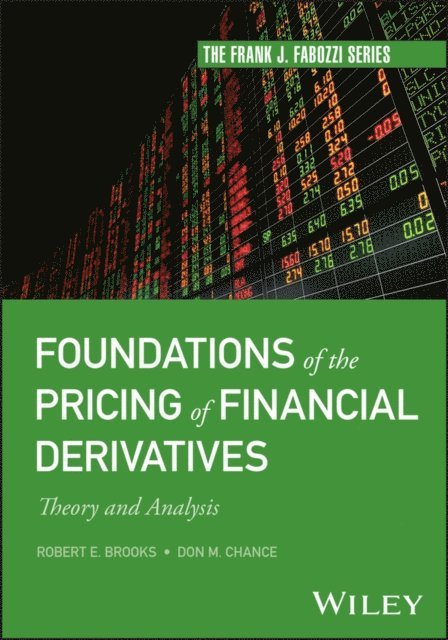
Foundations of the Pricing of Financial Derivatives
Theory and Analysis
AvRobert E. Brooks,Don M. Chance
Del i serien Frank J. Fabozzi Series
670 kr
Beställningsvara. Skickas inom 7-10 vardagar. Fri frakt över 249 kr.
Beskrivning
Produktinformation
- Utgivningsdatum:2024-01-25
- Mått:185 x 257 x 46 mm
- Vikt:1 066 g
- Format:Inbunden
- Språk:Engelska
- Serie:Frank J. Fabozzi Series
- Antal sidor:624
- Förlag:John Wiley & Sons Inc
- ISBN:9781394179657
Utforska kategorier
Mer om författaren
ROBERT E. BROOKS, PHD, CFA, is Professor Emeritus of Finance at the University of Alabama. He is the President of Financial Risk Management, LLC, a quantitative finance consulting firm. He is the author of several books and maintains a YouTube channel, @FRMHelpForYou. DON M. CHANCE, PHD, CFA, holds the James C. Flores Endowed Chair of MBA Studies and is Professor of Finance at the E.J. Ourso College of Business at Louisiana State University. He is the author of four books on derivatives and risk management. His consulting firm is Omega Risk Advisors, LLC, and his website is donchance.com.
Innehållsförteckning
- Preface xvChapter 1 Introduction and Overview 11.1 Motivation for This Book 21.2 What Is a Derivative? 61.3 Options Versus Forwards, Futures, and Swaps 81.4 Size and Scope of the Financial Derivatives Markets 91.5 Outline and Features of the Book 121.6 Final Thoughts and Preview 14Questions and Problems 15Notes 15Part I Basic Foundations for Derivative PricingChapter 2 Boundaries, Limits, and Conditions on Option Prices 192.1 Setup, Definitions, and Arbitrage 202.2 Absolute Minimum and Maximum Values 212.3 The Value of an American Option Relative to the Value of a European Option 222.4 The Value of an Option at Expiration 222.5 The Lower Bounds of European and American Options and the Optimality of Early Exercise 232.6 Differences in Option Values by Exercise Price 312.7 The Effect of Differences in Time to Expiration 372.8 The Convexity Rule 382.9 Put-Call Parity 402.10 The Effect of Interest Rates on Option Prices 472.11 The Effect of Volatility on Option Prices 472.12 The Building Blocks of European Options 482.13 Recap and Preview 49Questions and Problems 50Notes 51Chapter 3 Elementary Review of Mathematics for Finance 533.1 Summation Notation 533.2 Product Notation 553.3 Logarithms and Exponentials 563.4 Series Formulas 583.5 Calculus Derivatives 593.6 Integration 683.7 Differential Equations 703.8 Recap and Preview 71Questions and Problems 71Notes 73Chapter 4 Elementary Review of Probability for Finance 754.1 Marginal, Conditional, and Joint Probabilities 754.2 Expectations, Variances, and Covariances of Discrete Random Variables 804.3 Continuous Random Variables 864.4 Some General Results in Probability Theory 934.5 Technical Introduction to Common Probability Distributions Used in Finance 954.6 Recap and Preview 109Questions and Problems 109Notes 110Chapter 5 Financial Applications of Probability Distributions 1135.1 The Univariate Normal Probability Distribution 1135.2 Contrasting the Normal with the Lognormal Probability Distribution 1195.3 Bivariate Normal Probability Distribution 1235.4 The Bivariate Lognormal Probability Distribution 1255.5 Recap and Preview 126Appendix 5A An Excel Routine for the Bivariate Normal Probability 126Questions and Problems 128Notes 128Chapter 6 Basic Concepts in Valuing Risky Assets and Derivatives 1296.1 Valuing Risky Assets 1296.2 Risk-Neutral Pricing in Discrete Time 1306.3 Identical Assets and the Law of One Price 1336.4 Derivative Contracts 1346.5 A First Look at Valuing Options 1366.6 A World of Risk-Averse and Risk-Neutral Investors 1376.7 Pricing Options Under Risk Aversion 1386.8 Recap and Preview 138Questions and Problems 139Notes 139Part II Discrete Time Derivatives Pricing TheoryChapter 7 The Binomial Model 1437.1 The One-Period Binomial Model for Calls 1437.2 The One-Period Binomial Model for Puts 1467.3 Arbitraging Price Discrepancies 1497.4 The Multiperiod Model 1517.5 American Options and Early Exercise in the Binomial Framework 1547.6 Dividends and Recombination 1557.7 Path Independence and Path Dependence 1597.8 Recap and Preview 159Appendix 7A Derivation of Equation (7.9) 159Appendix 7B Pascal’s Triangle and the Binomial Model 161Questions and Problems 163Notes 163Chapter 8 Calculating the Greeks in the Binomial Model 1658.1 Standard Approach 1658.2 An Enhanced Method for Estimating Delta and Gamma 1708.3 Numerical Examples 1728.4 Dividends 1748.5 Recap and Preview 175Questions and Problems 175Notes 176Chapter 9 Convergence of the Binomial Model to the Black-Scholes-Merton Model 1779.1 Setting Up the Problem 1779.2 The Hsia Proof 1819.3 Put Options 1879.4 Dividends 1889.5 Recap and Preview 188Questions and Problems 189Notes 190Part III Continuous Time Derivatives Pricing TheoryChapter 10 The Basics of Brownian Motion and Wiener Processes 19310.1 Brownian Motion 19310.2 The Wiener Process 19510.3 Properties of a Model of Asset Price Fluctuations 19610.4 Building a Model of Asset Price Fluctuations 19910.5 Simulating Brownian Motion and Wiener Processes 20210.6 Formal Statement of Wiener Process Properties 20510.7 Recap and Preview 207Appendix 10A Simulation of the Wiener Process and the Square of the Wiener Process for Successively Smaller Time Intervals 207Questions and Problems 208Notes 209Chapter 11 Stochastic Calculus and Itô’s Lemma 21111.1 A Result from Basic Calculus 21111.2 Introducing Stochastic Calculus and Itô’s Lemma 21211.3 Itô’s Integral 21511.4 The Integral Form of Itô’s Lemma 21611.5 Some Additional Cases of Itô’s Lemma 21711.6 Recap and Preview 219Appendix 11A Technical Stochastic Integral Results 22011A.1 Selected Stochastic Integral Results 22011A.2 A General Linear Theorem 224Questions and Problems 229Notes 230Chapter 12 Properties of the Lognormal and Normal Diffusion Processes for Modeling Assets 23112.1 A Stochastic Process for the Asset Relative Return 23212.2 A Stochastic Process for the Asset Price Change 23512.3 Solving the Stochastic Differential Equation 23612.4 Solutions to Stochastic Differential Equations Are Not Always the Same as Solutions to Corresponding Ordinary Differential Equations 23712.5 Finding the Expected Future Asset Price 23812.6 Geometric Brownian Motion or Arithmetic Brownian Motion? 24012.7 Recap and Preview 241Questions and Problems 242Notes 242Chapter 13 Deriving the Black-Scholes-Merton Model 24513.1 Derivation of the European Call Option Pricing Formula 24513.2 The European Put Option Pricing Formula 24913.3 Deriving the Black-Scholes-Merton Model as an Expected Value 25013.4 Deriving the Black-Scholes-Merton Model as the Solution of a Partial Differential Equation 25413.5 Decomposing the Black-Scholes-Merton Model into Binary Options 25813.6 Black-Scholes-Merton Option Pricing When There Are Dividends 25913.7 Selected Black-Scholes-Merton Model Limiting Results 25913.8 Computing the Black-Scholes-Merton Option Pricing Model Values 26213.9 Recap and Preview 265Appendix 13.A Deriving the Arithmetic Brownian Motion Option Pricing Model 265Questions and Problems 269Notes 270Chapter 14 The Greeks in the Black-Scholes-Merton Model 27114.1 Delta: The First Derivative with Respect to the Underlying Price 27414.2 Gamma: The Second Derivative with Respect to the Underlying Price 27414.3 Theta: The First Derivative with Respect to Time 27514.4 Verifying the Solution of the Partial Differential Equation 27514.5 Selected Other Partial Derivatives of the Black-Scholes-Merton Model 27714.6 Partial Derivatives of the Black-Scholes-Merton European Put Option Pricing Model 27814.7 Incorporating Dividends 27914.8 Greek Sensitivities 28014.9 Elasticities 28314.10 Extended Greeks of the Black-Scholes-Merton Option Pricing Model 28414.11 Recap and Preview 284Questions and Problems 285Notes 286Chapter 15 Girsanov’s Theorem in Option Pricing 28715.1 The Martingale Representation Theorem 28715.2 Introducing the Radon-Nikodym Derivative by Changing the Drift for a Single Random Variable 28915.3 A Complete Probability Space 29115.4 Formal Statement of Girsanov’s Theorem 29215.5 Changing the Drift in a Continuous Time Stochastic Process 29315.6 Changing the Drift of an Asset Price Process 29715.7 Recap and Preview 300Questions and Problems 301Notes 302Chapter 16 Connecting Discrete and Continuous Brownian Motions 30316.1 Brownian Motion in a Discrete World 30316.2 Moving from a Discrete to a Continuous World 30616.3 Changing the Probability Measure with the Radon-Nikodym Derivative in Discrete Time 31016.4 The Kolmogorov Equations 31316.5 Recap and Preview 321Questions and Problems 322Notes 322Part IV Extensions and Generalizations of Derivative PricingChapter 17 Applying Linear Homogeneity to Option Pricing 32717.1 Introduction to Exchange Options 32717.2 Homogeneous Functions 32817.3 Euler’s Rule 33017.4 Using Linear Homogeneity and Euler’s Rule to Derive the Black-Scholes-Merton Model 33017.5 Exchange Option Pricing 33317.6 Spread Options 33717.7 Forward Start Options 33917.8 Recap and Preview 341Appendix 17A Linear Homogeneity and the Arithmetic Brownian Motion Model 342Appendix 17B Multivariate Itô’s Lemma 344Appendix 17C Greeks of the Exchange Option Model 345Questions and Problems 347Notes 347Chapter 18 Compound Option Pricing 34918.1 Equity as an Option 35018.2 Valuing an Option on the Equity as a Compound Option 35118.3 Compound Option Boundary Conditions and Parities 35318.4 Geske’s Approach to Valuing a Call on a Call 35618.5 Characteristics of Geske’s Call on Call Option 35818.6 Geske’s Call on Call Option Model and Linear Homogeneity 35918.7 Generalized Compound Option Pricing Model 36018.8 Installment Options 36118.9 Recap and Preview 362Appendix 18A Selected Greeks of the Compound Option 362Questions and Problems 363Notes 363Chapter 19 American Call Option Pricing 36519.1 Closed-Form American Call Pricing: Roll-Geske-Whaley 36619.2 The Two-Payment Case 37019.3 Recap and Preview 372Appendix 19A Numerical Example of the One-Dividend Model 373Questions and Problems 374Notes 374Chapter 20 American Put Option Pricing 37720.1 The Nature of the Problem of Pricing an American Put 37720.2 The American Put as a Series of Compound Options 37820.3 Recap and Preview 380Questions and Problems 380Notes 381Chapter 21 Min-Max Option Pricing 38321.1 Characteristics of Stulz’s Min-Max Option 38321.2 Pricing the Call on the Min 38821.3 Other Related Options 39321.4 Recap and Preview 395Appendix 21A Multivariate Feynman-Kac Theorem 395Appendix 21B An Alternative Derivation of the Min-Max Option Model 396Questions and Problems 397Notes 397Chapter 22 Pricing Forwards, Futures, and Options on Forwards and Futures 39922.1 Forward Contracts 39922.2 Pricing Futures Contracts 40422.3 Options on Forwards and Futures 40922.4 Recap and Preview 412Questions and Problems 413Notes 414Part V Numerical MethodsChapter 23 Monte Carlo Simulation 41723.1 Standard Monte Carlo Simulation of the Lognormal Diffusion 41723.2 Reducing the Standard Error 42123.3 Simulation with More Than One Random Variable 42423.4 Recap and Preview 424Questions and Problems 425Notes 426Chapter 24 Finite Difference Methods 42924.1 Setting Up the Finite Difference Problem 42924.2 The Explicit Finite Difference Method 43124.3 The Implicit Finite Difference Method 43424.4 Finite Difference Put Option Pricing 43524.5 Dividends and Early Exercise 43524.6 Recap and Preview 436Questions and Problems 436Notes 436Part VI Interest Rate DerivativesChapter 25 The Term Structure of Interest Rates 43925.1 The Unbiased Expectations Hypothesis 44025.2 The Local Expectations Hypothesis 44225.3 The Difference Between the Local and Unbiased Expectations Hypotheses 44625.4 Other Term Structure of Interest Rate Hypotheses 44725.5 Recap and Preview 450Questions and Problems 450Notes 450Chapter 26 Interest Rate Contracts: Forward Rate Agreements, Swaps, and Options 45326.1 Interest Rate Forwards 45426.2 Interest Rate Swaps 45926.3 Interest Rate Options 46926.4 Recap and Preview 471Questions and Problems 471Notes 472Chapter 27 Fitting an Arbitrage-Free Term Structure Model 47527.1 Basic Structure of the HJM Model 47627.2 Discretizing the HJM Model 47927.3 Fitting a Binomial Tree to the HJM Model 48127.4 Filling in the Remainder of the HJM Binomial Tree 48527.5 Recap and Preview 489Questions and Problems 490Notes 491Chapter 28 Pricing Fixed-Income Securities and Derivatives Using an Arbitrage-Free Binomial Tree 49328.1 Zero-Coupon Bonds 49328.2 Coupon Bonds 49628.3 Options on Zero-Coupon Bonds 49728.4 Options on Coupon Bonds 49828.5 Callable Bonds 49928.6 Forward Rate Agreements (FRAs) 50128.7 Interest Rate Swaps 50328.8 Interest Rate Options 50528.9 Interest Rate Swaptions 50628.10 Interest Rate Futures 50828.11 Recap and Preview 510Questions and Problems 510Notes 510Part VII Miscellaneous TopicsChapter 29 Option Prices and the Prices of State-Contingent Claims 51329.1 Pure Assets in the Market 51429.2 Pricing Pure and Complex Assets 51429.3 Numerical Example 51829.4 State Pricing and Options in a Binomial Framework 51929.5 State Pricing and Options in Continuous Time 52229.6 Recap and Preview 525Questions and Problems 525Notes 526Chapter 30 Option Prices and Expected Returns 52730.1 The Basic Framework 52730.2 Expected Returns on Options 52930.3 Volatilities of Options 53130.4 Options and the Capital Asset Pricing Model 53130.5 Options and the Sharpe Ratio 53230.6 The Stochastic Process Followed by the Option 53330.7 Recap and Preview 535Questions and Problems 535Notes 536Chapter 31 Implied Volatility and the Volatility Smile 53731.1 Historical Volatility and the VIX 53831.2 An Example of Implied Volatility 53931.3 The Volatility Surface 54631.4 The Perfect Substitutability of Options 54731.5 Other Attempts to Explain the Implied Volatility Smile 54931.6 How Practitioners Use the Implied Volatility Surface 55031.7 Recap and Preview 551Questions and Problems 551Notes 553Chapter 32 Pricing Foreign Currency Options 55532.1 Definition of Terms 55632.2 Option Payoffs 55632.3 Valuation of the Options 55732.4 Probability of Exercise 56132.5 Some Terminology Confusion 56332.6 Recap 563Questions and Problems 564Notes 565References 567Symbols Used 573Symbols 573Time-Related Notation 573Instrument-Related Notation 574About the Website 581Index 583
Mer från samma serie
How to Select Investment Managers and Evaluate Performance
G. Timothy Haight, Glenn Ross, Stephen O. Morrell
601 kr
Advanced Stochastic Models, Risk Assessment, and Portfolio Optimization
Svetlozar T. Rachev, Stoyan V. Stoyanov, Frank J. Fabozzi
705 kr
Structured Products and Related Credit Derivatives
Brian P. Lancaster, Glenn M. Schultz, Frank J. Fabozzi
670 kr
Developments in Collateralized Debt Obligations
Douglas J. Lucas, Laurie S. Goodman, Frank J. Fabozzi, Rebecca Manning
597 kr
Du kanske också är intresserad av
Advances in Futures and Options Research
Phelim P. Boyle, Frances A. Longstaff, Peter Ritchken, Don M. Chance, Robert R. Trippi
1 558 kr
- Signerad!
- Nyhet
- -30%
- Signerad!
- Signerad!
- Nyhet