• Fri frakt över 249 kr
  • •
  • Snabba leveranser
  • •
  • Billiga böcker
Kundservice

Du är på sajten för privatpersoner.

Företag, bibliotek eller offentlig verksamhet?

Du handlar på classic.bokus.com, där alla dina funktioner finns intakta.
Till classic.bokus.com
Bokus logotyp. Gå till startsidan.
  • Erbjudanden
  • Nyheter
  • Student
  • Topplistor
  • Barn & ungdom
  • Bokus Play
  • E-böcker
  • Pocketböcker
  • Spel & pussel

10% rabatt på allt med kod: NYSTART10 →

Sidfot

Mina sidor

    Hjälp

    • Kundservice
    • Vanliga frågor och svar
    • Frakt och leverans
    • Retur vid ångerrätt
    • Reklamera vara
    • Betalning
    • Köpvillkor
    • Allmänna villkor
    • Information om webbplatsens tillgänglighet

    Om Bokus

    • Om oss
    • Pressrum
    • För studenter
    • För företag
    • För bibliotek och offentlig verksamhet
    • För leverantörer
    • Hållbarhet

    Populärt

    • Aktuella erbjudanden
    • Presentkort
    • Studentlitteratur
    • Nya böcker
    • Topplistor
    • Signerade böcker
    • Engelska böcker

    Inspiration

    • Boktips
    • BookTok
    • Populära bokserier
    • Barnbokskaraktärer
    • Populära författare
    Logotyp för Bokus
    Följ oss på Facebook (extern länk)Följ oss på Instagram (extern länk)Följ oss på YouTube (extern länk)Följ oss på TikTok (extern länk)
    bokus @ CookiesAnpassa cookiesIntegritetspolicyKöpvillkor
    Till Citymail hemsida (extern länk)Till Budbee hemsida (extern länk)Till Postnord hemsida (extern länk)Till Schenker hemsida (extern länk)Till Early Bird hemsida (extern länk)Till Walleys hemsida (extern länk)
    1. Skönlitteratur
    2. Litteraturvetenskap
    3. Litteraturvetenskap

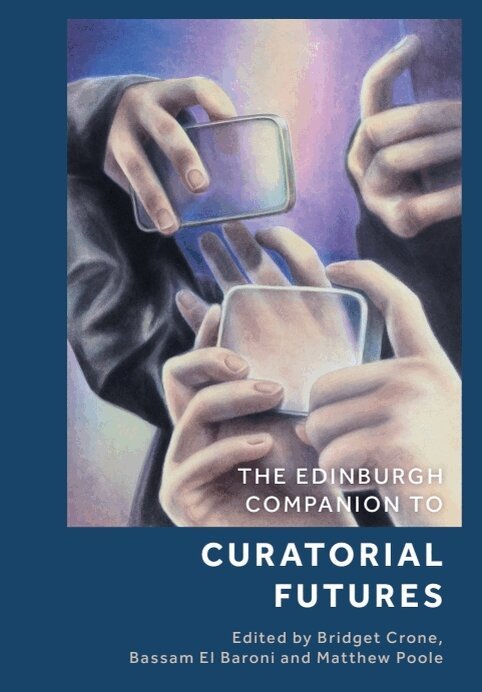
    Edinburgh Companion to Curatorial Futures

    AvBridget Crone,Bassam El Baroni

    Inbunden, Engelska, 2026

    Del i serien Edinburgh Companions to Literature and the Humanities

    2 367 kr

    Beställningsvara. Skickas inom 7-10 vardagar. Fri frakt över 249 kr.

    Beskrivning

    In a so-called post-neoliberal world, it can seem like culture is stuck in a perpetual presentism where history and the future are but mere data points for speculative calculations of gains, and culture seems all but a string of endlessly repeating commodities. In such an environment, can we rescue the future for art, for curating and the curatorial, and for culture more generally? Do we need to? What function do concepts like the future and futurity play in the field of curating and the curatorial? What use is 'the future' to curators and others working within the field of the curatorial? The Edinburgh Companion to Curatorial Futures is the first curatorial studies volume to engage with the increasingly ubiquitous concept of 'the future' and its exponential growth in the fields of artistic research, curating, art and academia. What is it we need to know as we think towards the future?

    Produktinformation

    • Utgivningsdatum:2026-01-31
    • Mått:170 x 244 x 29 mm
    • Vikt:1 039 g
    • Format:Inbunden
    • Språk:Engelska
    • Serie:Edinburgh Companions to Literature and the Humanities
    • Antal sidor:528
    • Förlag:Edinburgh University Press
    • ISBN:9781399508452

    Utforska kategorier

    • Litteraturvetenskap inom Skönlitteratur
    • Litteraturvetenskap inom Skönlitteratur
    • Referensverk och tvärvetenskap inom Samhälle och politik

    Mer om författaren

    Bridget Crone (1973–2023) was a writer and curator based in London, UK. She was a senior lecturer in Visual Cultures at Goldsmiths College, The University of London, where she co-convened the Ph.D. programme in Advanced Practices. Bridget died of cancer on 28th January, 2023, before the publication of this book, for which she is the founding editor.Crone had significant professional curatorial experience in the visual arts sector stretching across more than twenty years, working in the UK, Australia and internationally. She was the artistic director of Media Art Bath from 2006 to 2011 – a publicly funded research-based commissioning agency based in South West England – and, prior to that, she was curator at The Showroom Gallery, London. Crone also taught at universities and art schools in the UK and Australia, including Chelsea School of Art and Design, Monash University, and Victorian College of the Arts, Melbourne, as well as giving guest lecturers and seminars at universities across the UK. She was a member of the European Forum for Advanced Practices, a Europe-wide network engaged in questions of artistic research and a COST (European Cooperation in Science and Technology) Action.Focusing on the body in material and speculative terms, Crone’s work explores questions of ‘liveness’ and the image in relation to contemporary performance art and moving image practices, and the changing relations of body, technology and ecology. Her edited book The Sensible Stage: Staging and the Moving Image, was published in a second revised and extended edition in 2017. In 2022, Fieldwork for Future Ecologies, was published; co-edited by Crone, Sam Nightingale and Polly Stanton, (2022). Recent essays include: ‘Future’, with Henriette Gunkel, in The Bloomsbury Handbook for 21st Century Feminist Theory (2019) and ‘Flicker-time and Fabulation: from flickering images to crazy wipes’ in Fictions and Futures, (2017). Recent curatorial projects include Propositions for a stage: 24 frames of a beautiful heaven (2017, Institute of Contemporary Art, Singapore), Spectral Ecologies (2017, Mildura Arts Centre) and the multiple site-based project The Cinemas Project: exploring the spectral spaces of cinema in Regional Victoria (2014, Latrobe Regional Gallery, Bendigo Art Gallery, Warrnambool Art Gallery, Mildura Arts Centre, Geelong Gallery). Bridget wrote regularly for artists and recently published an extended introduction, titled ‘Wounds of Unbecoming’ (addressing questions of gender and trans materiality), for Turner Prize winner Tai Shani’s collected writings, Our Fatal Magic (2019).Bassam El Baroni is a curator, writer, sporadic artist and Associate Professor in Curating and Mediating Art at the School of Arts, Design and Architecture, Aalto University, Finland. He has lectured at the Dutch Art Institute, ArtEZ University of the Arts, Arnhem (2013–2018) and served as the artistic director of the now folded non-profit art space ACAF - Alexandria Contemporary Arts Forum, in Alexandria, Egypt (2005–2012). El Baroni’s work explores artistic and curatorial practices in relation to technology, the political economy, financialization, infrastructural futures and histories, and new forms of activism. Recent publications include: Between the Material and the Possible: Infrastructural Re-examination and Speculation in Art (2022) and Manual for a Future Desert (co-editor with Ida Soulard and Abinadi Meza, 2021). Curatorial projects include: Infrahauntologies, Edith-Russ-Haus for Media Art, Oldenburg, Germany; La Box ENSA, Bourges, France (2021-2022); Manifesta 8, Murcia, Spain, 2010 (co-curator); the Lofoten International Art Festival, Norway, 2013 (co-curator with Anne Szefer Karlsen and Eva González-Sancho); Agitationism, the 36th Eva International–Ireland’s Biennial, Limerick, 2014; and, What Hope Looks like after Hope (On Constructive Alienation) at HOME WORKS 7, Beirut, 2015. In 2021, El Baroni, in collaboration with Constantinos Miltiadis, Georgios Cherouvim and Gerriet K. Sharma, co-created Cybersyn 1973/2023, a video installation that reimagines the historic Project Cybersyn within the context of accelerated automation and advanced financialization. El Baroni holds a Ph.D. in Curatorial Knowledge from the Department of Visual Cultures, Goldsmiths, University of London. He lives and works in Helsinki, Finland. Matthew Poole is a Professor of Art History and Theory in the Department of Art & Design at California State University, San Bernardino. His practice involves producing exhibitions, publishing artists’ projects, writing on topics related to the relations of production and distribution of art, and teaching. He is currently the interim chair of the Department of Communication & Media at CSUSB, and from 2015-2021 he was chair of the Department of Art & Design. Prior to moving to California in 2012, Poole was a faculty member in the Department of Art History & Philosophy at The University of Essex, Colchester, UK, where he ran the post-graduate curatorial programs. Recent publications include: ‘Infrastructure, Ideology, Hegemony’, in Between the Material and the Possible: Infrastructural Re-examination and Speculation in Art, (2022); ‘Allography and the Baroque Agency of the Objectile’, in Construction Site for Possible Worlds, (2020); and ‘Marcel Duchamp’s Diagrammatics of Love, Sex, and Erotics’ in Glass Bead Journal Site 2: Dark Room – Somatic Reason and Synthetic Eros, published online April 2019.

    Recensioner i media

    This is a timely book, succinctly pointing us towards possible futures for the curatorial, and thus the making and re-making of the world, rather than looking to the past histories of curating and collecting that has so long plagued our discipline, and indeed, ways of thinking and doing.

    Innehållsförteckning

    • List of Figures1. Introduction: Emergent Directions in Curatorial Thinking and PracticeBridget Crone, Bassam El Baroni and Matthew PoolePart I. Curatorial Complexities2. Unravelling: After Practice-Based CuratingLucy Cotter3. Conspiratorial Realities: Toward a Media History of ArtMahan Moalemi4. Liquid Bodies Liquid Worlds: NotesBridget Crone, with an introduction by Lucy A. Sames5. Curatorial Constellations, Parataxis, NeoliberalismMatthew Poole6. Curating-at-Large: Notes Towards a Sufficiently General CategorySuhail MalikPart II. Re-Centring The Curatorial7. Stolen Moments: Namibian Music History UntoldAino Moongo and Renzo Baas8. Curating Incommensurable Nuclear FuturesEle Carpenter with Lise Autogena, Gabriella Hirst, Warren Harper, Alex Ressel, Kerri Meehan and Nangarridj Jeremiah Garlngarr9. Listening to Offshore Detention: The Politics of Curation in how are you today by the Manus Recording Project CollectiveJames E. K. Parker and Joel Stern10. Curative Curation: Black Women Curators as Restorative AgentsPortia Malatjie11. Johanna Unzueta’s Tools for Life: Engaging a Politics of Labour Within the Art InstitutionDanielle Child12. GABAN (strange): Holding Space for murum-gidyal (Healing) in Museums and GalleriesBrook Garru Andrew13. After-Events: Biennials Beyond the ExhibitionAnthony Gardner14. Working Together(ness): The Curatorial as a ‘Function’Dimitra Gkitsa with Grace SambohPart III. Datafication15. Desperately Seeking Audience: Analytics in the Twenty-First-Century MuseumKatrina Sluis16. Curating on the Web as a Way to Create Interferences in Today’s NetworkMarialaura Ghidini17. Curating/Fermenting Data: Speculative Practices for Curatorial FuturesMagdalena Tyżlik-Carver18. Sleep Series: ‘art by sleepers, for sleepers and art as sleep’Shu Lea Cheang and Matthew Fuller19. The Labour of SymbiosisCaroline A. Jones20. Curating Tech PlatformsMi You21. Useful Curating in the Postdigital EraStéphanie BertrandPart IV. Radical Infrastructures22. Acoustic Sympathies: Temporal, Vibrational and Improvisational WorldsBrandon LaBelle23. Companion to an Eviscerated City: A Tragireality in Two Voices and Four ActsLara Baladi and Beth Stryker24. Preserving Citizenry: Derry Film and Video Workshop and the Quest(ion) for InstitutionsIsobel Harbison25. Something Smiles Through All The Drowsiness of the World: A Field ReportMaha Maamoun for Kayfa ta26. From the ‘Lure for Feeling’ to Grassroots Planning: Grammars of Intention and Conjuncture in the Future PossibleJanna Graham27. Object Flow: From Storage to CommonsMarina Valle Noronha28. Where is the Body of the Curator?Lisa RosendahlPart V. Fictioning The Curatorial29. Curatorial Practice as Disaster FictionJacob Lillemose30. World Building: Feminist Futures on Mothership EarthEva Díaz31. Prototyping ValueLukáš Likavčan32. Parables of Curatorial FuturesTara McDowellNotes on ContributorsIndex