Häftad, Engelska, 2012
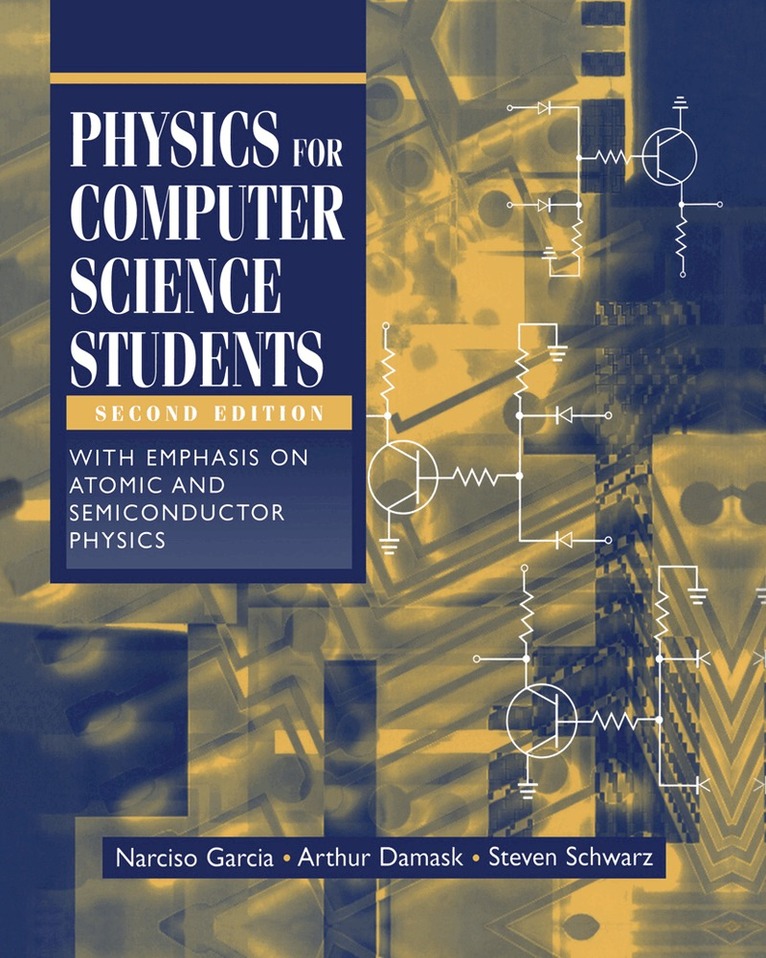
Physics for Computer Science Students
Av Narciso Garcia, Arthur Damask, Steven Schwarz
604 kr
Beställningsvara. Skickas inom 10-15 vardagar. Fri frakt över 249 kr.
Beskrivning
presentation of the classical and quantum free electron theories and their successes and shortcomings (Chapter 23). In order to explain the large differences in the electrical properties of solids as well as the peculiar properties of semiconductors, the existence of allowed and forbidden energy bands is investigated (Chapter 24). In this chapter, we introduce the concepts of the electron effective mass and of holes. Intrinsic and doped semiconductors, their electron and hole densities, and their electrical properties are discussed in Chapter 25. It is now a rather simple matter for the student to understand the behavior and the characteristics of semiconductor devices: diodes, bipolar transistors, field effect transistors, etc. Semiconductor devices are the subject of Chapter 26. The text concludes with two chapters unique to this physics textbook. In Chapter 27, we show how diodes and transistors can be used to construct the logic circuits (gates) that constitute the fundamental building blocks of the computer. Chapter 28 is a layman'S introduction to some of the techniques used in the fabrication of integrated circuits. The laboratory experiments for the first semester are standard in any physics department, and thus we do not feel that is is necessary to include them in this book.
Produktinformation
- Utgivningsdatum: 2012-10-23
- Mått: 203 x 254 x 33 mm
- Vikt: 1 306 g
- Format: Häftad
- Språk: Engelska
- Antal sidor: 560
- Upplaga: 2
- Förlag: Springer-Verlag New York Inc.
- ISBN: 9781461272175
Utforska kategorier
Betyg & recensioner
0 recensioner
Inga recensioner tillgängliga.